
Chef Jeong-sun
Aehobak-bokkeum (Korean Stir-Fried Zucchini)
Tender Korean zucchini half-moons cooked quickly over real heat, seasoned with salted shrimp so the squash tastes deeper than oil and still clean enough for a weeknight table.
A cooking platform built around craft, culture, and the stories behind what we eat.
Created by
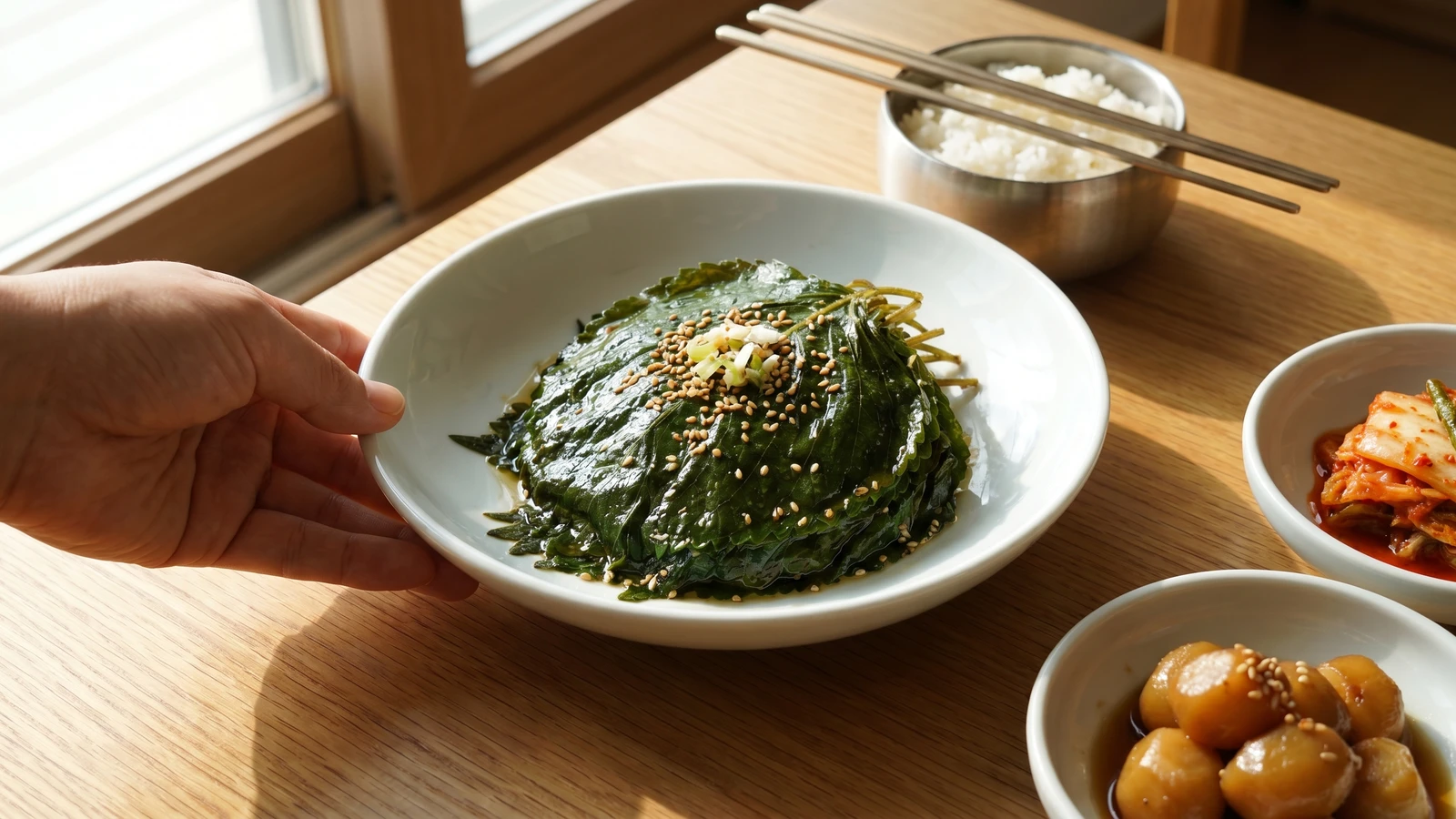
Young perilla leaves, softened briefly in salted water and finished in perilla oil, make a quiet banchan that tastes green, nutty, and faintly minty beside rice.
Kkaennip-namul begins at the market, not at the stove. Look for young perilla shoots, kkaennip-sun (깻잎순), with tender stems and small leaves. The big raw leaves for ssam are good in their place, wrapped around grilled meat, but this dish wants the younger plant. Cook the month you're standing in: late spring through summer is when it tastes most alive.
The work tonight is small but exact. Blanch just long enough to quiet the raw edge, rinse to stop the cooking, then squeeze with care. Too much water left in the leaves makes the seasoning slide off. Too hard a squeeze bruises them into a tired clump. After that, season in a bowl before the pan, because every namul deserves to be tasted alone before it meets the rice.
Notebook 19 says 250 grams of trimmed young perilla takes 1 tablespoon soup soy sauce, 2 teaspoons perilla oil, and one small clove of garlic. Not a cloud of garlic. Not enough soy sauce to turn it brown. Let it taste like itself: green, nutty, a little wild, with perilla oil carrying the leaf back to its own seed.
Kkaennip, the leaf of the perilla plant, belongs to the same Korean pantry as deulkkae (perilla seed) and deulgireum (perilla oil), ingredients long used in home cooking for greens, stews, and porridges. Kkaennip-sun namul is an everyday banchan rather than a ceremonial dish, most closely tied to the warm months when young shoots are sold in market bundles. Its history is the history of Korean home tables preserving seasonal greens by blanching, squeezing, seasoning, and serving them in small portions beside rice.
Quantity
250g
tough stems removed
Quantity
8 cups
for blanching
Quantity
1 tablespoon
for blanching water
Quantity
1 tablespoon, plus 1/2 teaspoon more if needed
Quantity
1 small clove
minced finely
Quantity
2 teaspoons
Quantity
1 teaspoon
Quantity
1
minced
Quantity
1 teaspoon
lightly crushed
Quantity
1/8 teaspoon, only if needed
| Ingredient | Quantity |
|---|---|
| young perilla shoots or tender perilla leaves (kkaennip-sun)tough stems removed | 250g |
| waterfor blanching | 8 cups |
| coarse saltfor blanching water | 1 tablespoon |
| soup soy sauce (guk-ganjang) | 1 tablespoon, plus 1/2 teaspoon more if needed |
| garlicminced finely | 1 small clove |
| perilla oil (deulgireum) | 2 teaspoons |
| neutral oil | 1 teaspoon |
| scallionminced | 1 |
| toasted sesame seedslightly crushed | 1 teaspoon |
| fine sea salt (optional) | 1/8 teaspoon, only if needed |
Pick through the perilla shoots and remove any thick or woody stems. Keep tender stems, because they give the namul a good bite. Wash the leaves in a large bowl of cold water, lifting them out rather than pouring the grit back over them. Repeat until the water is clean.
Bring 8 cups water to a rolling boil and add 1 tablespoon coarse salt. Add the perilla and press it under the water with chopsticks. Blanch tender shoots for 45 seconds, or mature leaves for 20 to 25 seconds. The leaves should collapse and turn a deeper green, but they should not go dull.
Drain at once and rinse under cold running water until the leaves are cool. Gather them into two loose bundles and squeeze firmly but not cruelly. You want the leaves damp, not dripping. If water runs onto the cutting board, squeeze once more. Too much water is why namul tastes thin.
Loosen the squeezed leaves into a mixing bowl. Add the soup soy sauce, minced garlic, 1 teaspoon of the perilla oil, the scallion, and the crushed sesame seeds. Mix by hand, separating clumps as you go, so the seasoning reaches every leaf. Taste one leaf now. It should be savory but still green, with garlic in the background.
Heat a small skillet over medium-low heat with the neutral oil and the remaining 1 teaspoon perilla oil. Add the seasoned leaves and stir-fry for 1 to 2 minutes, just until the garlic softens and the oil coats the leaves. Do not brown the garlic. This is not a hard fry; it is a warming through.
Take the pan off the heat and taste again. If it needs salt, add up to 1/8 teaspoon fine sea salt, not more soy sauce, so the leaves do not darken. Serve warm, room temperature, or chilled as banchan beside rice. It should sit in a small mound, glossy but not wet.
1 serving (about 55g)
Culinary guides, cultural storytelling, and the editorial depth that makes cooking meaningful.
Discover Culinary ExplorerChef Jeong-sun
Tender Korean zucchini half-moons cooked quickly over real heat, seasoned with salted shrimp so the squash tastes deeper than oil and still clean enough for a weeknight table.

Chef Jeong-sun
Tender Korean summer zucchini softened gently in the pan with saeujeot for salt and depth, finished with sesame so the vegetable stays sweet, green, and plainly itself.

Chef Jeong-sun
A bittersweet spring green from the southern shore, blanched just until pliant, then seasoned lightly so its clean coastal bitterness stays alive on the rice table.

Chef Jeong-sun
Torn king oyster or shiitake mushrooms, browned until their own water disappears, then finished with soy, garlic, sesame oil, and onion for a quiet banchan that earns its place.