
Chef Joost
Aardappelschotel met Gehakt
A plain name for a quietly clever dish: fresh mince, sweet fried onion, nutmeg, and mashed potato baked until the top goes golden and the table goes silent.
A cooking platform built around craft, culture, and the stories behind what we eat.
Created by
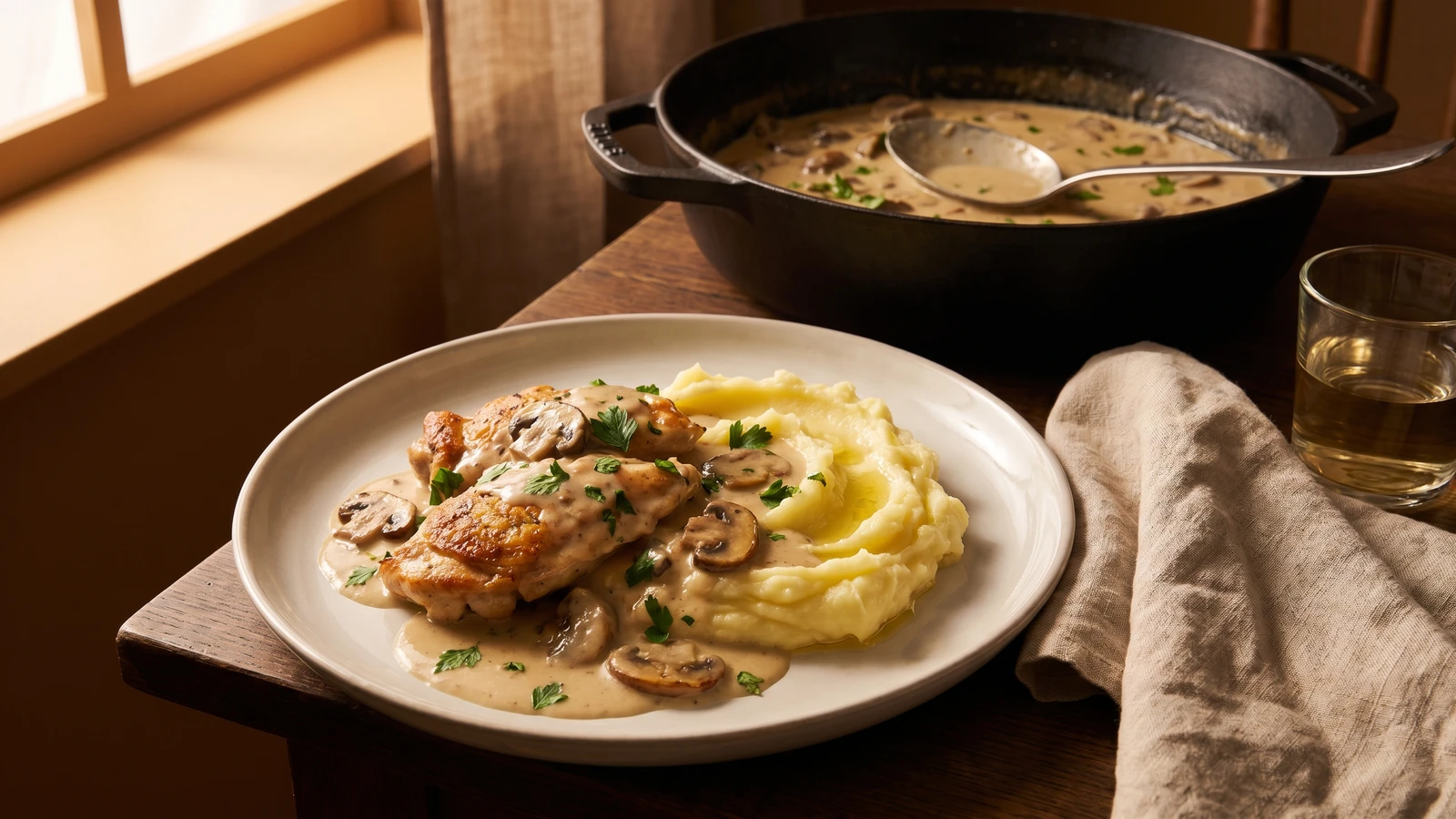
Plain on paper, beloved at the table: pan-fried chicken, browned mushrooms, and cream turned into the kind of Dutch weekday supper nobody brags about and everyone finishes.
In my grandmother's second notebook, the grand dishes have careful titles, but the weekday ones are written like household facts. Kip met champignons. Kip in roomsaus. Sometimes only kip, dinsdag, as if Tuesday itself knew what sauce was meant. That is how a dish becomes part of a family: not by ceremony, but by returning so often nobody thinks to praise it.
But let me tell you a secret. This is exactly where Dutch cooking is most often misread. A piece of chicken, mushrooms, cream, a little mustard, parsley if the pot by the window has not given up. Plain, yes, if you read only the shopping list. At the stove it becomes something else: the brown edge of the mushroom giving the sauce its backbone, the pan juices darkening the cream, the small sharpness of mustard keeping everything awake.
The name doesn't hide an ancient word journey, so we won't invent one. Kip is chicken, romige champignonsaus is creamy mushroom sauce, and champignon is our useful French borrowing for the cultivated button mushroom that became a Dutch weekday friend. History and cookery, they cannot be separated, but neither must they be inflated like a bad souffle.
Hou het altijd simpel, always keep it simple. Brown the mushrooms properly before the cream goes in, or the sauce will taste pale. Brown the chicken and let it rest while the sauce comes together, or it will dry out while you fuss. Then bring everything back to the pan and serve it over boiled potatoes, mash, or rice. I prefer potatoes, for obvious reasons: they know how to receive sauce without making a speech.
Kip in romige champignonsaus belongs to the postwar Dutch weekday kitchen, when affordable chicken, cultivated mushrooms, and packaged cream moved from restaurant-style cookery into ordinary home meals. Dutch mushroom cultivation expanded strongly after the Second World War, especially in Limburg and Noord-Brabant, making champignons a familiar supermarket ingredient rather than a luxury garnish. The dish shows a common Dutch pattern: a French-sounding sauce made practical, quick, and domestic, served with potatoes or rice at the family table.
Quantity
4 pieces, about 600g total
Quantity
300g
sliced
Quantity
1 medium
finely chopped
Quantity
2
minced
Quantity
2 tablespoons
Quantity
1 tablespoon
Quantity
150ml
Quantity
200ml
Quantity
1 teaspoon
Quantity
1 teaspoon fresh or 1/2 teaspoon dried
Quantity
1 tablespoon
chopped
Quantity
to taste
Quantity
to serve
| Ingredient | Quantity |
|---|---|
| boneless chicken thighs or chicken breasts | 4 pieces, about 600g total |
| button mushrooms or chestnut mushroomssliced | 300g |
| onionfinely chopped | 1 medium |
| garlic clovesminced | 2 |
| butter | 2 tablespoons |
| neutral oil | 1 tablespoon |
| dry white wine or chicken stock | 150ml |
| cream | 200ml |
| Dijon mustard | 1 teaspoon |
| fresh thyme leaves or dried thyme | 1 teaspoon fresh or 1/2 teaspoon dried |
| flat-leaf parsleychopped | 1 tablespoon |
| salt and black pepper | to taste |
| boiled potatoes, mashed potatoes, or rice | to serve |
Pat the chicken dry and season it well with salt and black pepper. Dry meat browns; wet meat sulks in the pan and gives you grey edges. If using chicken breasts, flatten the thickest part slightly so each piece cooks evenly.
Heat the oil and 1 tablespoon of the butter in a wide frying pan over medium-high heat. Cook the chicken for 4 to 5 minutes per side, until golden and nearly cooked through, then lift it to a plate. It will finish in the sauce, which is kinder than punishing it in a dry pan.
Add the sliced mushrooms to the same pan and leave them alone for a minute before stirring. Cook for 6 to 8 minutes, until their water has cooked off and the edges are brown. This is the step that makes the sauce taste like mushrooms rather than cream with mushrooms floating through it.
Lower the heat to medium and add the remaining tablespoon of butter, the onion, garlic, and thyme. Cook for 3 to 4 minutes, scraping the brown bits from the pan, until the onion softens. Pour in the wine or stock and let it bubble down by about half, then stir in the cream and mustard.
Return the chicken and any resting juices to the pan. Simmer gently for 5 to 7 minutes, turning the pieces once, until the chicken is cooked through and the sauce coats the back of a spoon. Do not boil the cream hard; it thickens best when treated like family, with firmness but no shouting.
Taste the sauce and adjust with salt and black pepper. Scatter over the parsley and serve with boiled potatoes, mash, or rice, making sure every plate gets enough sauce. A kuiltje, a little hollow, in the potatoes is not childish. It is engineering.
1 serving (about 315g)
Culinary guides, cultural storytelling, and the editorial depth that makes cooking meaningful.
Discover Culinary ExplorerChef Joost
A plain name for a quietly clever dish: fresh mince, sweet fried onion, nutmeg, and mashed potato baked until the top goes golden and the table goes silent.

Chef Joost
Ajam Besengek is the golden chicken stew of the Indo-Dutch table: coconut milk, turmeric, and candlenut cooked down until the sauce clings to the meat like memory.

Chef Joost
The old Dutch spelling says ajam, the city says Batavia, and the pot says exactly what the rijsttafel always was: memory, trade, and dinner in one dish.

Chef Joost
The name means simply fried chicken, but the Dutch spelling carries a whole Indies kitchen: turmeric, coriander, garlic, and a golden crust that remembers the boemboe.