
Chef Fai
Sticky Rice Dumplings in Coconut Cream (Bua Loi)
Glutinous rice flour, palm sugar, coconut cream, and a pinch of salt. Thai dessert follows the same governing rules as every savory dish. The system doesn't stop at the sweet course.
A cooking platform built around craft, culture, and the stories behind what we eat.
Created by
Palm sugar for sweet, coconut cream for richness, pandan for fragrance, banana leaf for the soul. Thai desserts follow the same governing system as every savory dish. The four pillars don't stop at the sweet course.
Palm sugar for sweet. That's the law. And nowhere does that law speak louder than in khao tom mat.
Most people treat Thai desserts like they exist outside the system. Like the rules Ajarn McDang taught me suddenly stop applying once sugar enters the picture. They don't. Thai sweets run on the same governing principles as everything else: palm sugar (nam tan pip) provides the sweetness, coconut cream provides the fat and body, and aromatic agents like pandan (bai toey) and banana leaf do the work that lemongrass and galangal do in savory cooking. The system doesn't break. It adapts.
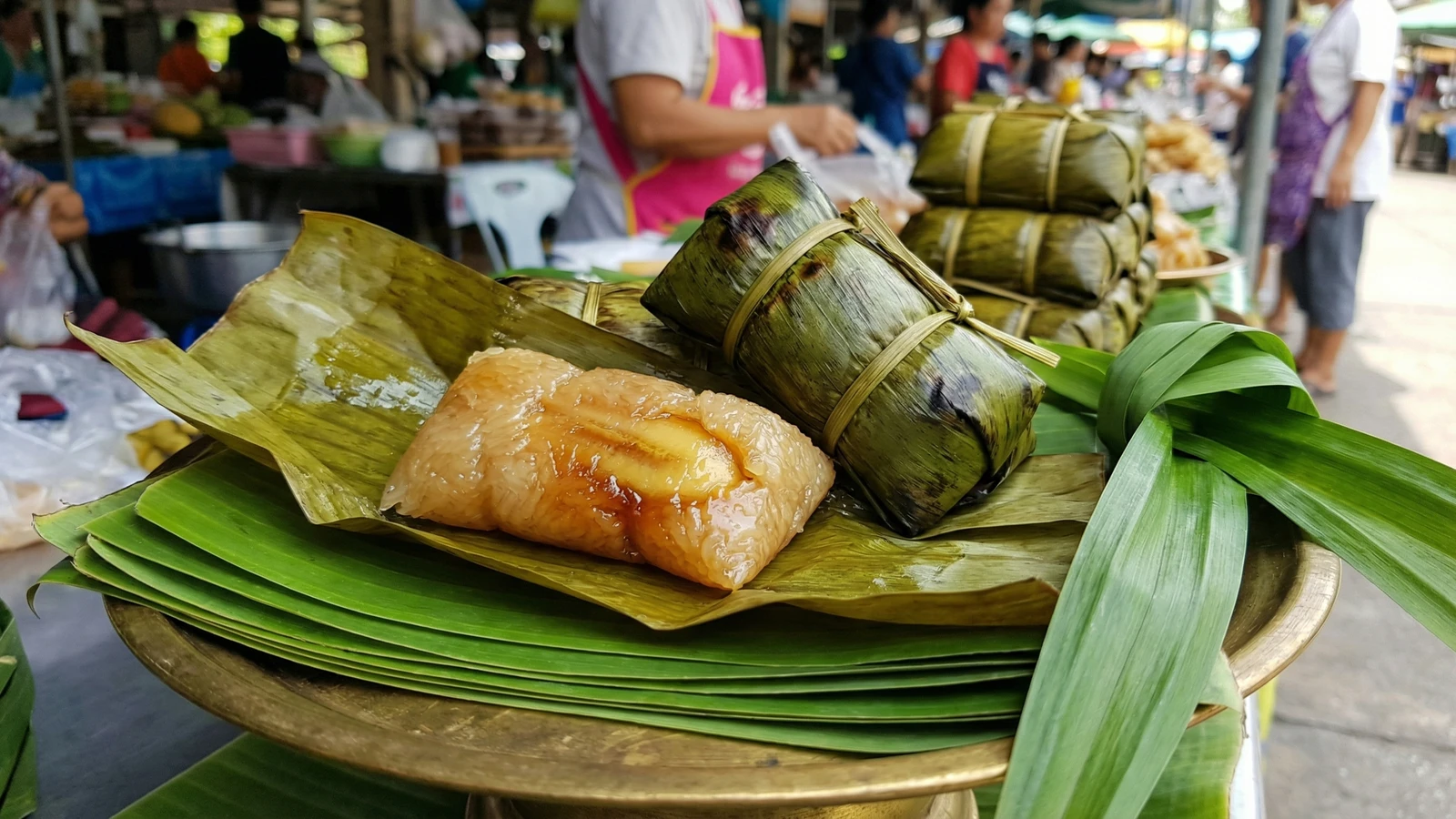
Khao tom mat is the dish that makes this obvious. You take glutinous rice (khao niew), soak it overnight, dress it in coconut cream sweetened with palm sugar, wrap it around a piece of ripe banana inside a banana leaf, tie it shut, and steam it. That's it. Five ingredients doing exactly what they're supposed to do. The banana leaf isn't decoration. It's a cooking vessel. During steaming, the leaf releases chlorophyll and volatile compounds directly into the rice. That grassy, green, slightly sweet perfume you smell when you unwrap a khao tom mat? That's the leaf working. Take away the leaf and wrap it in foil, and you've made a different thing entirely.
Ajarn always said: "Understand why each ingredient is there, and you'll never need a recipe." The sticky rice is the vehicle. The coconut cream is the fat that carries flavor and keeps the rice soft after cooling. The palm sugar is the sweetness, with its caramel depth that granulated white sugar can't touch. The pandan is the aromatic backbone. The banana leaf is the perfume and the plate. Every element has a job. Nothing is ornamental.
I learned to wrap khao tom mat from the aunties at Khlong Toei market who sold them in stacks of ten, tied with banana-leaf strips, warm from the steamer. Their hands moved so fast you couldn't follow. Fold, fill, fold, tie. Thirty seconds per parcel. I was slow. I'm still slow. But the wrapping isn't just technique. It's the thing that holds the whole dish together, literally and scientifically. The tight wrap creates pressure during steaming, which forces the coconut cream deeper into the rice grains. Loose wraps make loose khao tom mat. Tight wraps make the real thing.
Khao tom mat (ข้าวต้มมัด) is one of Thailand's oldest dessert preparations, predating modern kitchen equipment by centuries. The name translates literally to "rice boiled tied" (khao = rice, tom = boiled/cooked in liquid, mat = tied), describing the technique itself. The dish appears throughout Central and Southern Thailand at temple fairs (ngan wat), merit-making ceremonies, and Buddhist holiday markets, where vendors steam hundreds of parcels in enormous pots. The banana leaf wrapping served as both cooking vessel and portable packaging long before plastic existed, and the technique of infusing starchy foods through leaf-steaming is shared across Southeast Asia, from Filipino suman to Malaysian kuih.
Quantity
500g
soaked overnight in cold water, drained
Quantity
400ml
fresh-pressed preferred
Quantity
150g
chopped
Quantity
1/2 teaspoon
Quantity
4
knotted
Quantity
6
peeled, halved lengthwise
Quantity
100g
soaked overnight, boiled until tender
Quantity
12-14 pieces
cut into 8x10 inch rectangles, wilted
Quantity
for tying
| Ingredient | Quantity |
|---|---|
| glutinous rice (khao niew)soaked overnight in cold water, drained | 500g |
| coconut cream (hua kathi)fresh-pressed preferred | 400ml |
| palm sugar (nam tan pip)chopped | 150g |
| salt | 1/2 teaspoon |
| pandan leaves (bai toey)knotted | 4 |
| ripe nam wa bananas (kluai nam wa)peeled, halved lengthwise | 6 |
| dried black beans (thua dam) (optional)soaked overnight, boiled until tender | 100g |
| banana leafcut into 8x10 inch rectangles, wilted | 12-14 pieces |
| kitchen twine or banana-leaf strips | for tying |
Pass each banana leaf rectangle over an open flame or dip it briefly in boiling water. You'll see the color shift from matte to glossy, bright green. That's the leaf becoming pliable. A stiff leaf will crack when you fold it. A wilted leaf bends like fabric. Wipe each piece down with a damp cloth. Set them aside in a stack. If the leaves have tears, double them up. A hole in your wrapper means coconut cream leaking into the steamer instead of staying in the rice where it belongs.
In a wide saucepan over medium-low heat, combine the coconut cream, chopped palm sugar, salt, and knotted pandan leaves. Stir slowly until the palm sugar dissolves completely. Don't rush this. Palm sugar melts unevenly because it's a natural product with varying moisture content. You'll feel the lumps break down under your spoon. The mixture should taste sweet with a caramel undertone and a faint salted edge. If it tastes like plain sugar water, your palm sugar is bad. Good nam tan pip has depth: toffee, smoke, a whisper of something almost savory. That's what makes it irreplaceable. Remove from heat. Fish out the pandan leaves.
Drain the soaked sticky rice thoroughly. It should be swollen and opaque white after its overnight soak. Pour the warm coconut cream mixture over the drained rice and stir gently. Let it sit for 30 minutes. The rice absorbs the sweetened coconut cream during this rest. Stir it once or twice. By the end, most of the liquid should be absorbed and the rice should look glossy and slightly translucent at the edges. This is the step that separates good khao tom mat from bad. If you skip the soak, the rice is dry inside the parcel. Patience.
Peel the bananas and halve them lengthwise. Thai nam wa bananas (kluai nam wa) are short, stout, and firm even when ripe. They hold their shape during steaming and have a concentrated sweetness that regular Cavendish bananas can't match. If you're using Cavendish, choose ones that are ripe but still firm, no brown spots, no mush. Cut them into pieces that fit your leaf parcels, roughly 3-4 inches long. If you're using black beans, have them drained and ready.
Lay a banana leaf rectangle on your work surface, shiny side up. Spoon about 3 tablespoons of the dressed sticky rice into the center, spreading it into a rough rectangle. Lay a piece of banana on top. Scatter a few black beans alongside if using. Spoon another 2 tablespoons of rice on top, covering the banana. Now fold: bring the long sides of the leaf over the rice to overlap, then fold the short ends underneath like wrapping a gift. The parcel should be snug, not loose. Tie it shut with twine or a thin strip of banana leaf. Snug, not strangling. The rice needs a little room to expand as it steams.
Arrange the parcels in a steamer basket, seam side down, in a single layer or stacked gently. Don't cram them. Bring the water to a rolling boil before you set the basket on top. Steam over high heat for 40-45 minutes. The house will fill with a green, sweet, coconut-and-leaf fragrance about halfway through. That's the banana leaf doing its job, releasing its aromatic compounds into the rice. When they're done, the parcels will feel firm to the touch, not squishy. Let them rest for 10 minutes before unwrapping. The rice sets as it cools slightly.
Untie the parcel. Peel back the banana leaf slowly. The rice should be glossy, slightly translucent, and clinging together in a soft, sticky mass. The banana inside should be golden and melting. The aroma should be pandan, coconut, caramelized palm sugar, and that unmistakable green perfume from the leaf. Eat it warm or at room temperature. Both are correct. Khao tom mat actually improves slightly as it cools, because the starches in the glutinous rice set and the flavors concentrate. This is why market vendors sell them at room temp, stacked in pyramids. They know what they're doing.
1 serving (about 140g)
Culinary guides, cultural storytelling, and the editorial depth that makes cooking meaningful.
Discover Culinary ExplorerChef Fai
Glutinous rice flour, palm sugar, coconut cream, and a pinch of salt. Thai dessert follows the same governing rules as every savory dish. The system doesn't stop at the sweet course.

Chef Fai
Portuguese fios de ovos arrived in Ayutthaya and Thailand rewrote the rules: palm sugar replaced white, jasmine water replaced plain, and a foreign technique became Thai the moment it followed the system.

Chef Fai
Palm sugar and coconut cream frozen on a street cart with nothing but salted ice and strong arms. The sweet pillar of Thai cuisine in its coldest, purest form. Three ingredients in the base. A lifetime of principle behind them.

Chef Fai
Two layers, one principle: palm sugar for sweet, coconut cream for richness, pandan for fragrance, salt on top to prove that Thai cuisine balances even its desserts. The system governs everything, including sweets.