Culinary Explorer
A cooking platform built around craft, culture, and the stories behind what we eat.
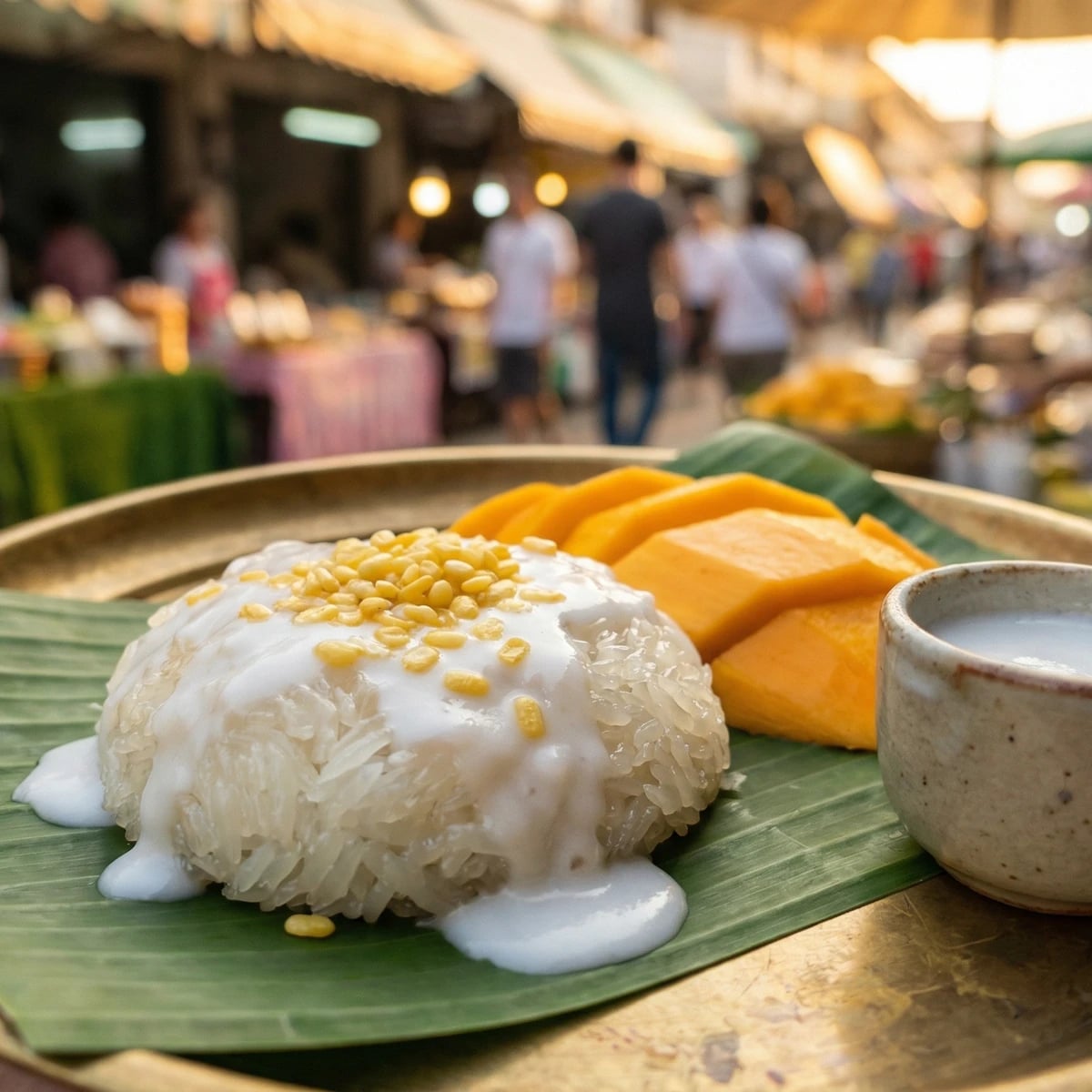
Mango Sticky Rice (Khao Niew Mamuang)
Created by Chef Fai
The sweet pillar isn't decoration. Palm sugar for sweetness, coconut cream for richness, pandan for fragrance, a pinch of salt to anchor it all. Thai dessert follows the same system as every savory dish. Principles, not recipes.
The sweet pillar governs this dish. Palm sugar for sweet. That's the law, and it doesn't stop applying just because you've moved from the savory side of the stall to the dessert cart.
Ajarn always said Thai cuisine is a system, not a menu. The four pillars don't vanish when you make khanom (ขนม, sweets). They transform. In khao niew mamuang, the sweet pillar moves to the center. Palm sugar (nam tan pip) provides a caramel warmth that granulated white sugar can never touch. Coconut cream (hua kathi) delivers fat and body. Pandan leaf (bai toey) gives that unmistakable green, floral fragrance that is to Thai desserts what vanilla is to French pastry. And then salt. A full pinch of it in the coconut sauce. That salt is what separates a great khao niew mamuang from a forgettable one. Without it, the sweetness is flat. With it, every flavor lifts.
Here's where people go wrong: the rice. Sticky rice (khao niew) is not jasmine rice. It's not long-grain anything. It's a glutinous short-grain rice that must be soaked overnight and steamed, never boiled. Boiling waterlogged sticky rice gives you porridge. Steaming it in a bamboo steamer basket over a tall pot (the huad and mo neung, the conical basket and pot that every Isan household owns) gives you individual grains that are tender, chewy, and ready to absorb the coconut cream mixture. The rice drinks the sauce. That absorption is the entire point. If your rice can't absorb, you've cooked it wrong.
I watched my mother make this for temple fairs in April, right at the peak of mango season. She'd steam the khao niew in the morning, mix the coconut cream sauce while it was still hot, fold them together, and let the rice sit under a banana leaf cover for an hour. Not in the fridge. Room temperature. The banana leaf wasn't garnish. It trapped moisture and kept the rice from drying out while the coconut cream soaked in. When she pulled that leaf back, the rice was glossy, fragrant, and ready. That's technique. That's the system at work, even in dessert.
Ingredients
Thai sticky rice (khao niew)
Quantity
2 cups
soaked overnight in cold water, drained
coconut cream (hua kathi)
Quantity
400ml
freshly pressed or first-press canned
palm sugar (nam tan pip)
Quantity
100g
chopped
| Ingredient | Quantity |
|---|---|
| Thai sticky rice (khao niew)soaked overnight in cold water, drained | 2 cups |
| coconut cream (hua kathi)freshly pressed or first-press canned | 400ml |
| palm sugar (nam tan pip)chopped | 100g |
Where cooking meets culture.
Culinary guides, cultural storytelling, and the editorial depth that makes cooking meaningful.
Discover Culinary Explorer