
Chef Dimitra
Athenian Kalamaki Hoirino se Pita (Καλαμάκι Χοιρινό σε Πίτα)
Athens calls it kalamaki: pork cubes charred on skewers, slid into warm pita with tomato, onion, and tzatziki. The meat needs a little fat, or the grill punishes it.
A cooking platform built around craft, culture, and the stories behind what we eat.
Created by
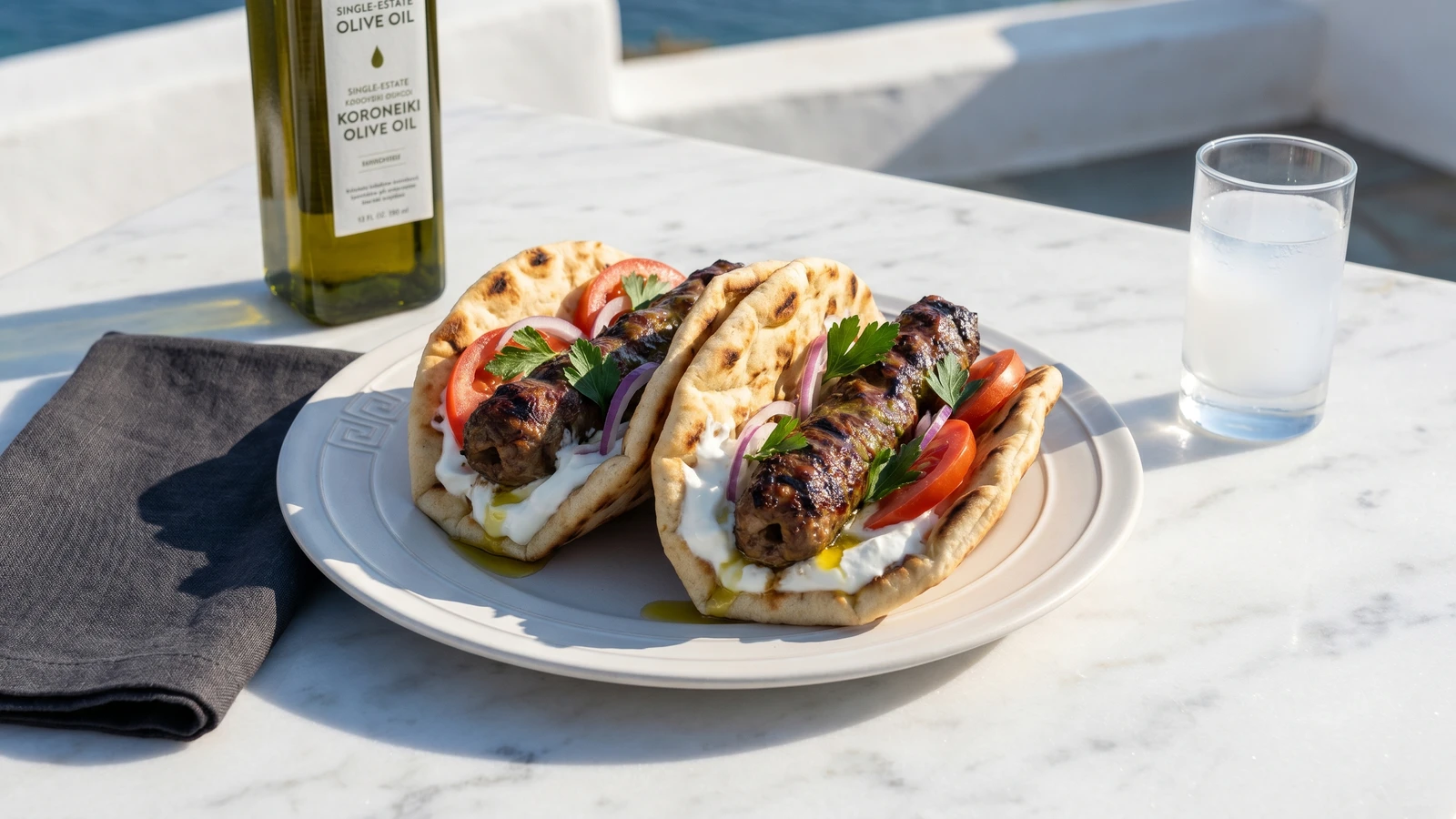
Smyrna's kebab belongs to cumin, cinnamon, and rested mince, grilled until charred at the edges, then tucked into warm pita with thick yogurt, tomato, onion, and parsley.
Kebab Smyrneiko se pita is Smyrna's seasoned mince kebab folded into the everyday bread of the Greek grill: cumin first, a little cinnamon behind it, char from the fire, cold yogurt, ripe tomato, onion, and parsley. The shape is long and ridged, not a round keftes. The region is the dish's surname, and Smyrna's surname smells of cumin the moment the meat hits the grill.
One method decides it. Salt the mince, knead it until it turns tacky, then rest it cold before shaping. That rest is what lets the meat hold to the skewer without egg or bread, so the inside stays juicy and the outside takes char. Give it an hour and it behaves.
At the table, I keep the wrap plain: warm pita, yogurt with a breath of garlic, tomato that tastes of summer, onion, parsley, and a little green-gold oil. In Thessaloniki, the refugee kitchen made cumin a family marker; even now one bite tells you where the recipe came from. I don't invent it. I find it, I test it, I write it down.
Kebab Smyrneiko belongs to the Asia Minor Greek table around Smyrna, where Ottoman kebab cookery met the spice habits of Greek households on the Aegean coast. After the 1922 expulsion, refugees carried the seasoned mince west to Thessaloniki, Piraeus, and Athens, where it entered grill houses beside pita, yogurt, tomato, and onion. The cumin is the signpost: mainland keftedes can live without it, but Smyrna's kebab cannot.
Quantity
500g
about 20% fat
Quantity
250g
Quantity
120g
grated and gently squeezed
Quantity
2
finely grated
Quantity
20g
finely chopped
Quantity
10g
Quantity
2 tsp
Quantity
1/2 tsp
Quantity
1 tsp
Quantity
1/4 tsp
Quantity
1 tsp
Quantity
1/2 tsp
Quantity
2 tbsp
for brushing
Quantity
4
16-18cm
Quantity
250g
Quantity
1
finely grated, for the yogurt
Quantity
1 tbsp
Quantity
1/4 tsp
for the yogurt
Quantity
2, about 300g
sliced
Quantity
1 small, about 100g
thinly sliced
Quantity
10g
for wrapping
Quantity
1
cut into wedges
| Ingredient | Quantity |
|---|---|
| minced beef chuckabout 20% fat | 500g |
| minced lamb shoulder | 250g |
| yellow oniongrated and gently squeezed | 120g |
| garlic clovesfinely grated | 2 |
| flat-leaf parsleyfinely chopped | 20g |
| fine sea salt | 10g |
| ground cumin | 2 tsp |
| ground cinnamon | 1/2 tsp |
| sweet paprika | 1 tsp |
| ground allspice | 1/4 tsp |
| freshly ground black pepper | 1 tsp |
| bukovo or mild red pepper flakes (optional) | 1/2 tsp |
| extra virgin Koroneiki olive oilfor brushing | 2 tbsp |
| Greek pita breads16-18cm | 4 |
| strained Greek yogurt | 250g |
| small garlic clovefinely grated, for the yogurt | 1 |
| lemon juice | 1 tbsp |
| fine sea saltfor the yogurt | 1/4 tsp |
| ripe tomatoessliced | 2, about 300g |
| red onionthinly sliced | 1 small, about 100g |
| flat-leaf parsley leavesfor wrapping | 10g |
| lemon (optional)cut into wedges | 1 |
Stir the strained yogurt with the small grated garlic clove, lemon juice, and 1/4 tsp salt. Keep it cold while you make the kebabs. It should be thick enough to cling to the pita, not run down your wrist.
Grate the onion on the large holes of a box grater, then squeeze it gently in your hand over the sink. Keep the damp pulp and lose the sharp watery juice. The onion should sweeten the mince, not loosen it.
Put the beef, lamb, onion pulp, 2 grated garlic cloves, chopped parsley, 10g salt, cumin, cinnamon, paprika, allspice, black pepper, and bukovo if using in a wide bowl. Knead by hand for 3 to 4 minutes, folding and pressing, until the mixture turns slightly glossy and clings to your fingers. This is the step that decides the kebab: salted mince must become tacky so it binds without egg or bread.
Press the mince into a shallow mound, cover it, and refrigerate for at least 1 hour, or up to 24 hours. Give it the hour. Hurry this part and the kebabs fight the skewer.
With damp hands, divide the chilled mince into 8 portions, about 110g each. Press each portion around a flat metal skewer into a long oval kebab, about 12cm long and 3cm thick, closing the ends firmly. If using wooden skewers, shape the kebabs around them after soaking the skewers for 30 minutes.
Heat a charcoal grill or heavy ridged griddle to medium-high. Clean the grate well and brush it lightly with olive oil. Brush the kebabs with a little olive oil too, just enough to give the surface a gloss.
Grill the kebabs for 4 to 5 minutes per side, turning once or twice, until the outside is browned with dark charred ridges and the center is cooked through. If you use a thermometer, look for 71C in the center. Let them rest on a plate for 3 minutes while you warm the pitas.
Brush the pitas lightly with the remaining olive oil and warm them on the grill for 30 to 45 seconds per side. They should bend easily and take a few browned spots. A dry pita cracks, and then it isn't a wrap, it's a small argument.
Spread each warm pita with yogurt. Slide in 2 kebabs, then add tomato slices, red onion, parsley leaves, and a thin thread of Koroneiki oil. Fold the bottom up, close the sides, and serve at once with lemon wedges if you like.
1 serving (about 410g)
Culinary guides, cultural storytelling, and the editorial depth that makes cooking meaningful.
Discover Culinary ExplorerChef Dimitra
Athens calls it kalamaki: pork cubes charred on skewers, slid into warm pita with tomato, onion, and tzatziki. The meat needs a little fat, or the grill punishes it.

Chef Dimitra
The pocketless pita of the Athenian souvlaki shop is soft, oiled, and griddled fast, made to bend around meat, tomato, onion, tzatziki, and fries without splitting.

Chef Dimitra
Athens psistaria chicken gyros belongs in a soft, warm pita: thigh meat charred at the edges, cold tzatziki, ripe tomato, sharp onion, and just enough potato if you like it.

Chef Dimitra
Athens grill-house skepasti is the covered pita: gyros, kasseri, tomato, onion, tzatziki, and fries pressed between two pitas until the cheese binds it together.