Culinary Explorer

A cooking platform built around craft, culture, and the stories behind what we eat.
Discover Culinary Explorer
Athens Grill-House Skepasti (Σκεπαστή)

Athens Grill-House Skepasti (Σκεπαστή)

Created by

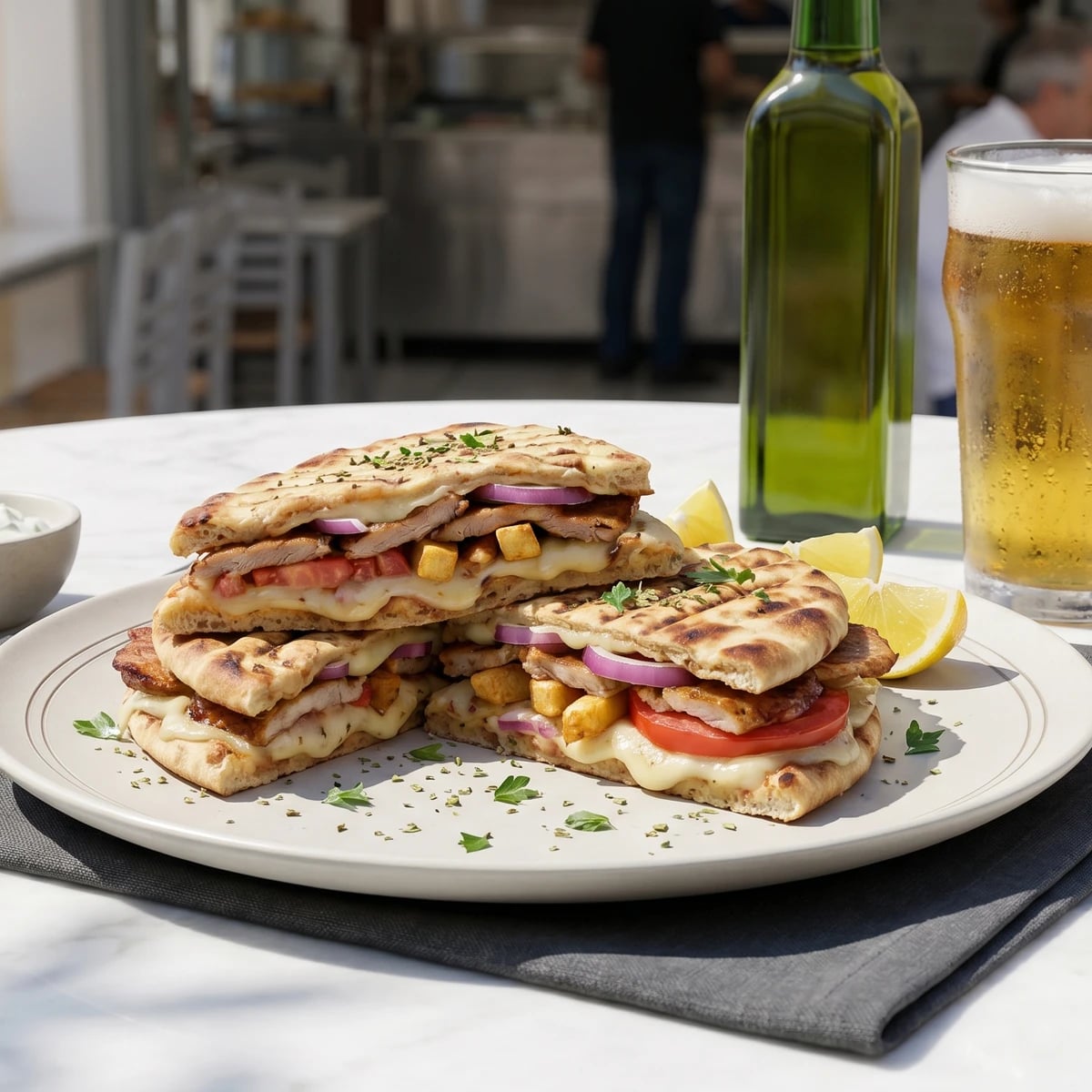
Athens grill-house skepasti is the covered pita: gyros, kasseri, tomato, onion, tzatziki, and fries pressed between two pitas until the cheese binds it together.

Sandwiches & Wraps
Greek
Game Day
Comfort Food
Quick Meal
20 min
Active Time
15 min cook35 min total
Yield2 large skepasti, 4 servings

Skepasti belongs to the Athens grill house, the souvlatzidiko counter where pita, gyros, fries, and a hot press make a full meal you can hold in your hands. Its name means covered, and that is exactly what it is: one pita underneath, one pita over the top, with the filling trapped between them like a flat, generous sandwich.

The method that decides it is the press. Everything must be hot when the two pitas meet, especially the meat and the fries, so the kasseri melts quickly and bonds the layers before the bread dries out. Press it briefly, firmly, and cut it into triangles while the cheese still pulls. Wait too long and you have a stack, not a skepasti.

I keep this one plain because the city version is already correct. Pork gyros if you have it, good pita that bends without cracking, a little tzatziki, tomato, onion, and fries tucked inside. Λίγα και καλά, even for street food. The region is the dish's surname, and here the region is urban Athens, loud with grills and late dinners.

Skepasti is a modern Greek grill-house dish, tied to the urban souvlatzidika of Athens and Thessaloniki rather than to an old village kitchen. It grew from the postwar pita-and-gyros trade, especially after vertical rotisserie gyros became common in Greek shops in the second half of the twentieth century. The second pita is not decoration: it turns the familiar gyros fillings into a pressed, shareable sandwich cut like a club.

The technique, the tradition, and the story behind every dish.

Discover Culinary Explorer

Ingredients

large Greek pita breads

Quantity

4

17 to 18cm wide

cooked pork gyros

Quantity

360g

hot

kasseri cheese

Quantity

160g

coarsely grated

potatoes

Quantity

220g

cut into thin fries

neutral oil

Quantity

500ml

for frying

fine sea salt

Quantity

1/2 teaspoon

for the fries

tomato

Quantity

1 medium

thinly sliced

red onion

Quantity

1 small

thinly sliced

tzatziki

Quantity

120g

extra virgin Koroneiki olive oil

Quantity

2 tablespoons

for brushing the pitas

dried Greek oregano

Quantity

1 teaspoon

flat-leaf parsley (optional)

Quantity

1 tablespoon

chopped

lemon wedges (optional)

Quantity

as needed

for serving

Equipment Needed

  • sandwich press or contact grill
  • heavy 28cm skillet
  • small deep frying pan
  • sharp chef's knife

Instructions

  1. 1

    Fry the potatoes

    Heat the neutral oil in a deep pan to 175C. Fry the potatoes until golden at the edges and tender inside, 5 to 7 minutes, then drain on paper and salt them while hot. Keep them warm. Cold fries sit like cardboard in a skepasti, and no sauce can rescue them.

  2. 2

    Warm the gyros

    Warm the cooked pork gyros in a hot skillet for 2 to 3 minutes, just until the edges brown again and the fat glistens. If the meat is already freshly cut from a spit, leave it alone. Good gyros does not need fussing.

  3. 3

    Heat the pitas

    Brush both sides of the pitas lightly with olive oil and warm them on a grill pan or flat griddle for 30 to 45 seconds per side. They should bend easily and pick up a little color, not turn crisp yet.

  4. 4

    Layer the filling

    Lay two warm pitas on the work surface. Spread each with 2 tablespoons tzatziki, then add half the kasseri, the hot gyros, tomato, onion, hot fries, oregano, and the remaining kasseri. Cap each one with a second pita and press lightly with your hand.

    Put cheese both under and over the filling. It melts into the two pitas and holds the skepasti together when you cut it.
  5. 5

    Press it hot

    Set each skepasti in a hot sandwich press, or in a skillet with a heavy pan on top. Press for 2 to 3 minutes, turning once if using a skillet, until the pitas are marked and the kasseri has melted. This is the whole trick: hot filling, hot bread, short pressure. The cheese becomes the hinge.

  6. 6

    Cut and serve

    Move each skepasti to a board and let it stand for 1 minute, no longer. Cut into quarters or six triangles with a sharp knife. Scatter with parsley if you like, add lemon wedges, and serve while the bread is still pliant and the cheese is soft.

Chef Tips

  • Use proper Greek pita, thick and soft, not pocket pita. Pocket pita splits and turns the filling into a small disaster on the plate.
  • Kasseri is the right cheese here because it melts cleanly and has a little tang. If you can't find it, kefalotyri is too salty for this job; use graviera or a mild kefalograviera instead.
  • Pork gyros is the shop-counter standard, but chicken gyros is common too. Keep the same method and don't overload the sandwich. A skepasti should press flat, not collapse under ambition.
  • Serve it with extra tzatziki and a few pickled green peppers if you want the souvlatzidiko feeling. Beer is honest here. This is comfort food, not a speech.

Advance Preparation

  • Slice the tomato and onion up to 2 hours ahead and keep them chilled separately.
  • The tzatziki can be made 1 day ahead and kept covered in the refrigerator.
  • If using homemade gyros meat, cook it ahead, slice it thin, and reheat hard in the skillet just before assembling.
  • Do not assemble skepasti ahead. The bread softens and the fries lose their bite.

Frequently Asked Questions

Nutrition Information

1 serving (about 275g)

Calories
725 calories
Total Fat
45 g
Saturated Fat
15 g
Trans Fat
0 g
Unsaturated Fat
27 g
Cholesterol
95 mg
Sodium
1120 mg
Total Carbohydrates
54 g
Dietary Fiber
4 g
Sugars
5 g
Protein
27 g

Note: Chef personas and recipes are created with AI assistance. Cook with care: follow safe food-handling practices, check doneness with a thermometer when needed, and adapt for allergies and your kitchen.

Where cooking meets culture.

Culinary guides, cultural storytelling, and the editorial depth that makes cooking meaningful.

Discover Culinary Explorer

More from Greek Pita Wraps: Gyros & Souvlaki

Browse the full collection