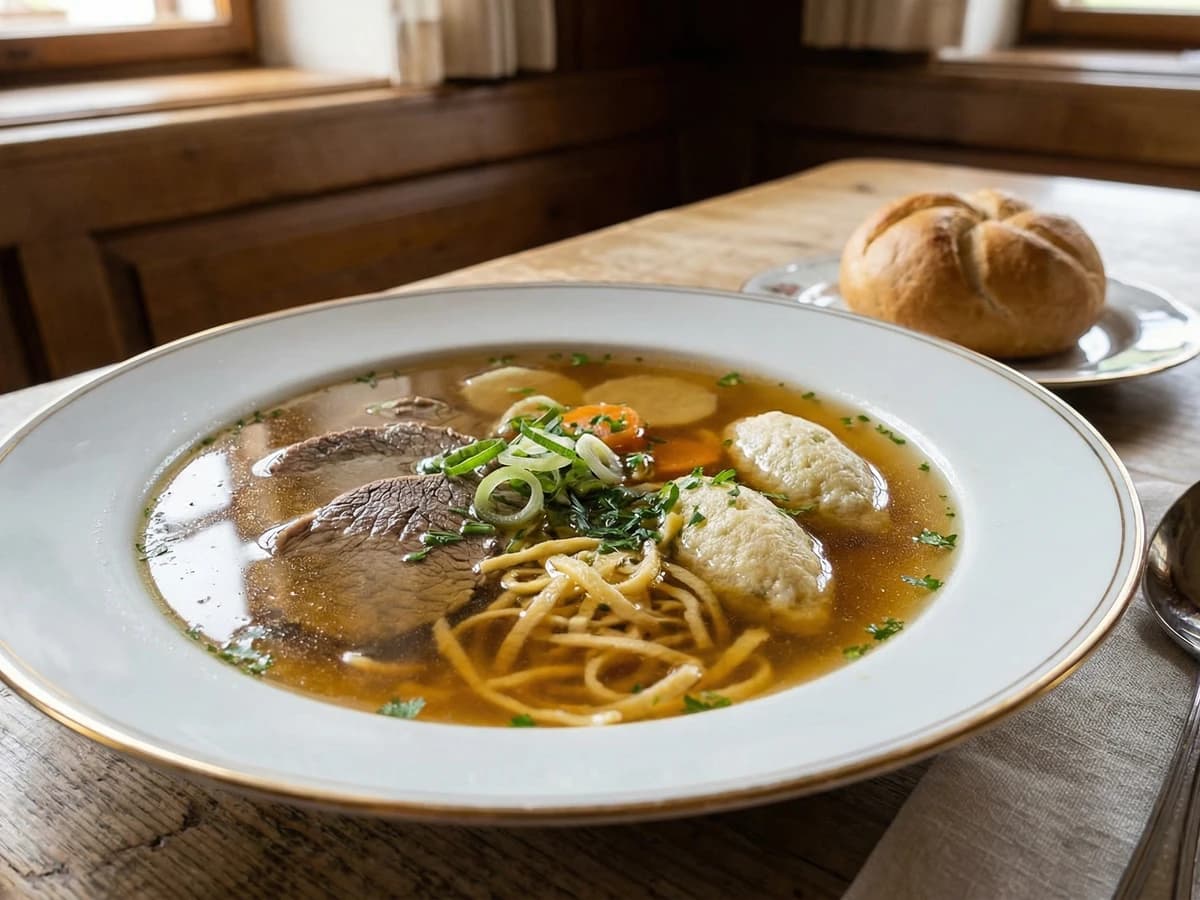
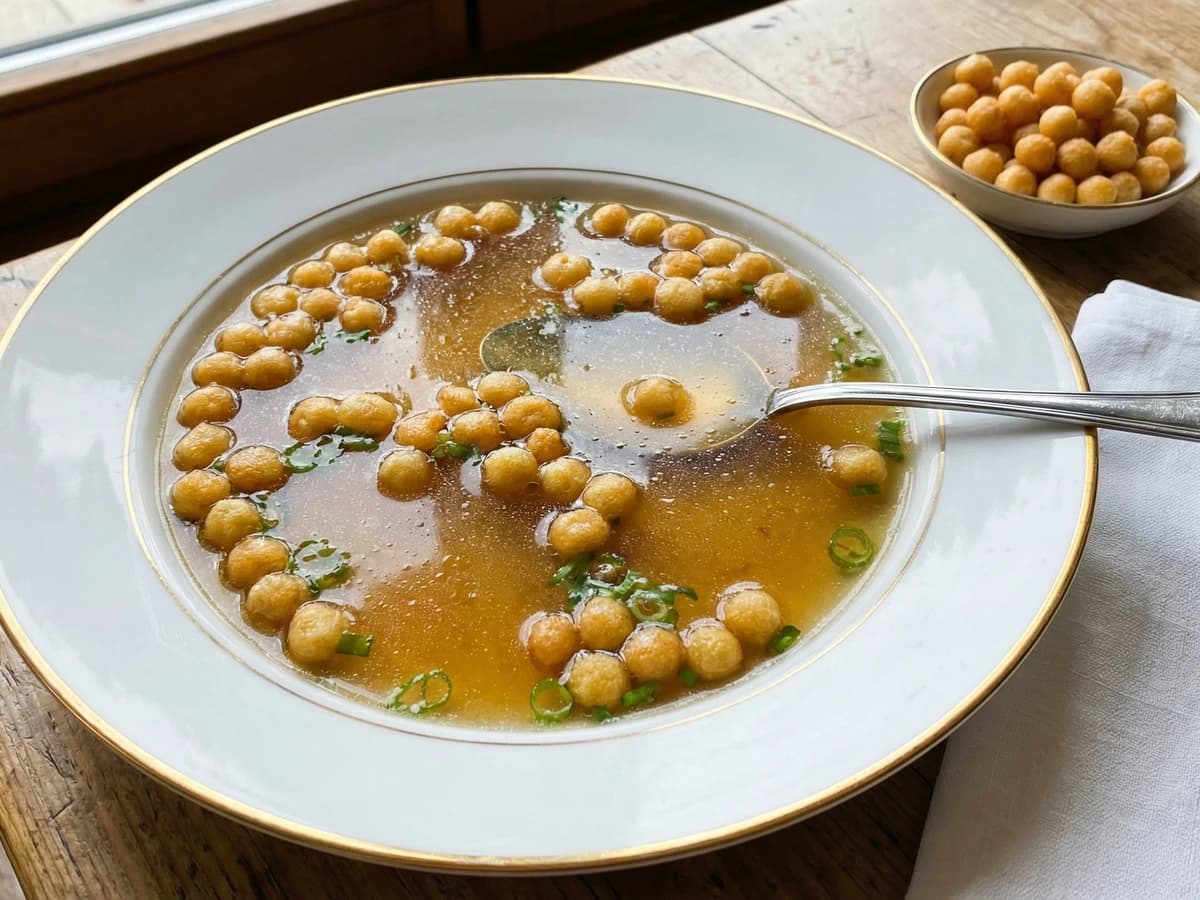
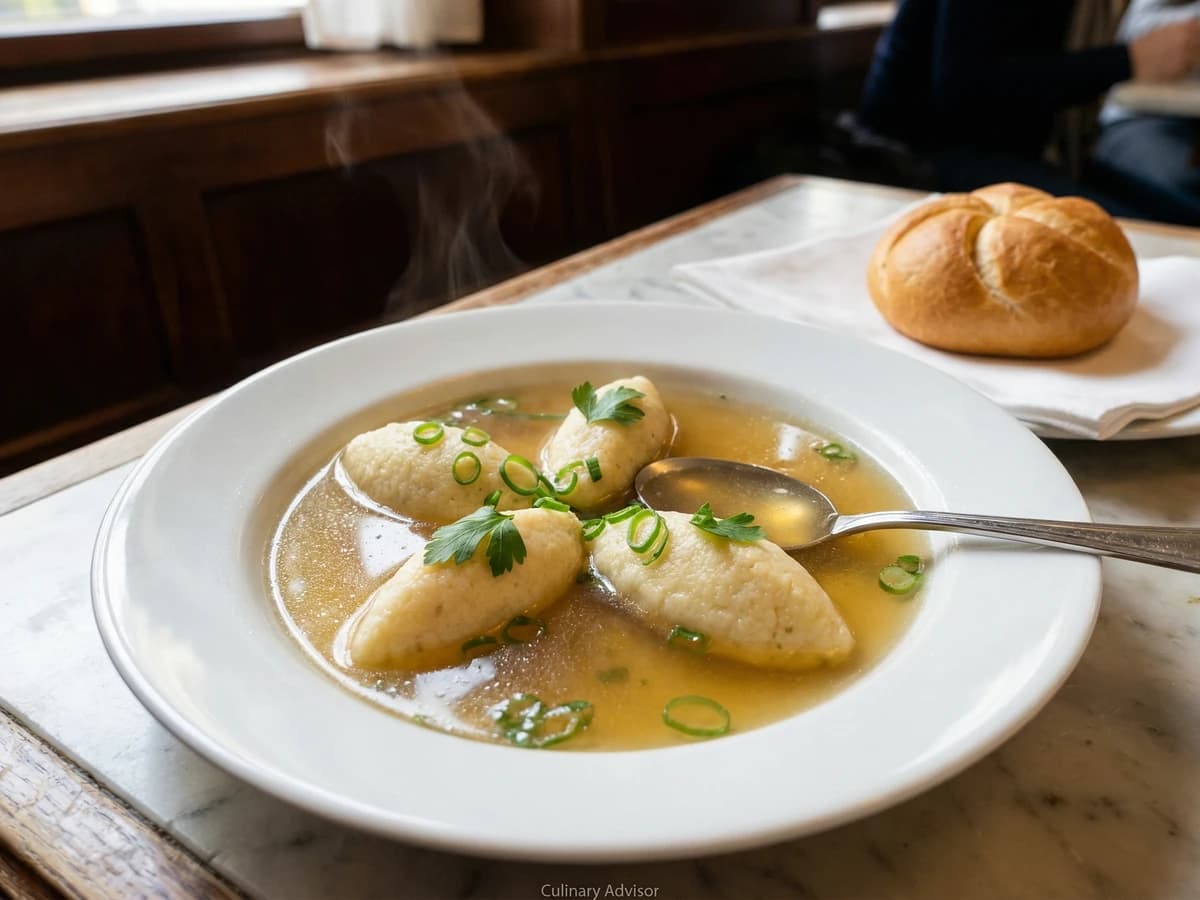
Tyrolean mountain cheese dumplings, pressed flat and fried crisp in butter, then floated in clear golden broth. The Alps in a bowl, and simpler than you'd think.
Soups & Stews
Austrian
Comfort Food
Weeknight
40 min
Active Time
20 min cook•1 hr total
Yield4 servings
Ifirst ate Kaspressknödel at a wooden table outside a Gasthaus in the Stubaital on one of those childhood trips with Gretel and my grandmother Eva. I must have been nine or ten. The bowl arrived and I remember looking at it, confused, because the dumplings were flat. Every Knödel I'd ever seen was round. These looked like little golden pancakes sitting in broth. Then I tasted one and forgot about shape entirely. The outside was crisp and buttery. The inside was soft, bread-like, held together by melted mountain cheese that pulled in long strings when I broke it with my spoon. The broth was clear and honest, the way Gretel insisted all good broth should be.
Kaspressknödel are Tyrolean to their bones. This is not Viennese cooking. This is mountain food, Almküche, the kind of thing a farmer's wife made because she had stale bread, hard cheese, onions, and eggs. She soaked the bread in milk to bring it back to life, mixed it with grated Bergkäse and whatever herbs grew near the door, pressed the mixture flat in her palms, and fried it in butter. Then she dropped it into broth and fed her family something warm and filling after a day in the cold. That's the whole story. Simple ingredients, good technique, no waste.
The pressing is what makes these different from every other Knödel in the Austrian repertoire. You flatten each dumpling into a thick disc before it goes into the pan. The flat shape gives you maximum surface area for browning, which means more crust, more flavor, more of that golden butter-and-cheese crunch against the soft broth. When you understand why they're pressed, you understand the whole dish.
Kaspressknödel belong to the Almküche tradition of Tyrolean Alpine cooking, where mountain dairy workers and farmers created filling meals from what the high pastures provided: aged cheese, stale bread, butter, and eggs. The word 'Kas' is Tyrolean dialect for Käse (cheese), and 'Press' refers to the distinctive flattening technique that separates these from round Semmelknödel. Regional debates persist across Tyrol, Salzburg, and Bavaria about whether the dumplings should be served in broth, on salad, or simply eaten plain from the pan, but in the Tyrolean heartland, Kaspressknödelsuppe remains the definitive preparation.
The technique, the tradition, and the story behind every dish.
Bergkäse (Austrian mountain cheese) or aged Gruyère
Quantity
150g
coarsely grated
onion
Quantity
1 medium
finely diced
unsalted butter
Quantity
3 tablespoons
divided
eggs
Quantity
2 large
lightly beaten
plain flour
Quantity
2 tablespoons
fresh chives
Quantity
2 tablespoons
finely chopped
fresh flat-leaf parsley
Quantity
1 tablespoon
finely chopped
salt and black pepper
Quantity
to taste
nutmeg
Quantity
pinch
freshly grated
beef broth
Quantity
1.5 liters
homemade or best quality
fresh chives
Quantity
for garnish
finely cut into rings
Ingredient
Quantity
stale white bread or Knödelbrotcut into small cubes
250g
warm whole milk
150ml
Bergkäse (Austrian mountain cheese) or aged Gruyèrecoarsely grated
150g
onionfinely diced
1 medium
unsalted butterdivided
3 tablespoons
eggslightly beaten
2 large
plain flour
2 tablespoons
fresh chivesfinely chopped
2 tablespoons
fresh flat-leaf parsleyfinely chopped
1 tablespoon
salt and black pepper
to taste
nutmegfreshly grated
pinch
beef brothhomemade or best quality
1.5 liters
fresh chivesfinely cut into rings
for garnish
Equipment Needed
•Large mixing bowl
•Wide heavy-bottomed pan (28cm)
•Medium pot for broth
•Box grater (coarse side)
Instructions
1
Soak the bread
Put the bread cubes in a large mixing bowl and pour the warm milk over them. Toss gently so every piece gets wet. Cover with a clean cloth and leave for fifteen minutes. The bread needs to absorb the milk fully, going soft and squeezable without turning to paste. If your bread is very stale and dry, you may need a splash more milk. If it's only a day old, use a little less. You're looking for bread that holds together when you squeeze a handful but isn't dripping.
Stale bread is not optional. Fresh bread has too much moisture and your Knödel will fall apart in the pan. If you forgot to leave your bread out, cut it into cubes and dry it in a low oven (120°C) for fifteen minutes. Gretel always said Knödel were invented to use up bread that had gone past its best, and she was right.
2
Cook the onion
Melt one tablespoon of butter in a small pan over medium-low heat. Add the diced onion and cook slowly until soft and translucent, about five minutes. You don't want any color here. Golden onion would compete with the cheese. Pale and sweet is what you're after. Set aside to cool slightly.
3
Build the Knödel mixture
Add the grated Bergkäse, cooled onion, beaten eggs, flour, chopped chives, and parsley to the soaked bread. Season with salt, pepper, and a small grating of nutmeg. Now get your hands in there and mix everything together. A spoon won't do it. You need to feel when the mixture comes together into a dough that holds its shape but isn't dense or sticky. If it feels too wet, add a little more flour, a teaspoon at a time. If it feels too dry and crumbly, add a splash of milk. The mixture should smell like cheese and butter and herbs. Let it rest for ten minutes so the flour can absorb and bind everything.
The cheese matters enormously. Real Bergkäse from Tyrol or Vorarlberg has a nutty, complex flavor that carries the whole dish. Aged Gruyère is your best substitute outside Austria. Don't use mild cheese. It will melt and vanish and your Knödel will taste like nothing but bread.
4
Shape and press the dumplings
Wet your hands lightly. Divide the mixture into eight equal portions. Roll each one into a ball, then press it flat between your palms into a disc about eight centimeters across and two centimeters thick. They should look like fat little patties, not thin pancakes. If the edges crack, squeeze them back together and press again. The pressing is the whole point of this dish: it creates two broad flat surfaces for browning, which gives you a crispy crust on both sides while the center stays soft and cheesy.
5
Fry until golden
Melt the remaining two tablespoons of butter in a wide pan over medium heat. When the butter foams and the foam begins to subside, lay the pressed Knödel in the pan. Don't crowd them. You'll likely need to work in two batches. Fry for three to four minutes on the first side without moving them. When you lift an edge and see deep gold underneath, flip them. The crust should be dry and firm, not pale and soft. Another three minutes on the second side. Listen for a steady, gentle sizzle. If the pan goes quiet, your heat is too low. If the butter starts to brown and smell sharp, too high.
Resist the urge to press the Knödel down with your spatula while they fry. You've already pressed them. Pressing again squeezes out moisture and cheese, and you end up with dry dumplings and a messy pan.
6
Heat the broth
While the Knödel fry, bring your beef broth to a gentle simmer in a separate pot. Taste it. Good broth should taste like something on its own, golden and beefy with a little salt. If it tastes thin or flat, you have the wrong broth and no dumpling in the world can save it. This is soup. The broth is half the dish.
7
Serve the soup
Place two fried Kaspressknödel in each warm soup bowl. Ladle the hot broth around them, not over them. You want the tops of the dumplings to stay above the surface so they keep their crust. The bottom half softens in the broth and the top stays crisp. That contrast is everything. Scatter fresh chive rings over the broth and serve immediately. Mahlzeit!
Chef Tips
•Knödelbrot, the pre-cut dried bread cubes sold in every Austrian supermarket, is the easiest starting point. Outside Austria, use a day-old white bread like a Semmel, Ciabatta, or even a good pain de mie. Avoid sourdough. Its acidity fights the cheese.
•Grate the cheese on the coarse side of a box grater, not fine. You want visible pieces of cheese in the Knödel that melt into pockets and strings when they hit the hot pan. Finely grated cheese disappears into the bread and you lose the texture that makes this dish special.
•If you have access to Tyrolean Graukäse, a traditional sour milk cheese, mix a small amount in with the Bergkäse. It adds a sharp, tangy bite that the mountain huts in the Stubaital are famous for. It's strong, so start with about 30 grams and taste the mixture before adding more.
•These Knödel are wonderful on their own as a snack with a green salad dressed in Kürbiskernöl (Styrian pumpkin seed oil). But for Kaspressknödelsuppe, you need the broth. Don't skip it.
Advance Preparation
•The Knödel mixture can be made up to six hours ahead and refrigerated. Shape and press just before frying. Cold dumplings from the fridge actually hold their shape better in the pan.
•Fried Kaspressknödel keep well in the fridge for two days. Reheat them in the hot broth for a minute or two. They won't be as crisp as fresh, but the flavor is still excellent.
•If you have homemade beef broth (and you should, eventually), make it on a weekend and freeze it in portions. Good broth in the freezer turns this from a project into a weeknight meal.
Frequently Asked Questions
Nutrition Information
1 serving (about 550g)
Calories
505 calories
Total Fat
26 g
Saturated Fat
14 g
Trans Fat
0 g
Unsaturated Fat
12 g
Cholesterol
160 mg
Sodium
1500 mg
Total Carbohydrates
40 g
Dietary Fiber
3 g
Sugars
6 g
Protein
25 g
Where cooking meets culture.
Culinary guides, cultural storytelling, and the editorial depth that makes cooking meaningful.