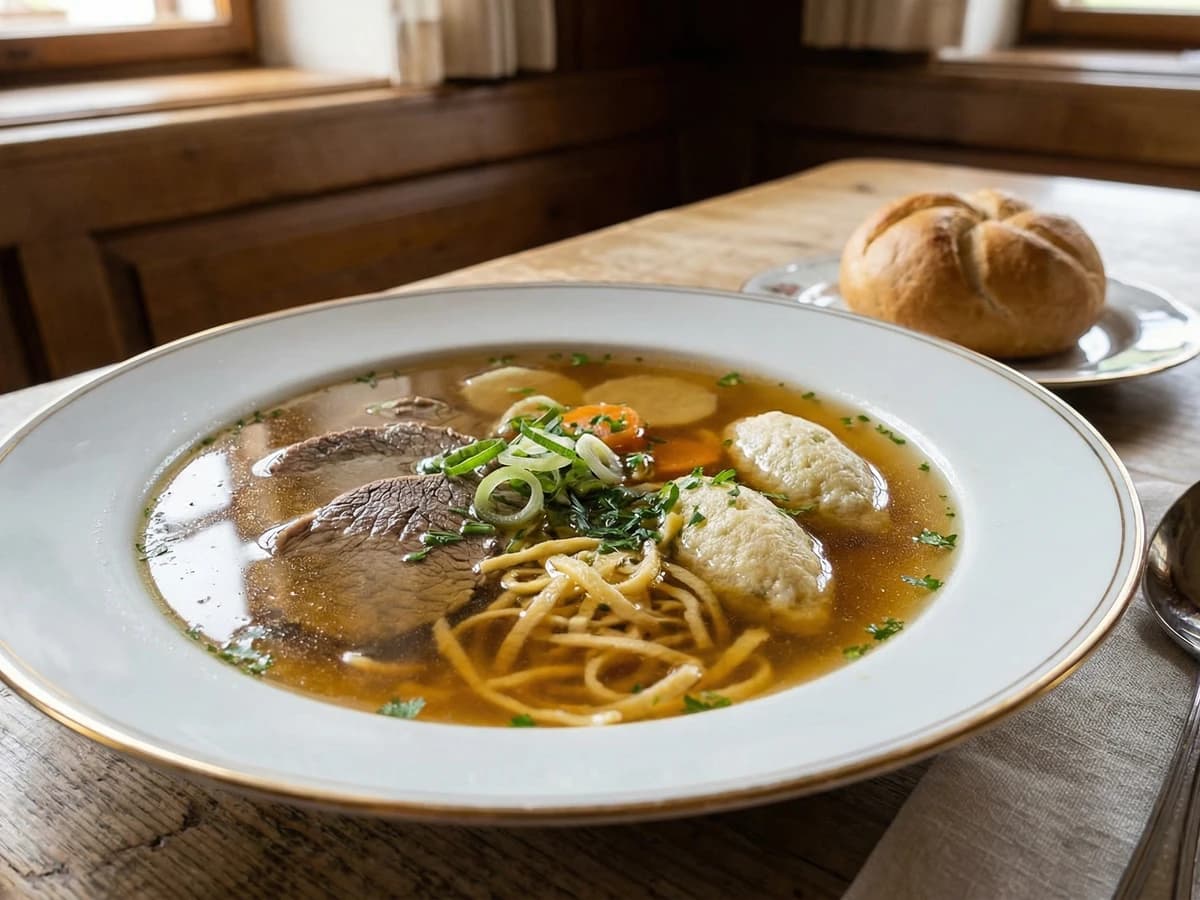
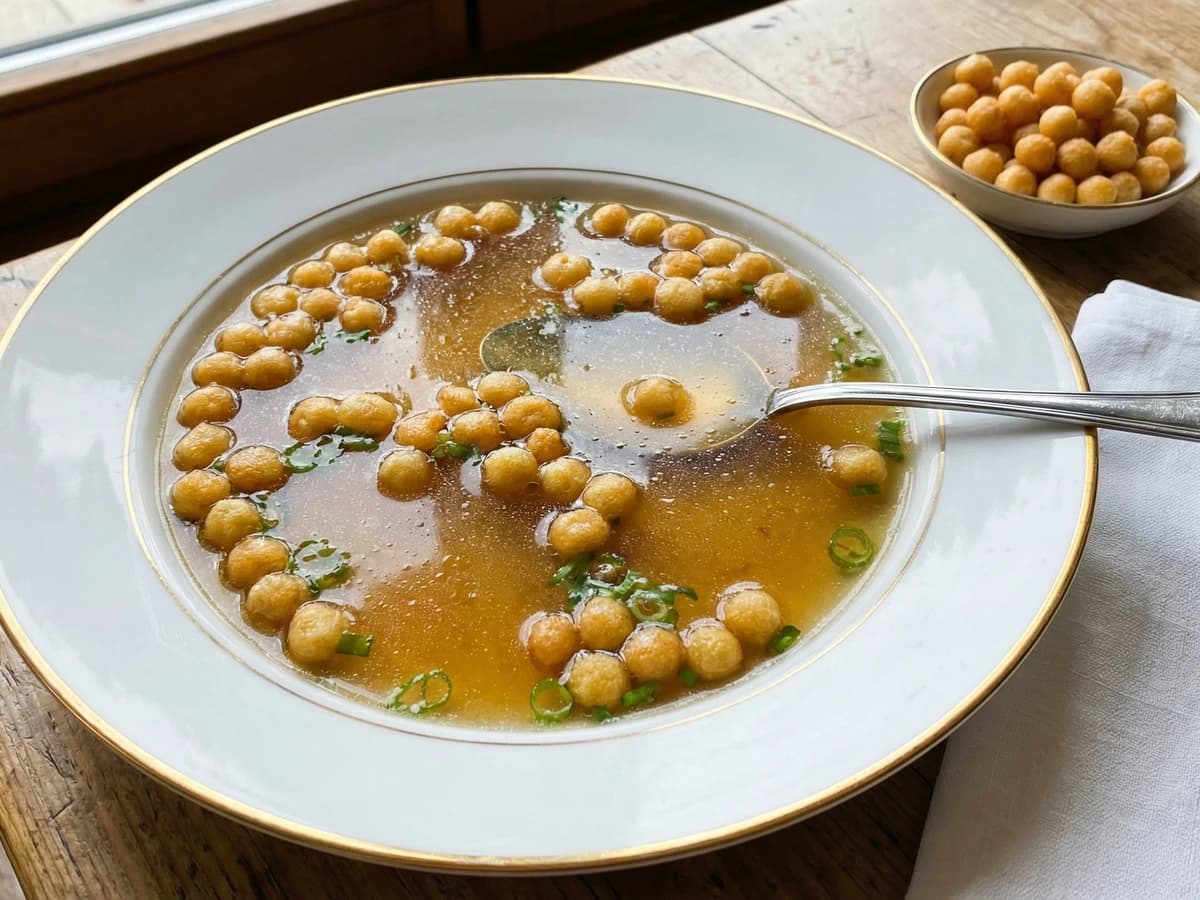
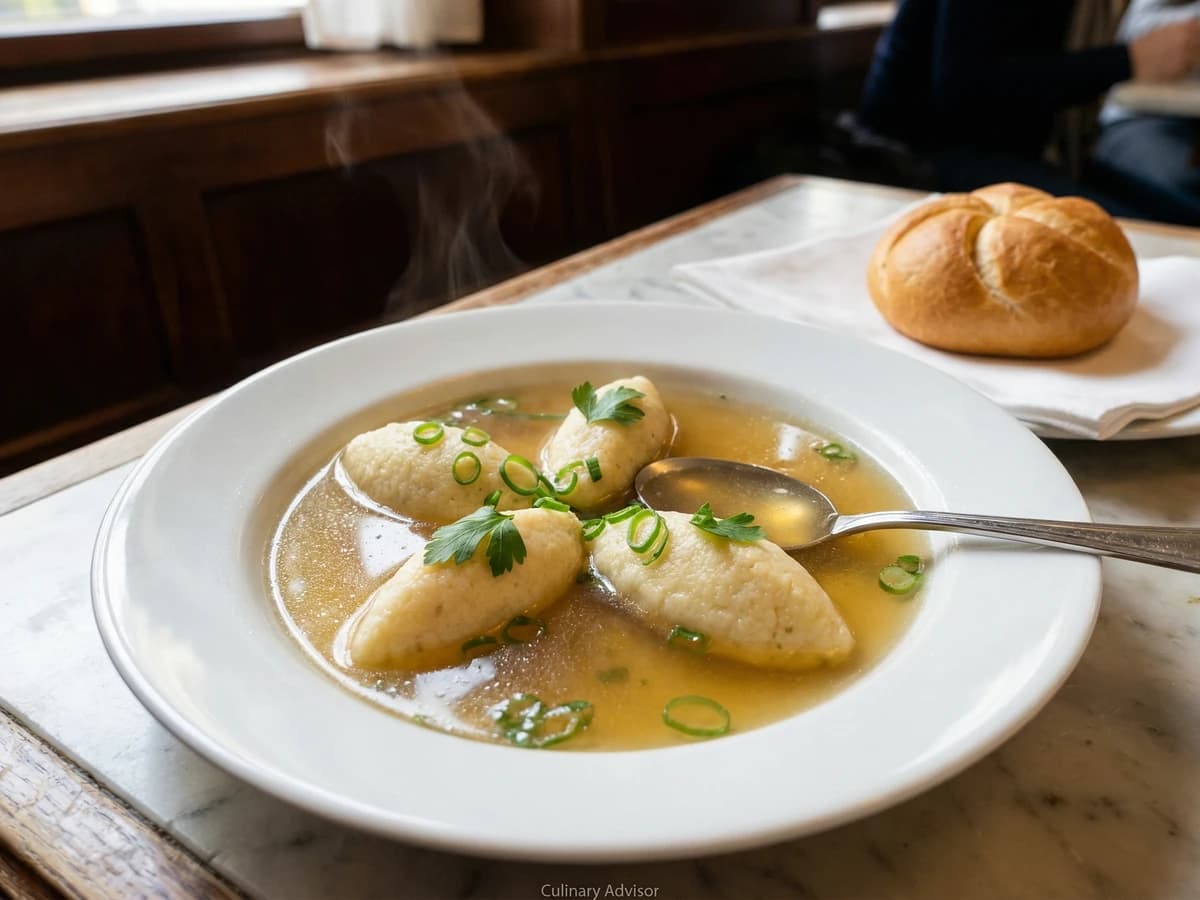
Carinthia's great feast day soup, rich with smoked pork, root vegetables, and sour cream, thickened with a slow-cooked roux and scattered with chives. The dish that fed whole villages at the Kirchtag.
Soups & Stews
Austrian
Special Occasion
Holiday
30 min
Active Time
2 hr cook•2 hr 30 min total
Yield6 servings
The first time I tasted Kirchtagssuppe was on a childhood trip to Carinthia with Gretel and my grandmother Eva. We'd driven south from Salzburg into the lake country, and somewhere near Villach we stopped at a Gasthaus where a parish fair was winding down. The soup arrived in a wide bowl, pale and creamy, with pieces of smoked pork and soft root vegetables sitting in a broth that was rich and tangy at once. I remember Gretel tasting it, nodding once, and saying, "This is what honest soup tastes like when it's been feeding a village since morning."
Kirchtagssuppe is Carinthia's celebration soup. It's what you make when the whole parish comes together for the Kirchtag, the annual feast honouring the local church's patron saint. The recipe is built to feed a crowd, and it tastes like it. Smoked pork simmers with beef bones until the broth turns deep and savoury. Root vegetables go in whole, then get pulled out and cut so they hold their shape. The broth is thickened with an Einbrenn, a slow-cooked roux that gives the soup its body without making it heavy. Then comes the Sauerrahm, sour cream stirred in at the end, which pulls everything together with that distinctive Carinthian tang.
This is not delicate consommé territory. Kirchtagssuppe is sturdy, generous, and deeply flavoured. It's the kind of soup that makes people go quiet at the table for a minute because they're eating instead of talking. The sour cream is what makes it Carinthian. Without that tang, you've just got a good meat soup. With it, you've got something that belongs to one region and one tradition, and you can taste exactly where you are.
Kirchtagssuppe takes its name from the Kirchtag, the annual parish fair celebrated in Carinthian villages on the feast day of the local church's patron saint. These fairs date back to medieval times, and the communal soup was the centrepiece of the celebration, cooked in enormous pots to feed entire congregations after church. The recipe varies from valley to valley, but the defining element is always Sauerrahm (sour cream), which marks it as distinctly Carinthian. In parts of lower Carinthia, a handful of dried yellow peas or beans appears in the pot, a remnant of the days when the soup had to stretch further and the pantry decided what went in.
The technique, the tradition, and the story behind every dish.
Place the smoked pork and beef bones in your largest pot. Cover with three liters of cold water. Cold water, always. It draws the flavour from the bones and meat slowly, building depth instead of just heat. Bring to a gentle simmer over medium heat. Gray foam will rise to the surface. Skim it away patiently until it stops coming. This takes ten to fifteen minutes. Don't rush it. A clean broth is a clear broth.
Geselchtes is Austrian smoked pork, dry-cured and cold-smoked. If you can't find it, use a good-quality smoked pork hock or even a piece of smoked bacon in one piece. What matters is the smokiness. Without it, the soup loses its backbone.
2
Add the vegetables
Once the broth is skimmed clean, add the carrots, parsnip, celeriac, potatoes, clove-studded onion, leek, peppercorns, bay leaves, lovage, and salt. Keep the vegetables whole. They'll cook in the broth for about an hour and you want to be able to fish them out later and cut them neatly. If you dice them now, they'll fall apart into mush and you'll lose the texture that makes this soup satisfying. Reduce the heat until the surface barely trembles. Let it simmer for one and a half hours.
Lovage is traditional in Carinthian cooking and tastes like celery's bolder, more aromatic cousin. If you can't find it, flat-leaf parsley works, but try growing lovage in a pot on your windowsill. One plant gives you more than you'll ever need.
3
Remove meat and vegetables
After an hour and a half, the smoked pork should be tender enough to pull apart easily with a fork. Lift it out and set it aside on a cutting board. Fish out the carrots, parsnip, celeriac, and potatoes. Leave the onion, leek, peppercorns, and bay leaves in the pot for now. Cut the vegetables into small, even cubes, roughly one centimetre. Slice or shred the smoked pork into bite-sized pieces. Set everything aside. Strain the broth through a fine-mesh sieve into a clean pot and discard the spent aromatics.
4
Make the Einbrenn
In a heavy saucepan, melt the butter over medium heat. When it foams, add the flour all at once and stir with a wooden spoon. Keep stirring. The Einbrenn needs to cook for three to four minutes until it turns a pale golden colour and smells nutty, like warm toast. This is not optional. Raw flour tastes like raw flour, and no amount of sour cream will hide it. If it darkens too fast, your heat is too high. Pull the pan off the burner for a moment and keep stirring.
Gretel always said an Einbrenn is the foundation of half the soups in Austria. Get it right and the soup has body. Rush it and the whole pot tastes of paste.
5
Thicken the broth
Ladle the warm strained broth into the Einbrenn one ladleful at a time, whisking constantly. The first two ladles will seize up into a thick paste. That's exactly right. Keep whisking and adding broth until the mixture loosens into a smooth, creamy liquid. Then pour it all back into the large pot with the remaining broth and stir well. Bring it back to a gentle simmer and let it cook for ten minutes so the flour is fully cooked through. The soup should coat the back of a spoon lightly. It's not a thick stew. It's a soup with substance.
6
Finish with sour cream
Take the pot off the heat. Whisk the Sauerrahm in a bowl to loosen it, then temper it by stirring in a few spoonfuls of the hot broth. This prevents the sour cream from curdling when it hits the soup. Pour the tempered sour cream into the pot and stir gently until the soup turns creamy and pale. Add the vinegar. Taste. The soup should be rich and savoury with a clean tang at the finish. If it needs more acid, add another splash of vinegar. Season with freshly ground black pepper. Go easy on additional salt. The smoked pork has been seasoning the broth all along.
Full-fat sour cream only. Low-fat versions will curdle and give you a grainy, broken soup instead of the silky tang you're after. This is not the place to cut corners.
7
Assemble and serve
Return the cubed vegetables and shredded smoked pork to the pot. Warm everything through over low heat for five minutes. Don't let it boil now that the sour cream is in, or it will separate. Ladle into warm, wide soup bowls. Scatter a generous handful of finely cut chives over each serving. The chives aren't decoration. Their sharp, fresh bite is the final layer against all that richness and smoke. Serve with thick slices of dark rye bread on the side. Mahlzeit!
Chef Tips
•The smoked pork is the soul of this soup. Spend time finding good Geselchtes from a butcher who smokes their own. Mass-produced smoked meat has a chemical edge to it that will push the whole pot in the wrong direction. If you're outside Austria, look for traditionally smoked pork at Eastern European or German delis.
•Temper the sour cream properly. I cannot say this enough. If you dump cold Sauerrahm straight into hot broth, it will curdle into sad little white flecks and your soup will look like it's given up on life. Warm it first, stir in some broth, then add it to the pot off the heat.
•This soup gets better overnight. The flavours deepen and the tang rounds out. Reheat it gently the next day, below a simmer, and adjust the seasoning with a little more vinegar or pepper. Don't add the chives until you serve.
•If you see dried yellow split peas in a Carinthian grandmother's version, that's traditional in some valleys. Soak them overnight and add them with the vegetables if you want that extra heartiness.
Advance Preparation
•The entire soup can be made one day ahead and refrigerated. The flavour improves overnight. Reheat gently below a simmer so the sour cream doesn't break.
•The broth and smoked pork can be cooked up to two days ahead and stored separately. Make the Einbrenn and finish with sour cream on the day you serve.
•Cut the chives just before serving. They lose their sharpness quickly once cut.
Frequently Asked Questions
Nutrition Information
1 serving (about 630g)
Calories
495 calories
Total Fat
31 g
Saturated Fat
15 g
Trans Fat
0 g
Unsaturated Fat
15 g
Cholesterol
105 mg
Sodium
1100 mg
Total Carbohydrates
34 g
Dietary Fiber
5 g
Sugars
7 g
Protein
24 g
Where cooking meets culture.
Culinary guides, cultural storytelling, and the editorial depth that makes cooking meaningful.