
Chef Klaus
Allgäuer Krautkrapfen
The Allgäu pan dish that makes a meal from noodle dough, winter kraut, onion, and fat: brown the cut sides first, then cook gently so the rolls hold.
A cooking platform built around craft, culture, and the stories behind what we eat.
Created by
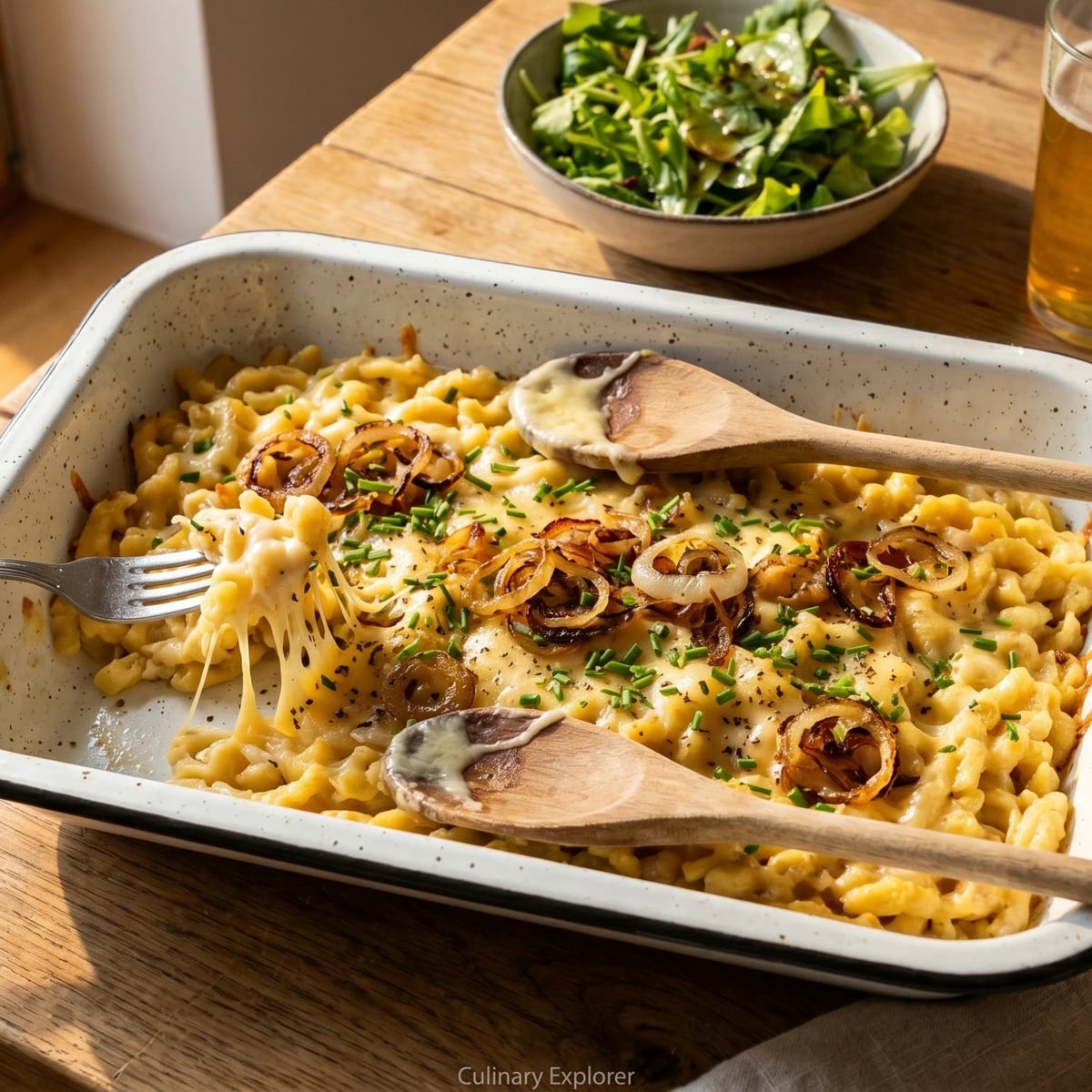
The cheese must meet the Spätzle while they are still hot and wet from the pot, or you get noodles with grated cheese sitting on top. That is not Kässpätzle.
Kässpätzle sits in the Swabian and Allgäu kitchen where a pot of flour, eggs, onions, and mountain cheese becomes supper without ceremony. It is weeknight food when you know what you're doing, Sunday food when the bowl comes to the table with enough fried onions on top. The Allgäu wants sharp Bergkäse and calls it Kässpätzle; across the Ländle you meet Käsknöpfle, shorter and button-shaped. Im Norden anders, im Süden anders, and here the south knows the dish best.
The argument is mostly shape and cheese. Swabia scrapes long Spätzle from a board or pushes them through a press; the Allgäu often wants them sturdy enough to hold a serious cheese; Vorarlberg makes smaller Knöpfle and is not shy with the onions. I won't make a border guard out of it. Use a good mature mountain cheese, a little Emmentaler for melt if you like, and no packet sauce. Nicht aus dem Glas. There is no sauce here except cheese, butter, onion, and a spoon of starchy cooking water doing their job.
The technique that decides the dish is timing. The cooked Spätzle must go from the pot into the warm cheese layers while they are still hot and carrying a little cooking water, because that starch and heat melt the cheese into the noodles instead of leaving it in greasy strings. Drain them bone dry and let them sit, and you've built yourself a lump. Keep the bowl warm, layer fast, and let the onions arrive crisp at the end. Erst verstehen, dann kochen.
Spätzle are recorded in Swabia by the 18th century, with the 1725 writings of Württemberg physician Rosino Lentilio often cited among the earliest references to the noodle family. Cheese versions grew naturally in the dairy regions along the Swabian Alb, the Allgäu, and Vorarlberg, where hard mountain cheeses from summer pasture could be stored through the cold months. The names still mark the regional line: Käsespätzle in Swabia, Kässpätzle or Kässpatzen in the Allgäu, and Käsknöpfle in Vorarlberg and the Ländle.
Quantity
400g
Quantity
4
Quantity
160ml
plus more as needed
Quantity
1 teaspoon
plus more for the cooking water
Quantity
1 small pinch
Quantity
250g
coarsely grated
Quantity
100g
coarsely grated
Quantity
3
thinly sliced
Quantity
3 tablespoons
Quantity
30g
Quantity
to taste
Quantity
2 tablespoons
finely sliced
| Ingredient | Quantity |
|---|---|
| plain flour or German Type 405 flour | 400g |
| large eggs | 4 |
| cold waterplus more as needed | 160ml |
| fine saltplus more for the cooking water | 1 teaspoon |
| freshly grated nutmeg | 1 small pinch |
| mature Allgäuer Bergkäse or Gruyère-style mountain cheesecoarsely grated | 250g |
| Emmentalercoarsely grated | 100g |
| large onionsthinly sliced | 3 |
| clarified butter or neutral oil | 3 tablespoons |
| unsalted butter | 30g |
| freshly ground black pepper | to taste |
| chives (optional)finely sliced | 2 tablespoons |
Put the sliced onions in a wide pan with the clarified butter and a pinch of salt, then cook them over medium heat for 20 to 25 minutes, stirring often, until deep golden and crisp at the edges. Don't rush them on high heat. Onion needs time to lose its water before it browns, or it burns outside and stays sharp inside. Lift them onto kitchen paper and keep the onion fat in the pan.
Beat the flour, eggs, water, salt, and nutmeg with a wooden spoon until the batter is thick, elastic, and pulls in long strands from the spoon. This beating matters because it wakes the gluten enough for Spätzle that hold together in the water. The batter should be softer than bread dough and thicker than pancake batter; add a spoon of water if it tears instead of stretching.
Let the batter rest for 15 minutes while you grate the cheeses and warm a large serving bowl or shallow baking dish. The rest hydrates the flour, so the Spätzle cook tender instead of floury at the centre. Warming the bowl matters because cold crockery steals the heat the cheese needs to melt.
Bring a large pot of well-salted water to a lively simmer. Press or scrape the batter into the water in batches, cutting off the flow so the pieces stay separate. When the Spätzle float, give them another 30 to 60 seconds; floating tells you they have set, and the extra moment cooks out the raw flour taste. Lift them with a slotted spoon, not a colander, so a little starchy water comes with them.
Put a layer of hot Spätzle into the warm bowl, scatter over a handful of grated cheese and a little black pepper, then repeat until everything is used. Work quickly. The cheese melts from the heat of the noodles and the starch on their surface, which is why dry, cooled Spätzle give you clumps instead of a joined dish. If it looks tight, add one or two spoonfuls of hot cooking water.
Melt the butter in the onion pan with the saved onion fat, then fold it through the layered Spätzle just enough to gloss them without breaking them into paste. Taste now, not before, because mountain cheese brings its own salt. Würzen, Fett, Salz zum Schluss. Crown the bowl with the fried onions and chives if using, then carry it straight to the table.
1 serving (about 390g)
Culinary guides, cultural storytelling, and the editorial depth that makes cooking meaningful.
Discover Culinary Explorer
Chef Klaus
The Allgäu pan dish that makes a meal from noodle dough, winter kraut, onion, and fat: brown the cut sides first, then cook gently so the rolls hold.

Chef Klaus
Swabian egg pasta turned toward the apple cellar: fresh Spätzle tossed with browned butter, tart apples, cinnamon, and enough restraint to stay supper, not cake.

Chef Klaus
Swabian Bubespitzle work when the potato dough is cool and dry before the egg goes in, then the little finger noodles brown cleanly in the pan.

Chef Klaus
The button-shaped Swabian noodle that proves the batter before the pan: beaten until it blisters, pressed small, then buttered with onions and cheese for supper.