Culinary Explorer

A cooking platform built around craft, culture, and the stories behind what we eat.
Discover Culinary Explorer
Jardineira

Jardineira

Created by

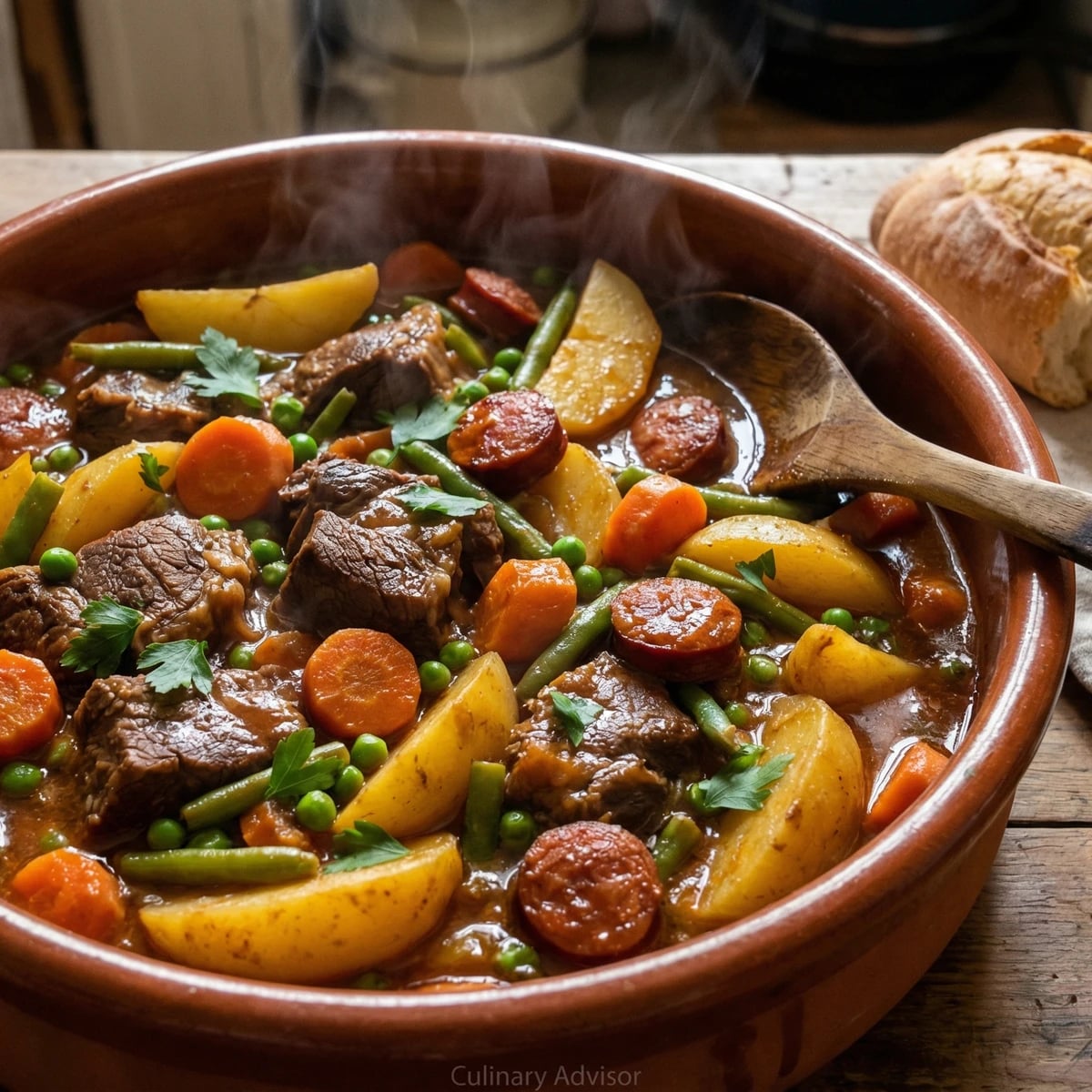
The gardener's stew, where braised beef meets whatever the garden offers that week. No two jardineiras are alike because no two gardens are alike. This is how Portuguese families have always cooked.

Main Dishes
Portuguese
Weeknight
One Pot
Make Ahead
30 min
Active Time
2 hr 30 min cook3 hr total
Yield6 servings

Jardineira means 'gardener's style' and that tells you everything you need to know. This is not a recipe with precise measurements written in some chef's notebook. This is a framework, a way of cooking that Portuguese home cooks have practiced for generations, throwing in whatever the garden gave them that week.

Avó Leonor made jardineira on Mondays. Sunday's leftover beef went into the pot, along with whatever vegetables were ready to pick: potatoes always, carrots if we had them, peas in spring, green beans in summer, broad beans when they were fat and sweet. The only constants were the slow refogado, the splash of wine, and the patience to let everything braise until the meat fell apart.

This is working-class food. Feed-the-family food. The kind of cooking that stretches a small piece of meat into a meal for six by surrounding it with vegetables and bread. My grandmother would never have called it 'elevated' or 'rustic chic.' She just called it Tuesday dinner.

At Mesa da Avó, we serve jardineira in the pot it was cooked in. No plating, no fuss. Everyone reaches in with their own spoon. That's how it's meant to be eaten: together, from the center of the table, with bread to mop up what's left.

Jardineira belongs to the broader European tradition of 'à la jardinière' cooking, but the Portuguese version developed its own character in rural kitchens where meat was precious and vegetables were currency. The dish became a staple of working-class Lisbon in the 19th century, when families stretched small amounts of beef with abundant market vegetables. Every region, every household, has their own version.

The technique, the tradition, and the story behind every dish.

Discover Culinary Explorer

Ingredients

beef chuck or shoulder

Quantity

800g

cut into 4cm pieces

extra virgin olive oil (azeite)

Quantity

4 tablespoons

onions

Quantity

2 large

roughly chopped

garlic

Quantity

4 cloves

sliced

tomato paste

Quantity

2 tablespoons

dry white wine

Quantity

1 cup

beef broth or water

Quantity

2 cups

bay leaves

Quantity

3

sweet paprika (pimentão doce)

Quantity

1 teaspoon

waxy potatoes

Quantity

600g

peeled and quartered

carrots

Quantity

3 medium

cut into thick rounds

green beans

Quantity

200g

trimmed and halved

peas

Quantity

150g

fresh or frozen

chouriço

Quantity

100g

sliced into rounds

flat-leaf parsley

Quantity

for garnish

chopped

sea salt

Quantity

to taste

black pepper

Quantity

to taste

freshly ground

Equipment Needed

  • Heavy 5-liter Dutch oven or traditional clay pot
  • Wooden spoon

Instructions

  1. 1

    Season the beef

    Pat the beef pieces dry with paper towels and season generously with salt and pepper. Let them sit at room temperature for 20 minutes while you prepare everything else. Cold meat doesn't brown properly.

  2. 2

    Brown the meat

    Heat 2 tablespoons of azeite in a heavy pot or Dutch oven over medium-high heat. Brown the beef in batches, giving each piece space and time to develop a deep golden crust on all sides. Don't crowd the pot or the meat will steam instead of sear. Remove to a plate and set aside. This takes patience, maybe 10 minutes total, but the flavor you're building here is the foundation of everything.

    Avó Leonor never rushed this step. She'd say the meat tells you when it's ready to turn: it releases from the pot on its own when the crust has formed.
  3. 3

    Build the refogado

    Lower the heat to medium and add the remaining azeite. Add the onions and a pinch of salt. Cook slowly, stirring occasionally, until the onions are soft and golden, about 12 minutes. Add the garlic and cook for another minute until fragrant. Stir in the tomato paste and paprika, cooking for 30 seconds until the paste darkens slightly and smells toasty.

    The refogado is the soul of Portuguese cooking. Não tenhas pressa. If the onion isn't properly softened, the whole dish suffers.
  4. 4

    Deglaze and braise

    Pour in the wine and let it bubble, scraping up all the browned bits from the bottom of the pot. These are flavor. Return the beef and any juices to the pot. Add the broth, bay leaves, and enough water to just cover the meat. Bring to a simmer, then reduce the heat to low. Cover and let it cook gently for 1 hour and 30 minutes. The meat should be nearly tender but not falling apart.

  5. 5

    Add the vegetables in stages

    Nestle the potatoes and carrots into the liquid around the meat. Add a splash more water if needed to keep everything just covered. Cover and cook for another 20 minutes. Then add the green beans and chouriço, pressing them gently into the stew. Cover and cook 15 minutes more. Finally, add the peas and cook uncovered for 5 to 10 minutes until everything is tender and the liquid has reduced to a rich, glossy sauce that coats the back of a spoon.

    Adding vegetables in stages means each one is perfectly cooked. Potatoes and carrots need longer; peas need almost nothing. This isn't fussy, it's respectful.
  6. 6

    Rest and serve

    Remove from heat and let the jardineira rest for 10 minutes. Taste and adjust the seasoning. The flavors will have deepened during cooking, so you may need less salt than you think. Scatter with parsley and serve directly from the pot, with crusty bread to mop up the braising liquid. This is not a dish that needs a plate. It needs a deep bowl and a big spoon.

Chef Tips

  • Use whatever vegetables you have. That's the whole point. Turnips, broad beans, cabbage, butternut squash: they all work. The only rule is to add them at the right time so nothing overcooks.
  • This dish is better the next day. Make it on Sunday, eat it Monday. The flavors deepen overnight and the meat becomes even more tender.
  • Some families add a splash of red wine vinegar at the end to brighten the stew. My grandmother didn't, but I've seen it in Beira Litoral and it works beautifully.
  • Portuguese chouriço is not Spanish chorizo. It's smoked, not cured with paprika. If you can't find it, a good smoked sausage is closer than chorizo.
  • The braising liquid should be rich enough to coat the vegetables but not soupy. If it's too thin at the end, remove the lid and let it reduce while the peas cook.

Advance Preparation

  • Jardineira improves dramatically overnight. Make it a day ahead, cool, refrigerate, and reheat gently the next day.
  • The beef can be browned and the refogado made up to 2 days ahead. Refrigerate separately and combine when ready to braise.
  • Leftovers keep 4 days refrigerated and freeze well for up to 3 months.

Frequently Asked Questions

Nutrition Information

1 serving (about 415g)

Calories
665 calories
Total Fat
36 g
Saturated Fat
12 g
Trans Fat
0 g
Unsaturated Fat
22 g
Cholesterol
135 mg
Sodium
1020 mg
Total Carbohydrates
35 g
Dietary Fiber
6 g
Sugars
7 g
Protein
45 g

Note: Chef personas and recipes are created with AI assistance. Cook with care: follow safe food-handling practices, check doneness with a thermometer when needed, and adapt for allergies and your kitchen.

Where cooking meets culture.

Culinary guides, cultural storytelling, and the editorial depth that makes cooking meaningful.

Discover Culinary Explorer

More from Chef Margarida's Main Dishes

Browse the full collection