
Chef Jeong-sun
Aehobak-guk (애호박국, Korean Zucchini Soup)
A clean summer soup of Korean zucchini and salted shrimp, built on quick anchovy-kelp broth and finished before the half-moons lose their shape on a weeknight table.
A cooking platform built around craft, culture, and the stories behind what we eat.

Created by
Freshwater eel simmered into a thick Jeolla soup with cabbage, doenjang, perilla seed powder, and green chilies, a summer tonic built slowly enough for one bowl to carry the day.
Jangeo-tang belongs to the heavy heat of summer, when people stop pretending a cold drink is enough and cook something that gives the body back its strength. In the markets of Jeolla, freshwater eel is not treated like a luxury ornament. It is food with work to do. One bowl should be rich, earthy, and steady, not oily, not muddy, and not buried under chili.
The soup lives or dies by how you handle the eel. Clean it well, simmer it gently, and give the broth enough ginger, garlic, and doenjang to steady the richness without shouting over it. Perilla seed powder is not a garnish here. It thickens the soup and quiets the river taste of the fish, which is why I measure it instead of throwing in a careless scoop.
I won't tell you this is a quick soup. It asks you to blanch greens, skim the pot, pull meat from bone, and season in layers. Those steps are the dish. 시대가 바뀌면 음식도 바뀌어야 해요. When times change, food must change too, so a fishmonger can clean the eel for you and a heavy pot can replace the old cauldron. But the broth and seasoning still need your attention tonight.
Jangeo-tang is most closely tied to Korea's southern river and coastal regions, especially Jeolla, where freshwater eel has long been eaten as boyangsik, food taken to restore strength during the humid summer heat. Like samgyetang on boknal, the traditional hottest days of the lunar calendar, eel soup reflects Korea's habit of answering heat with a hot, nourishing bowl rather than only cooling foods. Regional versions vary, but Jeolla styles often lean on doenjang, perilla seed powder, cabbage or radish greens, and a final sharpness from green chili or chopi, the prickly ash pepper used in parts of the south.
Quantity
900g
cleaned, cut into 3-inch pieces, bones and head included if available
Quantity
1 tablespoon
for rubbing the eel
Quantity
8 cups
Quantity
1 piece, about 4 inches square
Quantity
10
heads and guts removed
Quantity
30g
sliced
Quantity
8 cloves
4 smashed, 4 minced
Quantity
2 tablespoons
Quantity
1 tablespoon
Quantity
1 tablespoon
Quantity
1 teaspoon
Quantity
300g
cut into 2-inch pieces
Quantity
150g
Quantity
1 medium
sliced
Quantity
2
sliced on the diagonal
Quantity
2
cut into 2-inch lengths
Quantity
1/2 cup
Quantity
12
torn or sliced thick
Quantity
1 teaspoon
Quantity
1/4 teaspoon
Quantity
1/4 teaspoon at a time
Quantity
to serve
| Ingredient | Quantity |
|---|---|
| freshwater eel (jangeo)cleaned, cut into 3-inch pieces, bones and head included if available | 900g |
| coarse saltfor rubbing the eel | 1 tablespoon |
| water | 8 cups |
| dried kelp (dasima) | 1 piece, about 4 inches square |
| large dried anchovies (myeolchi)heads and guts removed | 10 |
| fresh gingersliced | 30g |
| garlic4 smashed, 4 minced | 8 cloves |
| doenjang (Korean fermented soybean paste) | 2 tablespoons |
| guk-ganjang (Korean soup soy sauce) | 1 tablespoon |
| gochugaru (Korean chili flakes) | 1 tablespoon |
| fish sauce or Korean anchovy sauce (optional) | 1 teaspoon |
| napa cabbage or eolgari cabbagecut into 2-inch pieces | 300g |
| blanched siraegi (dried radish greens) (optional) | 150g |
| onionsliced | 1 medium |
| Korean green chiliessliced on the diagonal | 2 |
| scallionscut into 2-inch lengths | 2 |
| perilla seed powder (deulkkae-garu) | 1/2 cup |
| perilla leaves (kkaennip)torn or sliced thick | 12 |
| toasted sesame oil | 1 teaspoon |
| ground black pepper | 1/4 teaspoon |
| salt (optional) | 1/4 teaspoon at a time |
| chopi or sancho pepper powder (optional) | to serve |
Ask the fishmonger to clean and cut the eel, keeping the bones and head if they are available. At home, rub the pieces with the coarse salt for 1 minute to loosen the slick coating, then rinse under cold running water and drain well. Do not taste raw eel, and keep the board clean. Eel must be cooked through.
Put the water, kelp, anchovies, ginger, and 4 smashed garlic cloves in a heavy pot. Bring it slowly to a simmer over medium heat. Pull the kelp out as soon as the water trembles, about 8 to 10 minutes, because kelp left too long turns the broth slick and bitter. Simmer the anchovies, ginger, and garlic for 12 minutes more, then lift out the anchovies.
Add the eel pieces, bones, and head to the pot. Keep the broth at a gentle simmer for 25 to 30 minutes, skimming the gray foam that rises. Hard boiling breaks the fish apart before the broth has taken its strength, and it makes the soup cloudy in a tired way instead of a rich one.
Lift the eel pieces into a wide bowl. Strain the broth through a fine sieve into a clean pot and discard the ginger, garlic, bones, and head. When the eel is cool enough to handle, pull the meat into large flakes, checking carefully for small bones. This is the part you do slowly. A tonic soup should not make the table nervous.
Bring a separate pot of water to a boil and blanch the cabbage for 2 minutes, just until flexible. Drain and squeeze lightly. If using blanched siraegi, squeeze it dry and cut it into bite-size lengths. Blanching removes the raw cabbage edge so the greens can drink the broth instead of watering it down.
Whisk the doenjang, guk-ganjang, gochugaru, fish sauce if using, and 4 minced garlic cloves into the strained broth. Add the onion, blanched cabbage, and siraegi. Simmer 15 minutes, until the greens soften and the broth tastes settled. Start with this measured seasoning. More doenjang can rescue a thin soup, but too much makes the eel disappear.
Stir the perilla seed powder with 1/2 cup hot broth in a small bowl to make a loose paste, then pour it back into the pot. This prevents dry clumps. Simmer 8 to 10 minutes, stirring now and then, until the broth turns thick and nutty and coats the back of a spoon.
Slide the flaked eel back into the pot and simmer gently for 5 minutes. Taste the broth now. If it needs salt, add it 1/4 teaspoon at a time, waiting half a minute before tasting again. 손맛 is real. I still measure it, so it can be handed on.
Add the green chilies, scallions, perilla leaves, sesame oil, and black pepper. Simmer 1 minute, then turn off the heat. The chilies should stay bright and sharp, and the perilla leaves should soften without losing their green fragrance. Serve with rice, kimchi, and chopi or sancho pepper at the table for those who know they want it.
1 serving (about 700g)
Culinary guides, cultural storytelling, and the editorial depth that makes cooking meaningful.
Discover Culinary ExplorerChef Jeong-sun
A clean summer soup of Korean zucchini and salted shrimp, built on quick anchovy-kelp broth and finished before the half-moons lose their shape on a weeknight table.
Chef Jeong-sun
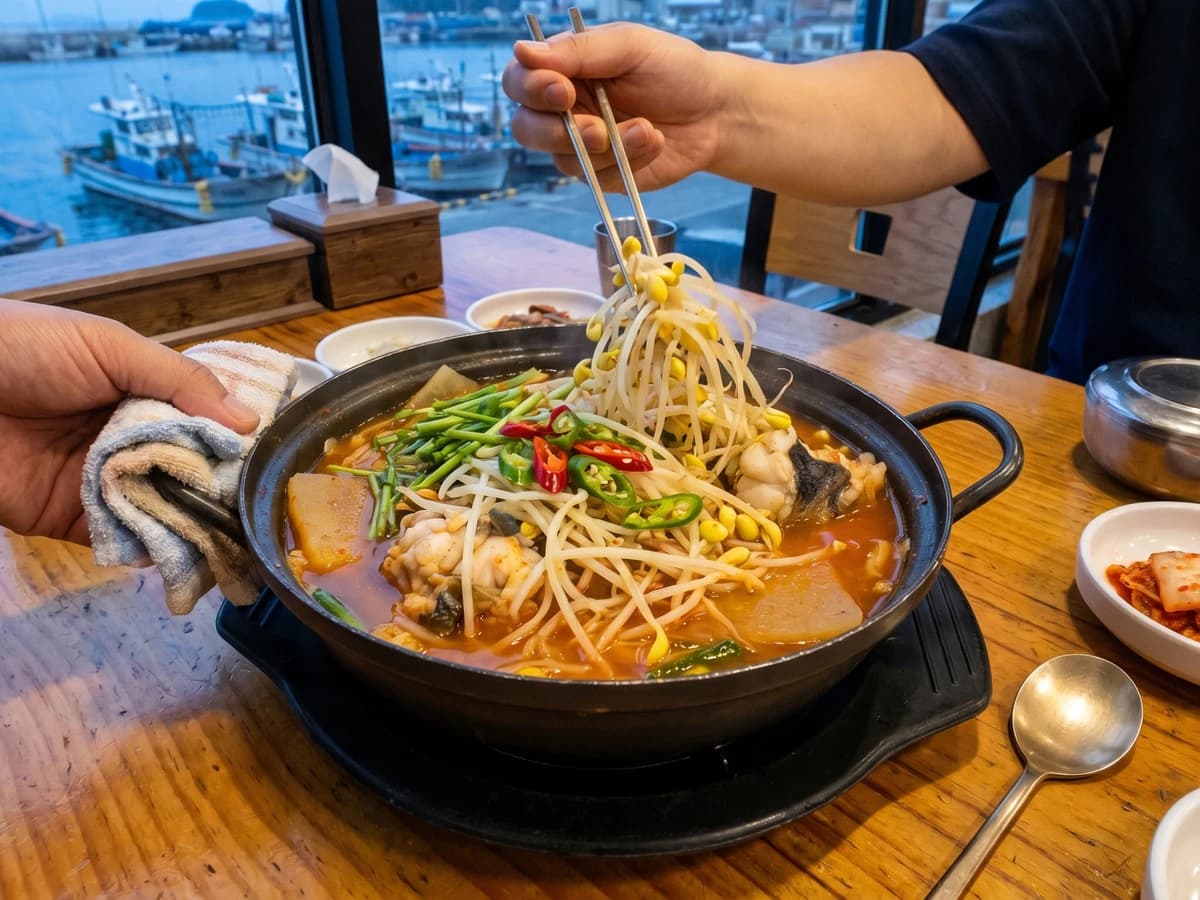
A Masan coast monkfish stew with firm white meat, gelatin at the bones, soybean sprouts for crunch, and a red broth seasoned to carry the fish, not bury it.

Chef Jeong-sun
A weeknight fish roe stew with radish and crown daisy in a clean spicy broth, where the whole success depends on adding the roe late enough that it sets tender, not chalky.

Chef Jeong-sun
Late-summer mallow leaves rubbed with salt until the bitter green water runs off, then simmered in a clean doenjang broth with dried shrimp, the quiet soup a Korean weeknight deserves.