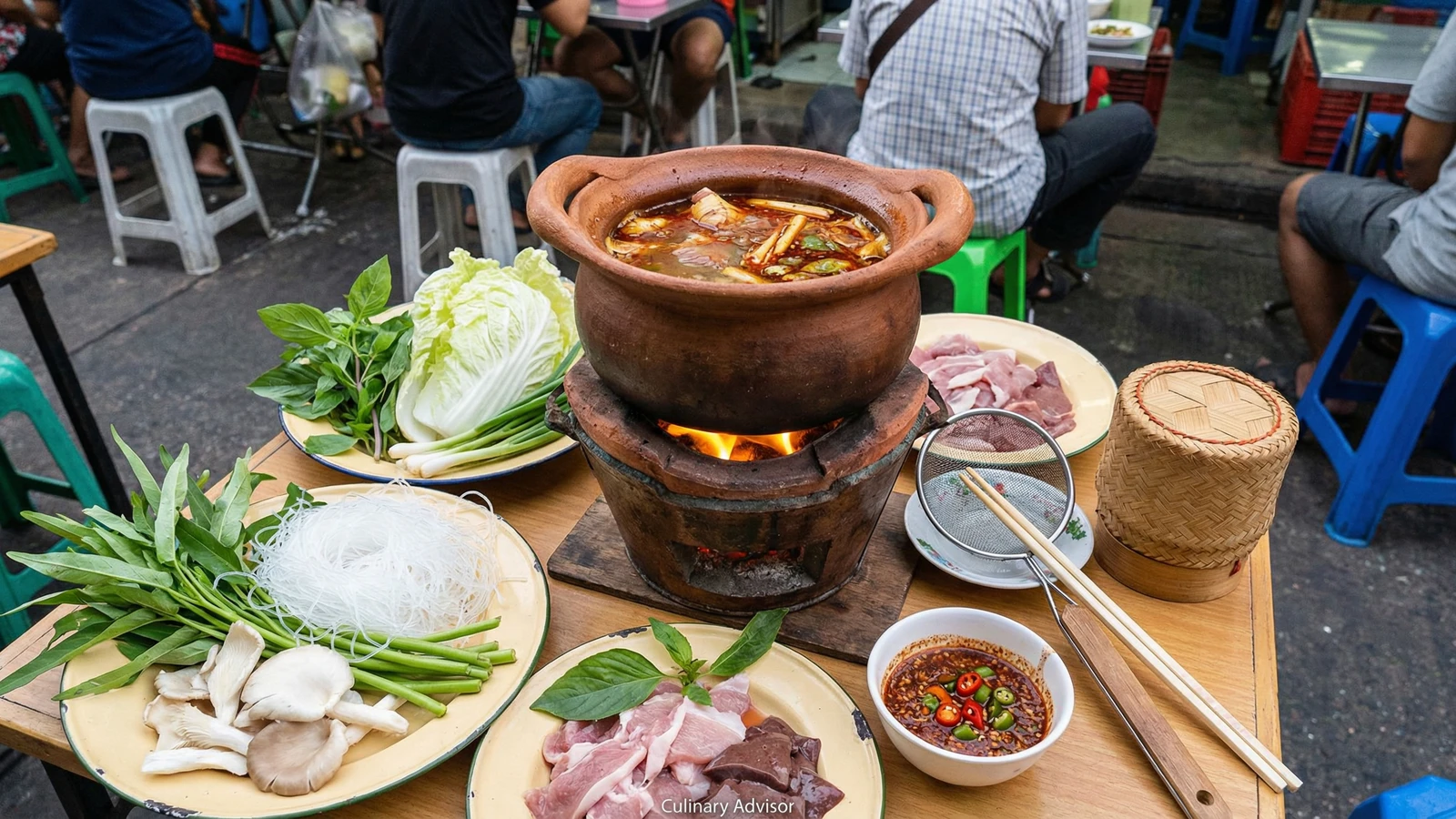
Jaew is the Isan kreung tam: pounded chili, garlic, padaek, and khao khua dissolved into herb broth. You cook together, you eat together, sticky rice in hand. This is how Isan feeds its people.
Soups & Stews
Thai
Dinner Party
Comfort Food
45 min
Active Time
30 min cook•1 hr 15 min total
Yield4-6 servings
Jaew hon breaks every rule you think you know about Thai hot pot. No coconut cream. No tom yum aromatics doing the heavy lifting. No sweet-sour balancing act from Central Thai cuisine. This is Isan. The rules are different here.
The governing principle is the same one Ajarn drilled into me from day one: the paste is the foundation. In Isan, that paste is jaew. Pounded dried chilies, garlic, shallots, and the ingredient that separates Isan from everywhere else: padaek (ปลาแดก), the fermented fish that is the salt and umami backbone of the entire northeastern Thai kitchen. Padaek is not fish sauce. Don't let anyone tell you it is. Fish sauce is refined, filtered, relatively polite. Padaek is raw, funky, unapologetically fermented. It delivers a depth that nam pla alone cannot touch. That funk is the soul of this dish.
Jaew hon means "hot jaew." You pound the paste, dissolve it into a simmering broth of lemongrass, galangal, and kaffir lime leaves, and then you cook at the table. Raw pork, liver, morning glory, mushrooms, napa cabbage, glass noodles: everything goes into the bubbling pot. You fish it out with chopsticks, dip it in more jaew on the side if you want, and eat it with sticky rice. That's it. No ceremony. No courses. Just a clay pot, a circle of people, and the simple act of feeding each other.
My mother's family in Isan would set up jaew hon on cool-season evenings when the plateau finally dropped below thirty degrees. A charcoal stove on the ground, a dented aluminum pot, and whatever the market had that morning. The broth got better as the night went on, richer with every round of meat and vegetables. Nobody rushed. Nobody left the table. That's the design. Jaew hon is food that makes you stay.
Jaew hon (แจ่วฮ้อน) originates from Thailand's Isan (northeastern) region and shares deep roots with Lao hot pot traditions across the Mekong. The word "jaew" (แจ่ว) refers to the family of pounded chili-based dipping sauces central to Isan and Lao cooking, functioning as the regional equivalent of the Central Thai kreung tam paste system. The "hon" (ฮ้อน) means "hot" in the Isan-Lao dialect, distinguishing this from room-temperature jaew dips. The dish likely evolved from the practical Isan tradition of communal one-pot cooking over charcoal, where the jaew paste doubles as both seasoning base and cooking medium, an efficient system born from a region where resources were historically scarce and shared meals were survival, not sentiment.
The technique, the tradition, and the story behind every dish.
soaked in room-temperature water 10 minutes, drained
lemon basil (maenglak)
Quantity
1 bunch
leaves picked
spring onions (ton hom)
Quantity
1 bunch
cut into 2-inch lengths
eggs (optional)
Quantity
4
sticky rice (khao niew)
Quantity
for serving
Ingredient
Quantity
dried red chilies (prik haeng)soaked in warm water 15 minutes, drained
7
garlic
5 cloves
shallots (hom daeng)
4
padaek (fermented fish sauce)strained of solids
3 tablespoons
khao khua (toasted rice powder)
2 tablespoons
lime juice (nam manao)
2 tablespoons
water or pork bone broth
6 cups
lemongrass (takhrai)cut into 3-inch pieces, bruised
3 stalks
galangal (kha)1/4 inch thick
5 slices
kaffir lime leaves (bai makrut)torn
5
fish sauce (nam pla)
1 tablespoon
palm sugar (nam tan pip)
1 teaspoon
pork loin or pork shouldersliced very thin against the grain
300g
pork liversliced very thin
150g
morning glory (pak bung)cut into 4-inch lengths
200g
napa cabbageleaves separated, torn into large pieces
200g
oyster mushroomstorn into strips
150g
glass noodles (wun sen)soaked in room-temperature water 10 minutes, drained
100g
lemon basil (maenglak)leaves picked
1 bunch
spring onions (ton hom)cut into 2-inch lengths
1 bunch
eggs (optional)
4
sticky rice (khao niew)
for serving
Equipment Needed
•Heavy granite mortar and pestle (krok hin) for pounding the jaew paste
•Thai-style hot pot or clay pot (mor din) for table-side cooking
•Portable gas burner or charcoal stove (tao than) for keeping the broth simmering at the table
•Small mesh strainer or slotted spoon for fishing ingredients from the broth
Instructions
1
Pound the jaew paste
In a granite mortar (krok hin), pound the drained dried chilies first. Break them down to rough flakes, not powder. Add the garlic and shallots and pound to a coarse, chunky paste. You want texture here: visible bits of shallot, chunks of garlic, ragged chili. This isn't a smooth Central Thai curry paste. Isan pastes are rougher, more immediate. You should smell the funk of the chilies and the sharp bite of raw garlic. That's your jaew foundation.
Some Isan cooks dry-roast the chilies, garlic, and shallots over charcoal before pounding. This adds a smoky layer that's traditional in many jaew preparations. If you have charcoal or a gas flame, char them until blistered and blackened in spots. The smokiness changes the entire dish.
2
Season the paste
Add the padaek to the mortar and pound it into the paste. The smell will hit you. That's correct. Padaek is fermented fish in its most unfiltered form, and it's the backbone of Isan cooking. Stir in the lime juice and khao khua (toasted rice powder). The khao khua gives body and that smoky, nutty character that defines Isan food. Taste the paste. It should be salty, funky, sour, with a slow chili burn. Set half the paste aside for dipping. The other half goes into the broth.
Do not substitute padaek with fish sauce alone. Fish sauce gives you salinity. Padaek gives you salinity plus a deep, murky, fermented complexity that is the entire point of Isan cooking. If you can't find padaek, use 2 tablespoons fish sauce plus 1 tablespoon of the thickest, darkest fish sauce you can find, but know that you're approximating.
3
Make the toasted rice powder
If making khao khua from scratch: take 3 tablespoons of raw sticky rice and dry-toast it in a pan over medium heat. No oil. Shake the pan constantly. The rice will go from white to golden to deep brown in about 5 minutes. You want a dark tan color, like wet sand. The kitchen will smell nutty and toasted. Let it cool completely, then pound in the mortar to a coarse powder. Not dust. Coarse. You want grit and texture.
Khao khua is the signature of the Isan table. It shows up in larb, in nam tok, in jaew, in soups. Make a big batch and keep it in a jar. It stays good for weeks at room temperature. Once you have it on hand, you'll put it in everything.
4
Build the herb broth
Bring the water or pork bone broth to a boil in your hot pot vessel or a large pot. Add the lemongrass, galangal, and torn kaffir lime leaves. Let it simmer for 10 minutes. The broth should smell herbal and clean, a stripped-down aromatic base that's there to support the jaew, not compete with it. Season lightly with the fish sauce and palm sugar. The sweetness should be barely perceptible. This is Isan. Sweet takes a back seat.
5
Dissolve the jaew
Take half of your jaew paste and stir it directly into the simmering broth. Watch the broth change. It goes from clear and herbal to murky, reddish-brown, alive with chili oil and padaek funk. Stir well. Taste. The broth should be salty, slightly sour, with a low chili heat that builds. Adjust with more padaek for depth, more lime for brightness. This broth is your cooking medium and your sauce. It needs to be bold enough to season everything that goes into it.
The broth will concentrate as the evening goes on. Water evaporates, flavors intensify. Keep a kettle of hot water nearby to top up the pot when the level drops. Don't let it reduce to a sludge. Keep it brothy.
6
Prepare the dipping platter
Arrange the raw pork slices and liver on one plate. Keep them thin, almost translucent. Thin meat cooks in seconds in a hot broth, which is the point: you're cooking at the table, not waiting around. Arrange the morning glory, napa cabbage, mushrooms, spring onions, and soaked glass noodles on a separate platter. Pick the lemon basil leaves and keep them in a small bowl. The basil goes in at the very last second, dropped into individual bowls or the pot right before eating. Heat wilts it. Don't cook it.
Pork liver must be fresh and sliced razor-thin. Soak the slices in cold water for 10 minutes to draw out excess blood, then drain and pat dry. Liver overcooked turns chalky and bitter. In the hot pot, it needs 15 to 20 seconds. That's it. Pull it out pink in the center.
7
Set the table and cook
Transfer the pot of jaew broth to your portable burner or charcoal stove at the center of the table. Keep it at a steady simmer, bubbles breaking the surface. Set out the platters of raw meat, vegetables, glass noodles, and the bowl of lemon basil. Put the reserved jaew paste in a small dipping bowl alongside. Sticky rice in kratip baskets, one for every two people. Now cook. Drop pork slices into the broth, swirl them for 20 to 30 seconds until just cooked through. Fish them out. Dip in the extra jaew if you want more heat. Tear off sticky rice, pinch some meat on top. That's a bite. Add vegetables in batches: morning glory and cabbage take about a minute, mushrooms slightly longer. Glass noodles go in last and only for 30 seconds or they turn to mush.
Crack eggs into the broth toward the end of the meal when it's at its richest. Let the whites set but keep the yolks soft. The egg picks up every layer of flavor the broth has built over the evening. It's the best bite of the night.
8
Finish with basil and serve
As each round of meat and vegetables comes out of the pot, scatter lemon basil (maenglak) leaves on top. The residual heat is enough to release the basil's fragrance without cooking it dead. The lemon basil adds a citrusy, peppery note that cuts through the richness of the padaek broth. Eat everything with sticky rice. Only sticky rice. Khao niew is the only starch that belongs at an Isan table. It's a utensil, a vehicle, and a flavor partner all at once. Never jasmine rice. Never.
Chef Tips
•Padaek is the hill I'll die on with this dish. It's the governing ingredient of Isan cuisine the way fish sauce governs Central Thai cooking. Padaek is coarser, funkier, less refined, and that's the point. It delivers a fermented depth that makes the broth taste like the earth it came from. If you use nam pla alone, you'll get a clean, salty broth. If you use padaek, you'll get Isan. Look for padaek at Southeast Asian grocery stores, usually in plastic bottles with murky brown liquid and visible fish pieces. Strain the solids before adding to the paste.
•The jaew paste gets split in half: one half dissolved into the broth, one half served as a side dip. The dipping jaew lets each person control their heat and funk level. Some people want every bite punched with extra chili. Some want the broth to do the work. Both are correct. The Isan table is built around personal adjustment.
•Jaew hon is a cool-season dish in Isan. The northeastern plateau drops to 15 to 20 degrees Celsius in December and January, which is genuinely cold for Thailand. The hot pot makes sense in that context: warmth, communal gathering, slow eating. If you're making this in a hot climate, crank the air conditioning and commit to the experience. The gathering around the pot is half the dish.
•The broth gets better as the meal goes on. Each round of pork, liver, and vegetables leaves flavor behind. By the end of the night, that broth is concentrated, rich, and deeply layered. The final eggs cooked in this evolved broth are the reward for patience. Don't rush the meal. Jaew hon is designed to last.
Advance Preparation
•The jaew paste can be pounded up to a day ahead and refrigerated. The flavors actually meld and improve overnight. Bring to room temperature before dissolving into the broth.
•Khao khua (toasted rice powder) keeps for weeks in an airtight jar at room temperature. Make a large batch.
•Sticky rice must be soaked for at least 4 hours, preferably overnight, before steaming. This is non-negotiable. Unsoaked sticky rice doesn't steam properly.
•Slice the pork and liver no more than an hour before serving. Keep them covered and refrigerated until you set the table. Liver oxidizes quickly and will turn grey if left exposed.
Frequently Asked Questions
Nutrition Information
1 serving (about 600g)
Calories
465 calories
Total Fat
9 g
Saturated Fat
3 g
Trans Fat
0 g
Unsaturated Fat
6 g
Cholesterol
275 mg
Sodium
1330 mg
Total Carbohydrates
54 g
Dietary Fiber
3 g
Sugars
4 g
Protein
38 g
Where cooking meets culture.
Culinary guides, cultural storytelling, and the editorial depth that makes cooking meaningful.