
Chef Jeong-sun
Aehobak-guk (애호박국, Korean Zucchini Soup)
A clean summer soup of Korean zucchini and salted shrimp, built on quick anchovy-kelp broth and finished before the half-moons lose their shape on a weeknight table.
A cooking platform built around craft, culture, and the stories behind what we eat.

Created by
Tiny marsh clams give this southern Korean soup its pale, clean broth; salt and a last fistful of chives are enough when the clams have been purged and boiled correctly.
Jaecheop arrives in the southern markets small enough to look like trouble, especially along the Seomjin and Nakdong when the water warms and the baskets are full. In Hadong I watched women tip them into enamel basins, all clatter and patience, because this soup begins before the fire. If the clams keep their river sand, the whole pot is lost.
This is not a soup to decorate. No gochujang, no anchovy broth, no spoonful of soup soy sauce to make you feel busy. The clams give a pale broth on their own, and your work is to keep it clean: purge, rinse, bring them up slowly from cold water, strain the broth, then season with salt measured in teaspoons instead of pride. The chives go in at the end so they bend but do not cook dull.
People know jaecheop-guk as haejang-guk (hangover soup), and it is good for that morning, but don't make it only when someone has behaved badly the night before. With rice and sharp kimchi, it is a quick weeknight bowl from the southern table, plain enough to punish carelessness and kind enough to reward patience. Cook the month you're standing in. If your market has no live, clean-smelling clams, make another guk tonight and wait.
Notebook 41 says the same sentence twice: salt after straining, chives last. My teacher would not let me forget it. A fistful of buchu (Korean garlic chives) is 60 grams in this pot, and now you do not have to guess.
Jaecheop-guk belongs most strongly to Korea's southern river mouths, especially the Seomjin River around Hadong and Gwangyang and the Nakdong River estuary near Busan, where tiny Corbicula clams live in sandy brackish beds. In the 1960s and 1970s, Busan's dawn vendors carried pots through neighborhoods as breakfast and haejang-guk (hangover soup), calling 재첩국 사이소, buy jaecheop soup, before work. Development and water changes reduced Nakdong catches in the late twentieth century, so Seomjin River jaecheop now carries much of the dish's regional identity.
Quantity
1 kg
sorted and rinsed
Quantity
2 liters
Quantity
1 tablespoon (18g)
Quantity
7 cups (1.65 liters)
Quantity
1 teaspoon, plus up to 1/4 teaspoon more if needed
Quantity
60g
trimmed and cut into 2-inch lengths
Quantity
to serve
Quantity
to serve
| Ingredient | Quantity |
|---|---|
| live jaecheop (marsh clams)sorted and rinsed | 1 kg |
| cold water, for purging | 2 liters |
| coarse sea salt, for purging | 1 tablespoon (18g) |
| cold water, for the soup | 7 cups (1.65 liters) |
| fine sea salt | 1 teaspoon, plus up to 1/4 teaspoon more if needed |
| buchu (Korean garlic chives)trimmed and cut into 2-inch lengths | 60g |
| cooked white rice (optional) | to serve |
| baechu-kimchi or kkakdugi (optional) | to serve |
Pick through the clams and discard any with cracked shells, and any open clam that does not close when tapped. Dissolve the coarse sea salt in 2 liters cold water in a large bowl, then add the clams. The water should cover them by about 2 cm. Cover the bowl and keep it in a cool, dark place for 2 hours so the clams spit out sand. This is the step people shorten, and then they blame the river for their own impatience.
Lift the clams out of the bowl with your hands or a sieve, leaving the grit behind. Do not pour the purge water over them. Rinse under cold running water, rubbing the shells between your palms until the water runs clear and the shells feel clean. Trim the buchu now and cut it into 2-inch lengths, because the end of this soup moves quickly.
Put the rinsed clams and 7 cups cold water in a 4-quart pot. Set it over medium heat and bring it slowly to a gentle boil, 8 to 10 minutes. Starting from cold water draws flavor from the tiny clams before their meat tightens. High heat opens the shells fast, but it gives you a thinner broth.
As the shells open, skim off the gray froth that gathers on top. Once most of the clams have opened, boil only 2 minutes more, then turn off the heat. Scoop the clams out with a slotted spoon. Discard any clams that remain closed. Overboiling makes the meat tough and clouds the clean broth you worked for.
Line a fine-mesh strainer with damp cotton cloth or a coffee filter and strain the broth into a clean pot, leaving the last spoonful of grit behind if you see any. When the clams are cool enough to handle, pick the meat from the shells. This is small work. Do it anyway. One gritty shell at the table ruins more than the cook's mood.
Return the strained broth and picked clam meat to the pot and warm it over medium heat. Add 1 teaspoon fine sea salt, stir, and taste. Add up to 1/4 teaspoon more only if the broth tastes thin or unfinished. Do not add soup soy sauce here; it darkens the soup and covers the clams. The broth should taste clean, lightly mineral, and gently salty, not like seawater.
Turn off the heat and scatter in the 60g buchu. Fold once, just until the chives turn bright green and bend. Ladle into bowls at once and serve with cooked white rice and kimchi. The soup is pale on purpose. Let it taste like itself.
1 serving (about 625g)
Culinary guides, cultural storytelling, and the editorial depth that makes cooking meaningful.
Discover Culinary ExplorerChef Jeong-sun
A clean summer soup of Korean zucchini and salted shrimp, built on quick anchovy-kelp broth and finished before the half-moons lose their shape on a weeknight table.
Chef Jeong-sun
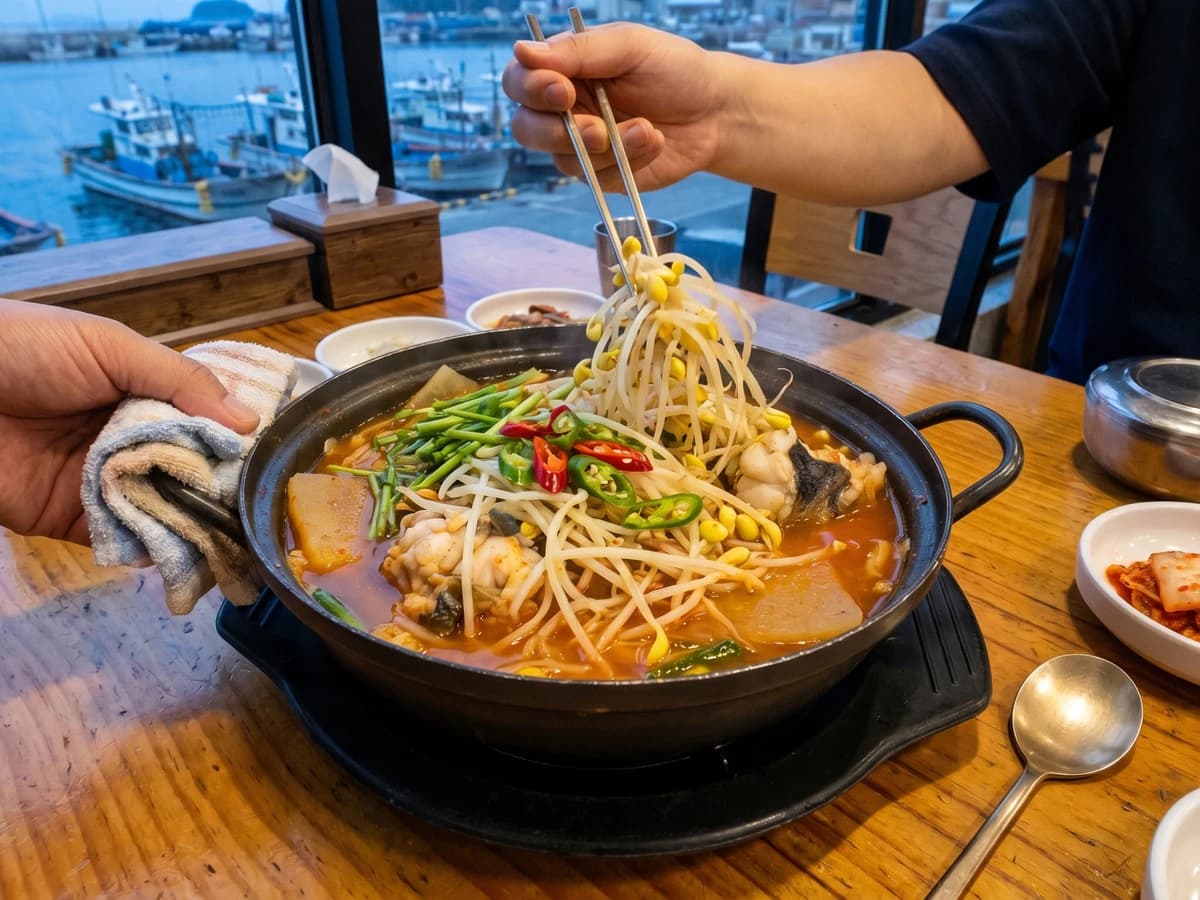
A Masan coast monkfish stew with firm white meat, gelatin at the bones, soybean sprouts for crunch, and a red broth seasoned to carry the fish, not bury it.

Chef Jeong-sun
A weeknight fish roe stew with radish and crown daisy in a clean spicy broth, where the whole success depends on adding the roe late enough that it sets tender, not chalky.

Chef Jeong-sun
Late-summer mallow leaves rubbed with salt until the bitter green water runs off, then simmered in a clean doenjang broth with dried shrimp, the quiet soup a Korean weeknight deserves.