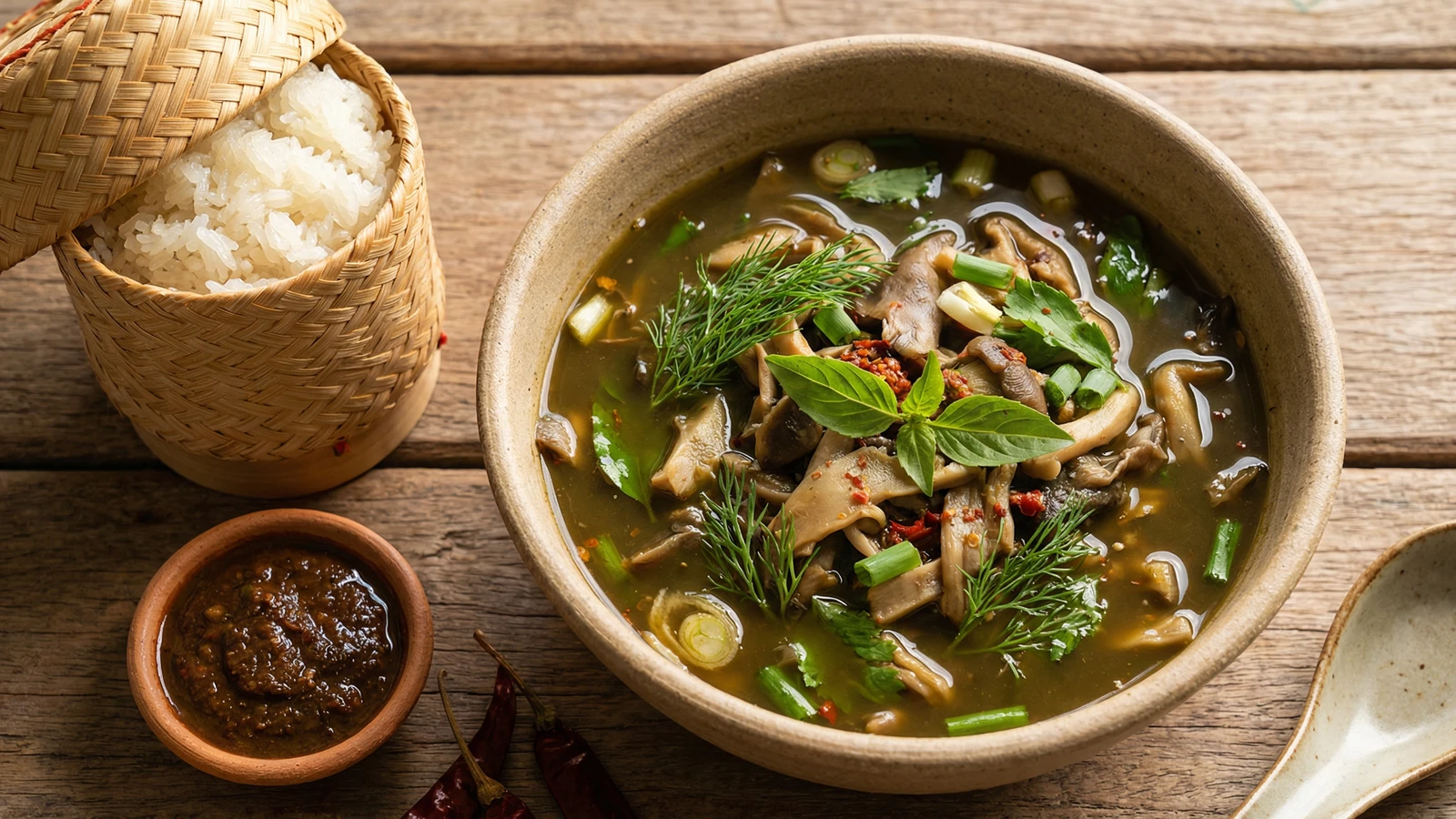
Isan throws out the Central Thai playbook: no coconut cream, no sweet-sour balance. Padaek for depth, yanang leaf for earth, wild mushrooms for the forest. Water-based, herb-driven, and governed by a system older than Bangkok.
Soups & Stews
Thai
Weeknight
Budget Friendly
25 min
Active Time
20 min cook•45 min total
Yield4 servings
Forget everything you know about Thai soup. Gaeng het doesn't care about your tom yam, your tom kha, your coconut-cream curries. This is Isan. Different land, different water, different rules.
Ajarn always said the four pillars govern Thai cuisine: fish sauce for salt, palm sugar for sweet, tropical fruits for sour, and the kreung tam as the foundation. He's right. But Isan takes those pillars and rebuilds them from the ground up. Padaek (ปลาแดก), the chunky, funky, unfiltered fermented fish of the northeast, replaces fish sauce. It's not a substitution. It's a completely different ingredient. Fish sauce is refined, clean, salty. Padaek is raw, deep, alive with funk. It gives gaeng het a backbone that fish sauce can't touch. Don't even think about swapping it out.
The kreung tam is still here. Pound dried chilies, shallots, garlic, lemongrass, and galangal in the krok. That paste goes into the broth. The principle holds: you cannot cook Thai food without making a paste. But the broth itself is water. Not coconut milk. Not stock. Water infused with bai yanang (ใบย่านาง), the dark green leaf extract that gives every Isan forest soup its distinctive mineral earthiness and murky color. Yanang leaf is structural. Without it, you have mushroom water. With it, you have gaeng het.
I learned this dish not from Ajarn but from my mother's people in Isan. My aunt would come back from the fields with a plastic bag of wild mushrooms, whatever she found that morning: hed khon, hed fang, hed nang fa. She'd pound the paste, squeeze the yanang leaves, and have soup on the table in thirty minutes. No recipe. No measurements. Just the principles, the same ones she learned from her mother, passed hand to hand like sticky rice at the table. That's the knowledge I refuse to let die.
Gaeng het belongs to the foraging tradition of Isan (northeastern Thailand), where cooks have gathered wild mushrooms from rice paddies, forests, and termite mounds during the rainy season for centuries. The dish predates any written recipe, relying on oral transmission and seasonal availability. Yanang leaf (Tiliacora triandra) extract, the signature base of Isan forest soups, is an ancient technique shared with Lao cuisine; the leaves are kneaded with water to release a dark green, slightly bitter liquid rich in minerals and chlorophyll that serves as the broth foundation for gaeng het, gaeng nor mai (bamboo shoot soup), and gaeng khae.
The technique, the tradition, and the story behind every dish.
padaek (fermented fish)liquid strained through a fine sieve
3 tablespoons
fish sauce (nam pla)for adjusting
1 tablespoon
dried red chilies (prik haeng)soaked 10 minutes, drained
5
shallots (hom daeng)peeled
5
garlic
4 cloves
lemongrass (takhrai)bottom 3 inches, sliced thin
2 stalks
galangal (kha)sliced
1-inch piece
kaffir lime leaves (bai makrut)torn
3
spring onions (ton hom)cut into 1-inch pieces
3
lemon basil (bai maenglak)
1 large handful
dill (pak chi lao)
1 large handful
sawtooth coriander (pak chi farang)roughly chopped
1 large handful
salt
1 teaspoon
Equipment Needed
•Heavy granite mortar and pestle (krok hin) for pounding the kreung tam
•Medium stockpot or clay pot
•Fine mesh sieve for straining padaek and yanang extract
•Kratip (sticky rice basket) for serving
Instructions
1
Extract the yanang leaf
If using dried yanang leaves, place them in a bowl with 2 cups of water. Knead and squeeze the leaves with your hands, working them hard for 3 to 4 minutes. The water will turn dark green, almost black-green, like swamp water. That's correct. Strain through a fine sieve, pressing out every drop. Discard the leaves. If using prepared yanang extract, mix it with 2 cups of water. This liquid is your broth foundation. It's what makes this Isan and not something else.
Dried yanang leaves are available at Southeast Asian markets and online. Fresh leaves give a brighter, more vegetal result, but dried works. Frozen yanang extract in bags is the easiest option if you can find it. There is no substitute. Without bai yanang, this is not gaeng het.
2
Pound the kreung tam
In a heavy granite mortar (krok hin), pound the soaked dried chilies with a pinch of salt until they break down into rough flakes. Add the garlic and shallots. Pound to a rough, chunky paste. Then the lemongrass and galangal. Keep pounding until everything is integrated but still textured. You want pieces, not baby food. The aroma should be sharp, spicy, and deeply fragrant. If it doesn't hit you in the face, keep pounding.
Ajarn always said: the kreung tam tells you when it's ready. When the aroma fills the room, you're there. For this paste, rough is right. Isan pastes are less refined than Central Thai curry pastes. That's not laziness. That's the tradition.
3
Build the broth
Bring 3 cups of water to a boil in a pot. Add the kreung tam and stir it in. The water will turn cloudy and fragrant within seconds. Add the torn kaffir lime leaves. Let this simmer for 3 minutes so the paste releases its oils into the broth. Then pour in the yanang leaf extract. The broth will darken to a deep green-brown. That color is gaeng het. Stir in the strained padaek liquid. Smell it. The funk is supposed to be there. That's the backbone.
4
Cook the mushrooms
Add all the mushrooms to the broth. If you're using a mix of varieties, put the firmer ones in first (straw, king oyster) and the delicate ones (oyster, enoki) a minute later. Simmer for 5 to 7 minutes. The mushrooms should be tender but still have structure. They'll absorb the padaek and yanang, becoming little sponges of forest flavor. Taste the broth now. It should be salty from the padaek, earthy from the yanang, spicy from the chilies. If it needs more salt, add fish sauce a teaspoon at a time. The fish sauce is a supporting player here. Padaek is the lead.
Wild mushrooms from Isan include hed khon (termite mushrooms), hed fang (straw mushrooms from rice paddies), and hed nang fa. Use whatever mix you can source. Oyster and straw mushrooms are the most accessible outside Thailand. The variety matters less than the freshness.
5
Finish with herbs
Kill the heat. This is critical. The herbs go in off the flame. Add the spring onions, sawtooth coriander, dill (pak chi lao), and lemon basil (bai maenglak) all at once. Stir them through the hot broth and put the lid on for one minute. That residual heat is enough to wilt them without cooking them dead. The dill and basil should be bright, fragrant, and still identifiable when you ladle the soup. If they've gone dark and limp, you left them too long or the heat was too high. Ladle into bowls. Serve with sticky rice. Not jasmine. Sticky. That's the only accompaniment this soup needs or wants.
Chef Tips
•Padaek and fish sauce are not the same thing. Fish sauce (nam pla) is filtered, clear, and refined. Padaek is unfiltered, chunky, and deeply funky, fermented whole fish with rice bran. For gaeng het, strain the padaek liquid through a sieve to catch the solids, but use that liquid. The funk is the point. Substituting fish sauce alone gives you a clean, polite soup. Gaeng het is not polite.
•Yanang leaf (bai yanang, ใบย่านาง) is the single ingredient that makes Isan forest soups what they are. It provides an earthy, mineral, slightly bitter base that coconut cream provides in Central Thai cuisine. There is no substitute. If you can't find yanang, make a different soup. Putting spinach juice in there and calling it gaeng het is an insult to every Isan cook who's been squeezing these leaves for generations.
•Dill (pak chi lao, ผักชีลาว) translates literally as 'Lao coriander,' and it's one of the signature herbs of Isan and Lao cooking. In gaeng het, it's structural, not decorative. The dill should be a full handful, enough that you taste it in every spoonful. Central Thai cooks almost never use dill. In Isan, it's everywhere.
•This is a rainy season dish. In Isan, wild mushrooms appear after the first rains, and cooks forage them from fields, forests, and termite mounds. If you're making this outside the season, cultivated oyster and straw mushrooms are your best option. The principle of foraging, using what the land provides when it provides it, is core to Isan cooking. Respect the season when you can.
•Serve with khao niew (sticky rice) only. Not jasmine, not brown rice, not cauliflower rice. Sticky rice is the utensil. You tear off a piece, press it into a ball, and use it to scoop the mushrooms and soak up the broth. The dish is designed around this interaction. Eating gaeng het with a spoon and jasmine rice is like eating pizza with a knife and fork on a bed of pasta. Technically possible. Completely wrong.
Advance Preparation
•The kreung tam can be pounded up to a day ahead and stored in the refrigerator. Bring to room temperature before adding to the broth.
•Yanang leaf extract can be prepared a few hours ahead and refrigerated. It darkens slightly but remains effective.
•Padaek should be strained before you start cooking. Keep the liquid ready.
•Do not add the fresh herbs (dill, lemon basil, sawtooth coriander) until the moment of serving. They lose their brightness within minutes. This soup goes from pot to table immediately.
Frequently Asked Questions
Nutrition Information
1 serving (about 350g)
Calories
80 calories
Total Fat
1 g
Saturated Fat
0 g
Trans Fat
0 g
Unsaturated Fat
0 g
Cholesterol
0 mg
Sodium
1750 mg
Total Carbohydrates
11 g
Dietary Fiber
3 g
Sugars
2 g
Protein
6 g
Where cooking meets culture.
Culinary guides, cultural storytelling, and the editorial depth that makes cooking meaningful.