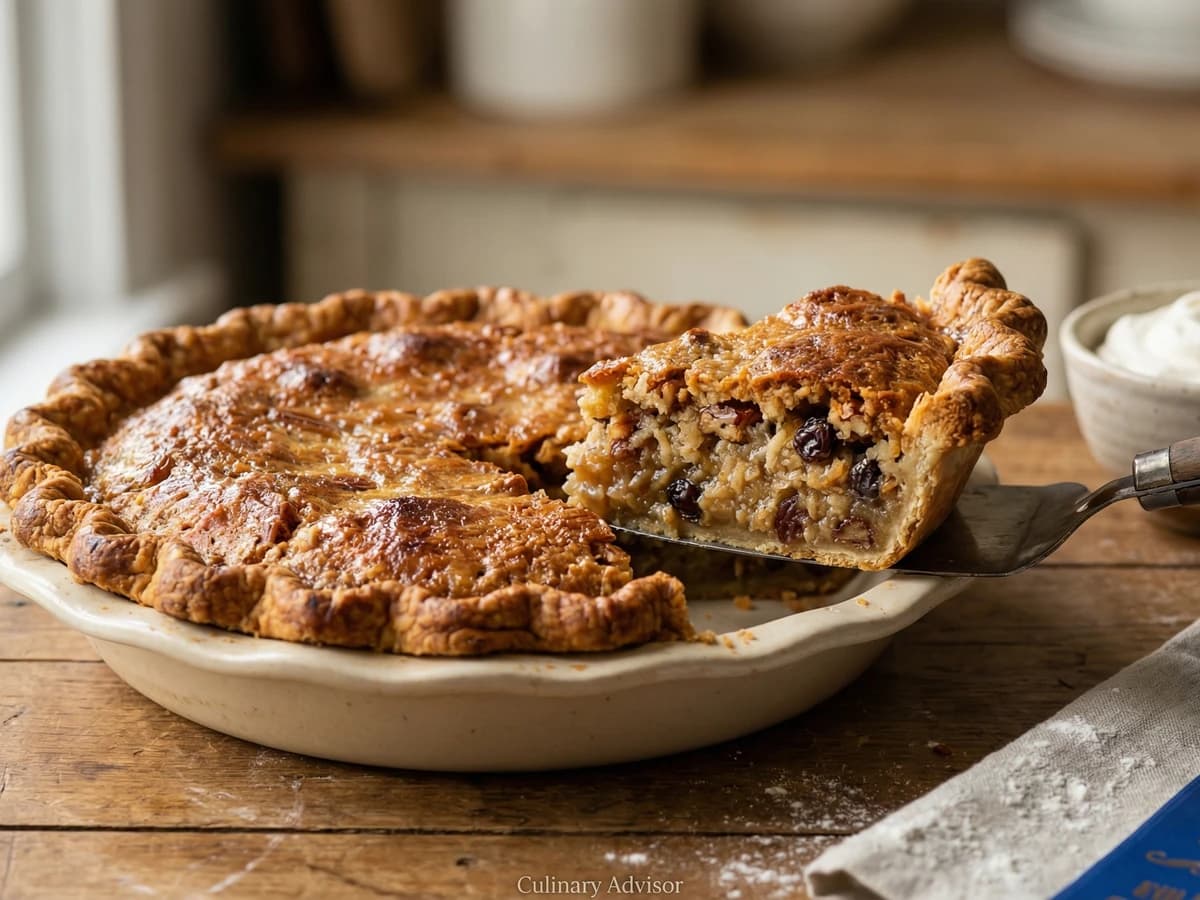
The humble funeral pie of the Iowa heartland: plump raisins suspended in spiced sour cream custard, crowned with golden-peaked meringue that shatters into sweetness with every forkful. This is the pie that built church suppers.
Pastries & Cookies
American
Comfort Food, Potluck, Make Ahead
45 min
Active Time
55 min cook•1 hr 40 min total
Yield8 servings
Every small town in Iowa has a church basement that smells of coffee urns and casseroles, and in that basement, on folding tables covered in paper cloths, you will find this pie. It appears at funerals and potlucks, at harvest celebrations and after-service luncheons. The old women who make it learned from their mothers, who learned from theirs, the recipe traveling across the Atlantic in the memories of German and Scandinavian immigrants who settled the prairie.
They called it funeral pie because the ingredients kept. Raisins in the pantry, eggs from the henhouse, cream gone sour in the icebox. When word came that a neighbor had passed, a farm wife could assemble this pie without a trip to town. It was food for grief, made quickly and offered with love.
The genius lives in the balance. Sour cream provides tang that cuts the sweetness of the raisins. Warm spices echo the cinnamon rolls those same immigrant grandmothers baked on Saturday mornings. The meringue is not decoration but architecture: it insulates the custard, creates textural contrast, and transforms a humble pie into something worth driving across the county to taste.
I have eaten this pie in diners from Des Moines to Dubuque, at county fairs where it competed for blue ribbons, at kitchen tables where it was served still warm with black coffee. The best versions share a common quality: restraint. Not too sweet. Spices present but not shouting. Raisins plump and tender, never leathery. Make it this way and you honor a tradition older than the state itself.
The technique, the tradition, and the story behind every dish.
Whisk together the flour, salt, and sugar in a large bowl. Add the cold lard and butter cubes. Using a pastry blender or your fingertips, work the fats into the flour until the mixture resembles coarse meal with some pea-sized pieces remaining. Those larger pieces will create flaky layers. Drizzle four tablespoons of ice water over the mixture and stir with a fork until the dough begins to clump. Add more water, one tablespoon at a time, until the dough holds together when pressed. Gather into a disk, wrap in plastic, and refrigerate for at least one hour.
Lard produces the flakiest crust and is historically authentic to Iowa farm kitchens. If you cannot find good lard, use all butter, but know you are trading some tenderness for flavor.
2
Plump the raisins
While the dough chills, place the raisins in a small saucepan with one cup of water. Bring to a simmer over medium heat, then remove from heat and let stand for thirty minutes. The raisins will absorb the water and swell to nearly twice their size. Drain any remaining liquid. Plump raisins are essential. Dry raisins make a disappointing pie.
3
Roll and blind-bake the crust
On a lightly floured surface, roll the chilled dough into a twelve-inch circle about an eighth-inch thick. Transfer to a nine-inch pie plate, pressing gently into the corners. Trim the edges to leave a one-inch overhang, then fold under and crimp decoratively. Prick the bottom with a fork, line with parchment, and fill with pie weights or dried beans. Bake at 400°F for fifteen minutes, then remove the weights and parchment. Continue baking until the bottom looks dry and set, another five to eight minutes. Remove and reduce oven temperature to 350°F.
The crust must be fully baked before filling. A soggy bottom ruins this pie. Look for a light golden color across the entire base.
4
Build the custard base
In a medium saucepan, whisk together the sugar, flour, cinnamon, nutmeg, cloves, and salt. This dry mixture prevents lumps. In a separate bowl, beat the egg yolks until pale, then whisk in the sour cream and vinegar until smooth. Add this mixture to the saucepan and stir to combine. The batter will be thick and pale, the color of old ivory.
5
Cook the filling
Set the saucepan over medium heat and cook, stirring constantly with a wooden spoon, until the mixture thickens and begins to bubble. You will feel the resistance change as the flour activates. Continue cooking for two minutes after the first bubbles appear, stirring in figure-eights to prevent scorching. The custard should coat the back of the spoon heavily. Remove from heat and fold in the drained raisins, distributing them evenly.
6
Fill the warm crust
Pour the hot filling into the pre-baked crust, spreading it evenly with a spatula. The raisins will want to sink, and that is fine. Some will suspend in the custard, others will settle near the bottom. This creates pleasant variation in every slice. The filling should mound slightly in the center.
7
Make the meringue
In a clean, dry bowl of a stand mixer (or using a hand mixer), beat the egg whites and cream of tartar on medium speed until foamy. Increase speed to high and add the sugar gradually, one tablespoon at a time, beating constantly. Continue beating until the meringue holds stiff, glossy peaks when you lift the beaters. This takes four to five minutes. The peaks should stand straight up without drooping. Underbeaten meringue weeps; overbeaten meringue becomes grainy.
Any trace of fat will prevent the whites from whipping properly. Wipe the bowl with a paper towel dampened with vinegar before you begin.
8
Top with meringue
Working quickly while the filling is still warm, spoon the meringue onto the center of the pie. Use the back of a spoon or a small offset spatula to spread it to the edges, making sure the meringue touches the crust all around. This seal prevents the meringue from shrinking. Create decorative swirls and peaks across the surface. The peaks will brown beautifully.
9
Brown the peaks
Bake the pie at 350°F for twelve to fifteen minutes, until the meringue peaks turn golden brown with darker tips. Watch carefully after ten minutes. Meringue moves from perfect to scorched quickly. The surface should be golden and set, the valleys between peaks still pale and soft.
10
Cool completely before serving
Remove the pie to a wire rack and cool at room temperature for at least two hours before slicing. The filling needs time to set. Cutting too soon yields a runny mess and disappointment. A properly cooled slice holds its shape, revealing the amber custard studded with dark raisins beneath that crown of meringue. Serve at room temperature or slightly chilled, with strong black coffee.
Chef Tips
•Seek out raisins from a store with good turnover. Stale raisins, those that have sat on a shelf for a year, will not plump properly no matter how long you soak them. The best come from bins at a busy natural foods store.
•Full-fat sour cream is essential. Low-fat versions contain stabilizers that affect the custard's texture, and the tang that defines this pie comes from the cream's natural acidity. Do not substitute.
•If your farmhouse lacks lard, ask a butcher who processes pigs. Good leaf lard, rendered from the fat around the kidneys, produces the flakiest pastry and has a clean, neutral flavor that butter cannot match.
•This pie is served at room temperature or slightly chilled, never warm. The filling sets as it cools, and cutting into a warm pie yields only disappointment and a puddle on your plate.
•A slice of this pie with vanilla ice cream is acceptable at county fairs but frowned upon at church suppers, where the meringue is considered adornment enough.
Advance Preparation
•The pie dough can be made up to three days ahead and refrigerated, or frozen for up to three months. Thaw overnight in the refrigerator before rolling.
•The fully baked and cooled pie keeps at room temperature for up to two days. Refrigerate after that, though the meringue may weep slightly. It remains delicious.
•The crust can be blind-baked earlier in the day. Cover loosely and keep at room temperature until you are ready to fill.
Frequently Asked Questions
Nutrition Information
1 serving (about 200g)
Calories
515 calories
Total Fat
36 g
Saturated Fat
18 g
Trans Fat
1 g
Unsaturated Fat
17 g
Cholesterol
163 mg
Sodium
503 mg
Total Carbohydrates
104 g
Dietary Fiber
3 g
Sugars
61 g
Protein
18 g
Where cooking meets culture.
Culinary guides, cultural storytelling, and the editorial depth that makes cooking meaningful.