
Chef Lupita
Almendrados Conventuales Poblanos
Puebla's convent almond cookies, made from blanched almonds, sugar syrup, egg yolks, canela, and patient hands, the kind of sweet that belongs beside coffee in talavera, not in a plastic bakery box.
A cooking platform built around craft, culture, and the stories behind what we eat.
Created by
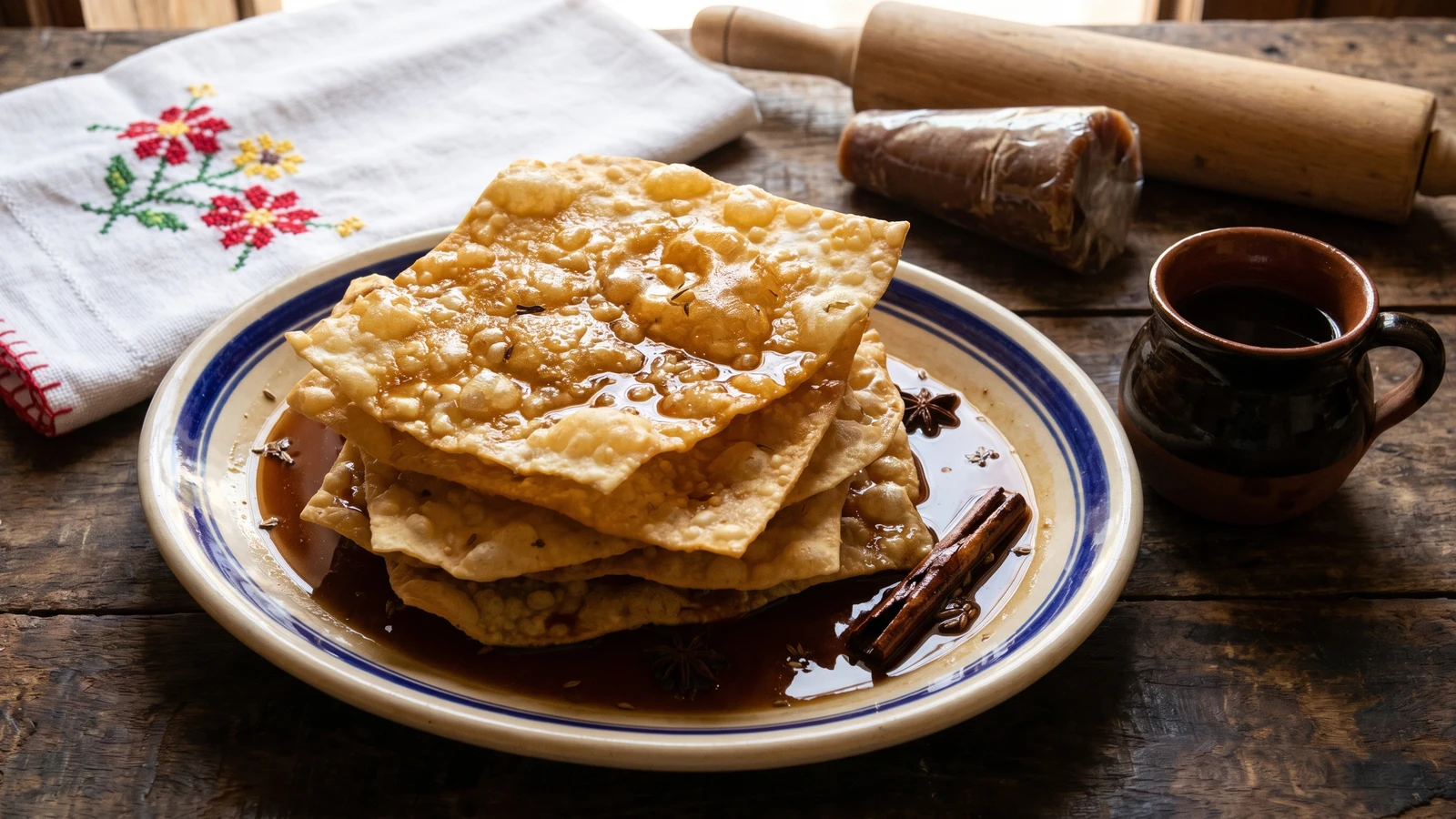
Yucatán's Christmas Eve and Hanal Pixán sweet. Paper-thin fried dough, brittle at the edges, drowned in dark piloncillo syrup steeped with anise, canela, and orange peel.
Hojuelas are from Yucatán. The peninsula has its own pastry tradition, separate from central Mexico, separate from the north, shaped by the Spanish, the Lebanese, and the Maya, and the hojuela sits at the center of that inheritance. You find them on Christmas Eve, on the altars for Hanal Pixán in late October and early November, and at any Yucatecan family gathering where someone's tía decided to spend the afternoon at the rolling pin.
The hojuela is two things at once. Brittle, almost cracker-like fried dough rolled until you can read a newspaper through it. And dark piloncillo syrup steeped with whole anise seed, canela, orange peel, and a clove, poured over the hojuelas while they are still warm so they drink the miel and turn pliant at the edges while staying crackling at the center. That contrast is the dish. A hojuela without enough syrup is a sad cracker. A hojuela drowned in syrup made with brown sugar instead of piloncillo is a missed opportunity.
I collected this recipe in Mérida from a señora named Doña Elvia who has been making hojuelas for her family every December 24th for forty-one years. She rolls them on a marble slab with a heavy wooden pin, one at a time, and she does it by feel. When I asked her how thin they should be she said, hold one up to the window. If you can't see the light through it, keep rolling. That is the standard.
My mother's notebook does not have hojuelas. They are not a Jalisco dish. But she had a page of Yucatecan recipes copied from a friend, written in her careful pencil, with one note in the margin next to a hojuela recipe: roll them thinner than you think. She was right. Saber cocinar es saber vivir.
Hojuelas descend from the Andalusian fried pastry tradition that the Spanish brought to the Yucatán peninsula in the 16th century, related to the hojaldres and the Sephardic-Andalusian fritters that traveled across the Atlantic with conquest-era settlers. The Yucatecan version diverged from central Mexican buñuelos through the addition of anise, a spice brought to the peninsula in significant quantities through the trade routes that connected Mérida to Cuba and Veracruz in the colonial period. The pairing of hojuelas with Hanal Pixán, the Maya day of the dead observance distinct from central Mexico's Día de Muertos, reflects the syncretic absorption of a Spanish pastry into an indigenous ceremonial calendar, and the dish appears on Yucatecan altars alongside mucbipollo and atole nuevo as one of the recognized offerings to returning souls.
Quantity
3 cups, plus more for rolling
Quantity
1/4 cup
Quantity
1 teaspoon
Quantity
1/2 teaspoon
Quantity
1 teaspoon
lightly crushed
Quantity
3 tablespoons
at room temperature
Quantity
2
Quantity
1/3 cup
Quantity
2 tablespoons
Quantity
1 teaspoon
finely grated
Quantity
about 4 cups
Quantity
1 pound (about 2 cones)
chopped
Quantity
3 cups
Quantity
1 stick
broken in half
Quantity
2 tablespoons
Quantity
1 strip, about 3 inches long
Quantity
1
| Ingredient | Quantity |
|---|---|
| all-purpose flour | 3 cups, plus more for rolling |
| granulated sugar | 1/4 cup |
| fine sea salt | 1 teaspoon |
| baking powder | 1/2 teaspoon |
| whole anise seedlightly crushed | 1 teaspoon |
| manteca de cerdo (pork lard)at room temperature | 3 tablespoons |
| large eggs | 2 |
| fresh orange juice | 1/3 cup |
| aguardiente de caña or white tequila | 2 tablespoons |
| orange zestfinely grated | 1 teaspoon |
| manteca de cerdo or neutral oil for frying | about 4 cups |
| piloncillochopped | 1 pound (about 2 cones) |
| water | 3 cups |
| Mexican canela (true cinnamon)broken in half | 1 stick |
| whole anise seed (for syrup) | 2 tablespoons |
| orange peel | 1 strip, about 3 inches long |
| whole clove | 1 |
Place the chopped piloncillo, water, canela, the two tablespoons of whole anise seed, the orange peel, and the clove in a heavy saucepan. Set over medium heat and stir until the piloncillo dissolves. Once it dissolves, stop stirring. Let the syrup come to a gentle simmer and cook for 20 to 25 minutes, until it darkens to the color of strong tea and coats the back of a spoon. The anise has to steep in the hot syrup. That is where the perfume comes from. Strain into a heatproof bowl and set aside. The syrup should be warm but not hot when you dress the hojuelas, so make it first.
In a wide bowl, whisk together the flour, granulated sugar, salt, baking powder, and the crushed anise seed. Add the room-temperature lard and rub it into the flour with your fingertips until the mixture looks like coarse sand. In a separate bowl, beat the eggs with the orange juice, the aguardiente, and the orange zest. Pour the wet into the dry and bring it together with your hand until you have a shaggy mass.
Turn the dough onto a clean counter and knead for eight to ten minutes. It will feel stiff at first. Keep working. You want a dough that is smooth, elastic, and dry to the touch, the kind of dough that pulls back when you stretch it. This is not a tender pastry dough. It needs gluten so the hojuelas roll out paper-thin without tearing. Wrap in a clean cloth and rest for 30 minutes at room temperature. The rest is not optional. Without it the dough fights you on the roller.
Divide the rested dough into 24 small balls, each about the size of a walnut. Cover with a cloth so they do not dry out. Lightly flour your counter and your rolling pin. Take one ball, flatten it with your palm, then roll it out in every direction until it is the thickness of a sheet of paper. You should almost see the grain of the counter through it. If it tears, the dough is too dry or it has not rested enough. Stack the rolled hojuelas on a floured cloth with a piece of parchment between each, so they do not stick. La cocina no es decoración, es trabajo. The thinness is the whole point.
Pour the frying lard or oil into a wide heavy pot to a depth of about an inch and a half. Heat to 350°F over medium heat. If you do not have a thermometer, drop a small scrap of dough in. It should rise to the surface within three seconds and bubble vigorously without browning instantly. Lard is the Yucatecan choice and gives the cleanest, most savory result. Neutral oil works if you cannot get good lard, but la manteca es el sabor.
Slide one hojuela into the hot fat. It will balloon and ripple within seconds. Press it gently under with the back of a slotted spoon so the top side cooks too, about 20 seconds. Flip it and fry the other side for another 15 to 20 seconds. You want pale gold with deeper amber blisters across the surface, never dark brown. Lift out with a spider and drain on a wire rack set over a sheet pan. Work quickly. These cook in under a minute each.
While the hojuelas are still warm from the fryer, dip each one into the warm miel de anís or ladle the syrup generously over a platter of stacked hojuelas. They should be soaked, not glazed. The hojuela holds the syrup like a sponge and that contrast between the brittle fried dough and the dark anise-perfumed syrup is the whole reason this dish exists. Serve on a Yucatecan slipware platter, family-style, with the syrup pooling around the edges. Así se hace y punto.
1 serving (about 170g)
Culinary guides, cultural storytelling, and the editorial depth that makes cooking meaningful.
Discover Culinary ExplorerChef Lupita
Puebla's convent almond cookies, made from blanched almonds, sugar syrup, egg yolks, canela, and patient hands, the kind of sweet that belongs beside coffee in talavera, not in a plastic bakery box.

Chef Lupita
Ciudad de Mexico's panaderia banderillas are long sticks of hojaldre pressed with sugar, baked until amber, and finished with a hard glaze for coffee at the kitchen table.

Chef Lupita
Mérida's pale egg-yolk-and-vanilla kisses, tiny cookies built on eight yolks and a perfume of orange blossom, sandwiched with guava paste and dusted heavy with powdered sugar.

Chef Lupita
Hidalgo's bisquet de nata carries Pachuca's mining history into the breakfast table: a Cornish-style bread softened by Mexican nata, split warm and eaten with café de olla.