
Chef Lupita
Almendrados Conventuales Poblanos
Puebla's convent almond cookies, made from blanched almonds, sugar syrup, egg yolks, canela, and patient hands, the kind of sweet that belongs beside coffee in talavera, not in a plastic bakery box.
A cooking platform built around craft, culture, and the stories behind what we eat.
Created by
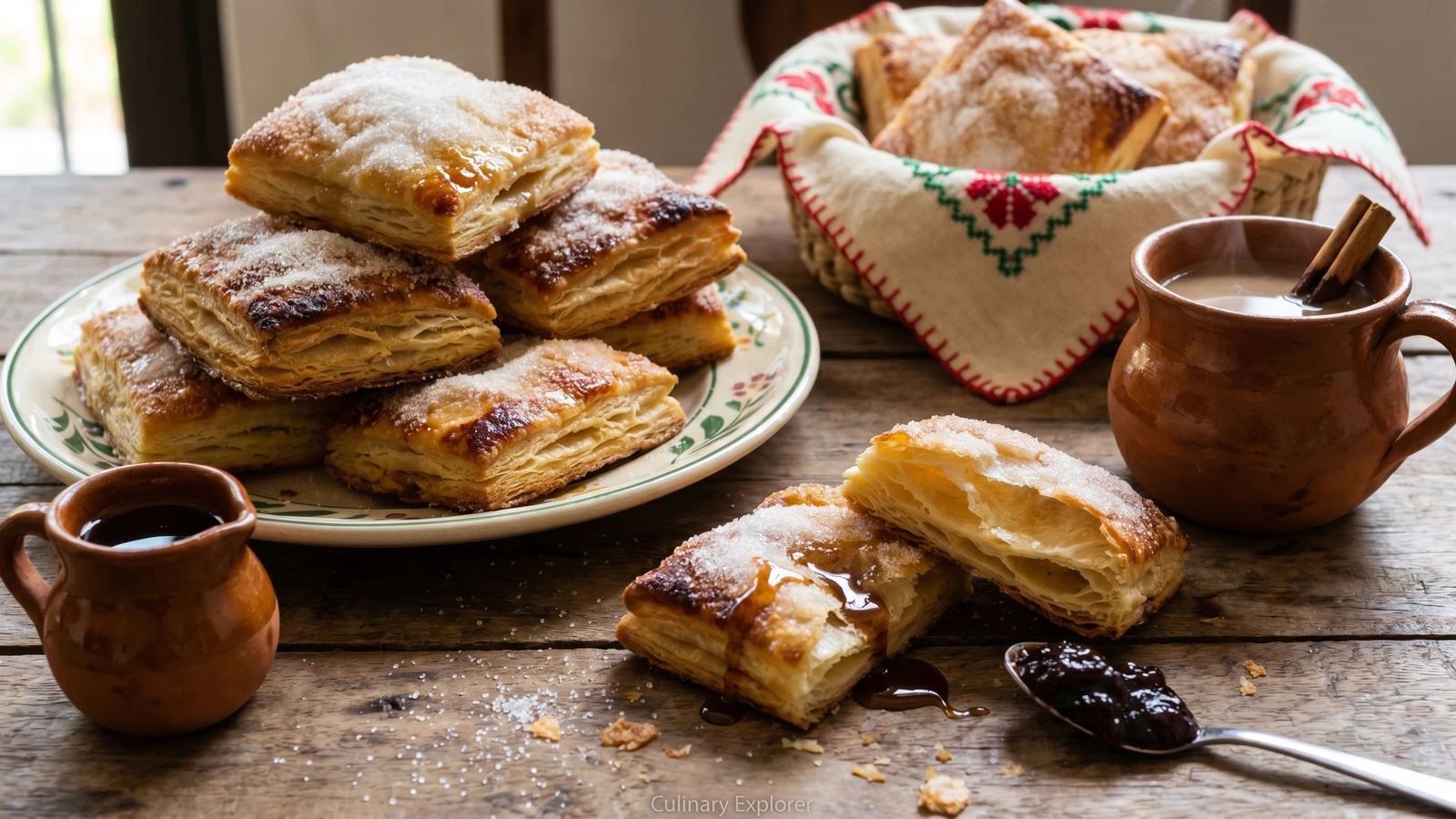
Yucatán's merienda pastry, buttery hojaldre layers piled with a snowdrift of sugar, baked until the layers separate and the top turns glassy. Crumbles on the first bite and ruins your shirt.
Hojaldras dulces belong to Yucatán. Specifically to the pastelerias and panaderias of Mérida and Valladolid, where they sit in glass cases alongside polvorones and marquesitas waiting for the late-afternoon merienda crowd. This is not a Mexico City pastry. The peninsula has its own baking tradition, shaped by Spanish, Lebanese, and Mayan hands, and the hojaldra is one of its quietest signatures.
The dough is laminated, four turns, the way the Spanish brought it. But the fat is lard mixed with butter, not the all-butter block the French use, and that is what makes it Yucatecan. The lard gives the layers a tenderness that butter alone cannot. The sugar on top is piled generously and partially melts in the oven into a glassy crust that crackles under your teeth. Some bakers use white sugar. Some grate piloncillo into the mix for a darker, almost caramelized lid. Both are correct. Cada panaderia tiene su mano.
This is a slow recipe and there is no shortcut for the four turns or the long rest in the refrigerator. If you skip the rest, the layers will not separate and you will have a heavy slab that tastes vaguely of butter. If you respect the time, you will have something that pulls apart in your hands and leaves sugar on the front of your shirt. My mother kept a recipe for hojaldras in her notebook, copied from a woman she met on a trip to Mérida in 1991. The note in the margin said: 'mucha azucar arriba, no seas tacaña.' Plenty of sugar on top, do not be stingy. She was right. Saber cocinar es saber vivir.
Hojaldre, the Spanish laminated dough, arrived in the Yucatán peninsula with the colonial baking tradition of the 16th and 17th centuries and was adapted by local bakers who substituted the abundant pork lard of the peninsula for part of the imported butter. The merienda culture that gave hojaldras dulces their everyday role, the late-afternoon coffee-and-pastry pause between comida and a light cena, was reinforced in the 19th century by Lebanese immigrants who arrived in Mérida during the henequen boom and integrated their own baking traditions into the local panaderia repertoire. The pastelerias of Mérida's historic center, several of which have operated continuously for over a hundred years, still produce hojaldras dulces daily as a fixture of the peninsular pastry case.
Quantity
3 1/2 cups, plus more for rolling
Quantity
1 teaspoon
Quantity
2 tablespoons
Quantity
1 cup
Quantity
1 tablespoon
Quantity
1 large
Quantity
1 cup
cold and firm
Quantity
1/2 cup
cold and firm
Quantity
1 large egg beaten with 1 tablespoon milk
Quantity
1 cup
Quantity
1/2 cup
finely grated
Quantity
1/4 cup
Quantity
1/2 cup
| Ingredient | Quantity |
|---|---|
| all-purpose flour | 3 1/2 cups, plus more for rolling |
| fine sea salt | 1 teaspoon |
| granulated sugar (for the dough) | 2 tablespoons |
| cold water | 1 cup |
| white vinegar | 1 tablespoon |
| egg yolk | 1 large |
| manteca de cerdo (pork lard)cold and firm | 1 cup |
| unsalted buttercold and firm | 1/2 cup |
| egg wash | 1 large egg beaten with 1 tablespoon milk |
| granulated white sugar (for dusting) | 1 cup |
| piloncillo (optional)finely grated | 1/2 cup |
| local honey (optional) | 1/4 cup |
| mermelada de ciruela or mermelada de naranja agria (optional) | 1/2 cup |
In a wide bowl, whisk the flour, salt, and 2 tablespoons of sugar together. In a separate cup, stir the cold water, vinegar, and egg yolk until the yolk breaks up. Pour the liquid into the flour. Mix with your hand until the dough comes together in a shaggy mass. Do not knead it smooth. You want a rough, slightly tacky dough that you will refine through folding. Wrap in plastic and refrigerate for 30 minutes. The vinegar relaxes the gluten so the dough rolls thin without fighting back. This is how the pastelerias in Mérida do it.
While the dough rests, mash the cold lard and the cold butter together with the back of a wooden spoon or a bench scraper until they form a single uniform block. Do not let them soften past cool. Shape into a flat 6-inch square on a sheet of parchment, wrap, and refrigerate. La manteca es el sabor and in hojaldre it is also the structure. Lard alone gives crumble. Butter alone gives a French puff pastry, which this is not. The mix is the Yucatecan version: tender, layered, and slightly savory underneath all that sugar.
On a lightly floured counter, roll the chilled dough into a 10-inch square. Place the cold fat block in the center, rotated 45 degrees so the corners of the fat point at the flat sides of the dough. Fold each corner of the dough over the fat to meet in the middle like an envelope. Pinch the seams closed. You should have a neat package with no fat peeking through.
Lightly flour the counter. Roll the package into a long rectangle about 8 by 18 inches, working from the center outward in firm even strokes. Keep the corners square. Fold the dough into thirds like a business letter: the bottom third up, the top third down. That is one turn. Rotate the dough 90 degrees so the open seam is on your right like a book. Roll out again to the same dimensions and fold again into thirds. That is two turns. Wrap and refrigerate for one hour. No me vengas con atajos. The rest between turns is what lets the layers separate in the oven.
Place the cold dough on the floured counter with the seam on your right. Roll out and fold into thirds. Rotate, roll out, and fold into thirds again. That is four turns total. Wrap and refrigerate for at least two hours, preferably overnight. The long rest in the refrigerator is when the layers settle and the dough loses its memory. Hojaldre made and baked the same day is always tighter than hojaldre made the day before.
Heat the oven to 400°F (200°C). Line two heavy sheet pans with parchment. Roll the chilled dough on a floured counter into a large rectangle about 1/4 inch thick. Trim the edges square with a sharp knife, do not drag the blade or you will seal the layers. Cut into 12 squares or rectangles, about 4 inches across. The trimmings can be stacked, not balled, and rerolled once for a second batch.
Transfer the pieces to the lined sheet pans, leaving 2 inches between each. Brush the tops with the egg wash, then pile a generous tablespoon of granulated sugar on each one. Pile it. Do not sprinkle. The Yucatecan hojaldra is identified by the snowdrift of sugar on top that partially melts and partially stays crystalline in the oven. If you want the darker version, mix grated piloncillo with the white sugar at a ratio of one part piloncillo to two parts sugar before piling.
Bake on the middle rack for 22 to 25 minutes, rotating the pans halfway through. The hojaldras should rise to two or three times their original height, the layers visible from the side, and the sugar on top should be glassy and golden in patches. If they are still pale at 20 minutes, give them another three. Underbaked hojaldre is gummy in the middle. Pull them out when the bottoms are deep gold.
Cool the hojaldras on a wire rack for at least 15 minutes. The sugar crust needs to set or it will smear on your fingers. Serve as they do in Mérida for merienda, in the late afternoon, with cafe de olla or chocolate. Drizzle with honey or split one open and spoon in a little mermelada de ciruela or marmalade made from naranja agria. They crumble the second you bite. That crumble is the point. Así se hace y punto.
1 serving (about 87g)
Culinary guides, cultural storytelling, and the editorial depth that makes cooking meaningful.
Discover Culinary ExplorerChef Lupita
Puebla's convent almond cookies, made from blanched almonds, sugar syrup, egg yolks, canela, and patient hands, the kind of sweet that belongs beside coffee in talavera, not in a plastic bakery box.

Chef Lupita
Ciudad de Mexico's panaderia banderillas are long sticks of hojaldre pressed with sugar, baked until amber, and finished with a hard glaze for coffee at the kitchen table.

Chef Lupita
Mérida's pale egg-yolk-and-vanilla kisses, tiny cookies built on eight yolks and a perfume of orange blossom, sandwiched with guava paste and dusted heavy with powdered sugar.

Chef Lupita
Hidalgo's bisquet de nata carries Pachuca's mining history into the breakfast table: a Cornish-style bread softened by Mexican nata, split warm and eaten with café de olla.