Culinary Explorer

A cooking platform built around craft, culture, and the stories behind what we eat.
Discover Culinary Explorer
Hawaiʻi Local Pickled Mango with Li Hing Mui (Salted Plum Powder)

Hawaiʻi Local Pickled Mango with Li Hing Mui (Salted Plum Powder)

Created by

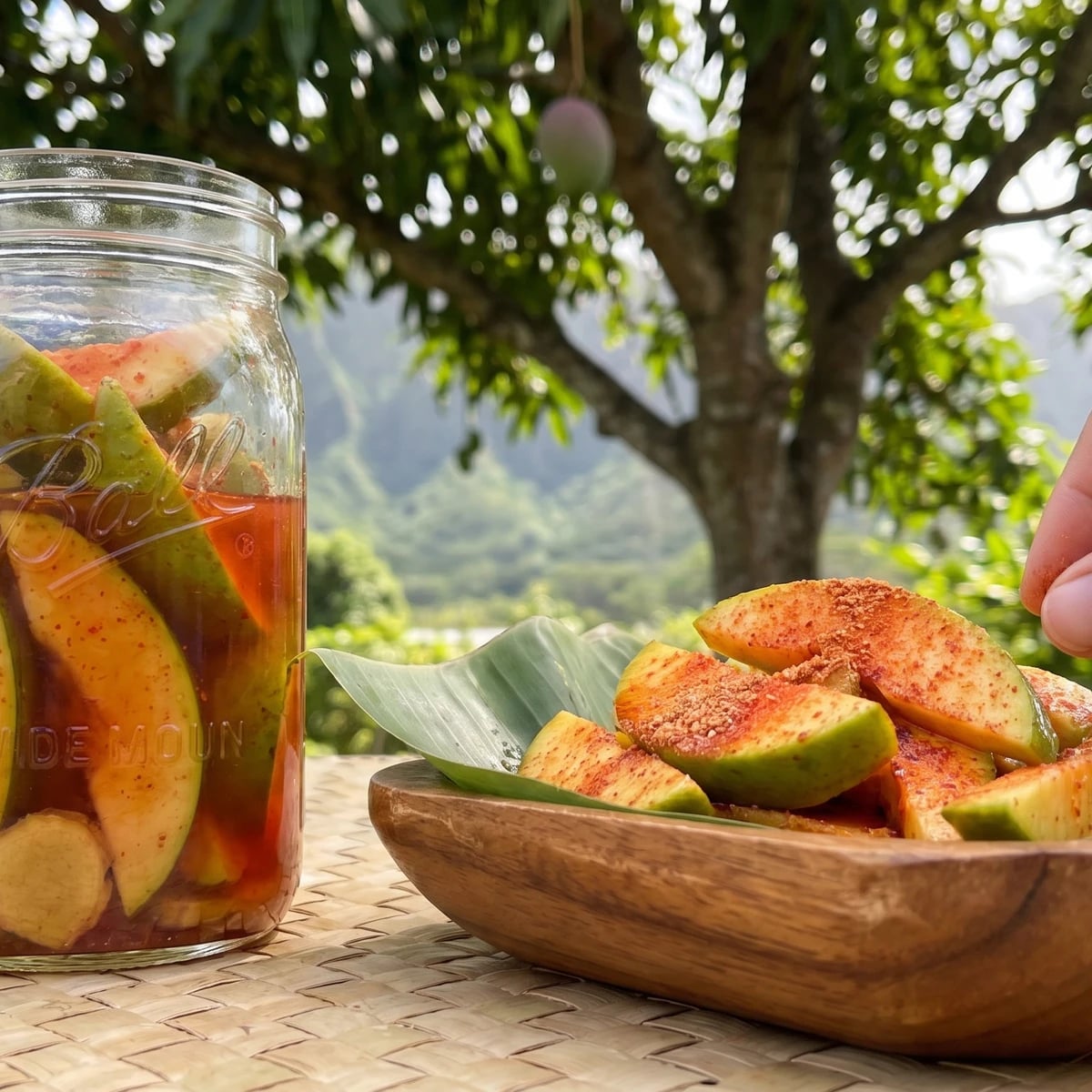
Hard green mango from a Hawaiʻi backyard, sliced thick and cured in vinegar, salt, sugar, and red li hing mui until it snaps tart, salty, sweet, and ready for the fridge.

Sauces & Condiments
Polynesian, Hawaiian
Make Ahead
Comfort Food
Budget Friendly
30 min
Active Time
5 min cook24 hr 35 min total
Yield2 quart jars, about 12 servings

My kumu's voice comes first: Eat what you have. In Hawaiʻi, that sometimes means the green mango thudding off a tree before it ever turns gold, hard as a stone and too sour for the hand. So auntie slices it thick, tucks it in vinegar and paʻakai, Hawaiian salt, and lets red li hing mui, Cantonese salted-plum powder, stain the brine.

This one belongs to Hawaiʻi's local table, the backyard jar beside the rice cooker, not the old deep-food line of poi, the soft pounded kalo paste, or paʻiʻai, the firm hand-pounded taro. The powder is not Hawaiian in origin, and we don't pretend it is. It came through Chinese families and stores, into crack-seed snack counters, into school bags and beach coolers, and Hawaiʻi made a keeping snack out of what hung over the fence.

Don't make small of it because it's newer. Preservation is the island answer to scarcity. The same law lives across the Triangle in different hands: Tahiti keeps māhi, fermented breadfruit paste, in pits; Māori families in Aotearoa pack tītī, muttonbird, into pōhā, bull-kelp bags; atoll people in Tuvalu and Tokelau hold breadfruit and pulaka, swamp taro, through lean months. This mango is not those foods, yeah, but it sits in that same common-sense family: we no throw out good food.

Use mango still green enough to crunch. Make the brine strong enough to cure but sweet enough to make you reach back into the jar. Give it a day, better two, and serve it cold with plate lunch, fried chicken, rice, or Spam musubi. Deep food gets reverence. Everyday food gets respect too.

Mango was in Hawaiʻi by the early nineteenth century, tied in many accounts to Don Francisco de Paula Marín's Honolulu plantings and later spread through yards across the islands. Li hing mui, Cantonese salted dried plum, came through Chinese immigrant grocery and crack-seed snack traditions in the twentieth century, and its red powder found a home on fruit, shave ice, and pickles. This is Hawaiʻi local food from the plantation-era mix, not pre-contact Hawaiian deep food, and it sits beside older Polynesian keeping traditions like Tahitian māhi, fermented breadfruit, and Māori pōhā tītī, preserved muttonbird in bull-kelp bags in Aotearoa.

The technique, the tradition, and the story behind every dish.

Discover Culinary Explorer

Ingredients

very green unripe mangoes

Quantity

4 large, about 3 pounds

scrubbed and peeled if thick-skinned

paʻakai (Hawaiian salt) or coarse sea salt

Quantity

3 tablespoons

divided

distilled white vinegar or rice vinegar

Quantity

2 cups

water

Quantity

1 cup

granulated sugar

Quantity

1 1/4 cups

red li hing mui powder (salted plum powder)

Quantity

2 tablespoons

plus more for finishing if you like

seedless dried li hing mui plums (optional)

Quantity

3

fresh ginger (optional)

Quantity

4 thin slices

Equipment Needed

  • Two clean 1-quart glass jars with tight lids
  • Nonreactive 2-quart saucepan
  • Wide-mouth funnel
  • Small jar weights or clean folded parchment

Instructions

  1. 1

    Pick the mangoes

    Choose mangoes still hard, green, and sour, with no sweet perfume. If your thumb dents the flesh or the fruit smells ripe, save it for something else. Eat what you have, but for this pickle you need crunch.

  2. 2

    Slice and salt

    Cut the cheeks from the seed, then slice the mango into half-inch spears or thick wedges. Toss with 1 tablespoon of the paʻakai and let it sit 20 to 30 minutes, until the cut sides shine and a little water gathers in the bowl. Drain it well but do not rinse, unless your salt is very heavy.

    That short salt sit pulls water from the fruit so the brine doesn't go weak. It also helps the mango keep its snap.
  3. 3

    Make the brine

    In a nonreactive saucepan, combine the vinegar, water, sugar, remaining 2 tablespoons paʻakai, li hing mui powder, dried plums if using, and ginger if using. Warm it over medium heat, stirring until the sugar and salt dissolve and the brine turns deep red. No need boil hard; the powder settles, so keep it moving.

  4. 4

    Cool the brine

    Take the brine off the heat and cool it completely, then chill it if you have time. Hot brine softens green mango. Cold brine keeps the edges crisp and lets the li hing bite stay clean.

  5. 5

    Pack the jars

    Pack the drained mango into two clean 1-quart glass jars. Pour the cooled red brine over the fruit to cover, dividing the plums and ginger between the jars if you used them. Tap the jars to release air pockets, press the mango below the brine with a clean jar weight or folded parchment, and close the lids.

    This is a refrigerator pickle, not a pantry-canned jar. Keep it cold from here on.
  6. 6

    Cure and serve

    Refrigerate at least 24 hours, better 48, turning the jars once so the red brine reaches every piece. Serve cold with a clean fork. The mango should be tart, salty-sweet, crisp under the tooth, and red along the edges. Dust with a little more li hing mui powder at the table if your family likes it loud.

Chef Tips

  • Green means green. A ripe mango turns soft and perfumed in the jar, and then the pickle loses the whole reason you came for it. No blame the mango; you chose the wrong day.
  • Li hing mui powders vary. Some are salty, some sweet, some bright red from coloring, some duller and more plum-heavy. Taste yours before adding extra at the end.
  • No mango tree? Market green mangoes work fine. Buy firm fruit, avoid bruised soft spots, and use what you have.
  • Keep the jars refrigerated and use a clean fork each time. If you see mold, heavy fizzing, or a smell that turns wrong instead of sharp and plummy, that food is no longer good food.

Advance Preparation

  • The brine can be made up to 3 days ahead and kept cold; stir it well because li hing mui powder settles.
  • The pickled mango is ready after 24 hours and better after 48 hours.
  • Keep refrigerated and eat within 2 to 3 weeks for the best crunch.

Frequently Asked Questions

Nutrition Information

1 serving (about 170g)

Calories
155 calories
Total Fat
0 g
Saturated Fat
0 g
Trans Fat
0 g
Unsaturated Fat
0 g
Cholesterol
0 mg
Sodium
2200 mg
Total Carbohydrates
37 g
Dietary Fiber
2 g
Sugars
31 g
Protein
1 g

Note: Chef personas and recipes are created with AI assistance. Cook with care: follow safe food-handling practices, check doneness with a thermometer when needed, and adapt for allergies and your kitchen.

Where cooking meets culture.

Culinary guides, cultural storytelling, and the editorial depth that makes cooking meaningful.

Discover Culinary Explorer

More from Fermented & Preserved: Polynesia's Keeping Traditions

Browse the full collection