
Chef Lupita
Acitrón de Cidra Conventual
Puebla's convent-style acitrón, made from cidra peel instead of endangered biznaga, built through repeated syrup soakings until the cubes turn firm, translucent, and ready for rosca or chiles en nogada.
A cooking platform built around craft, culture, and the stories behind what we eat.
Created by
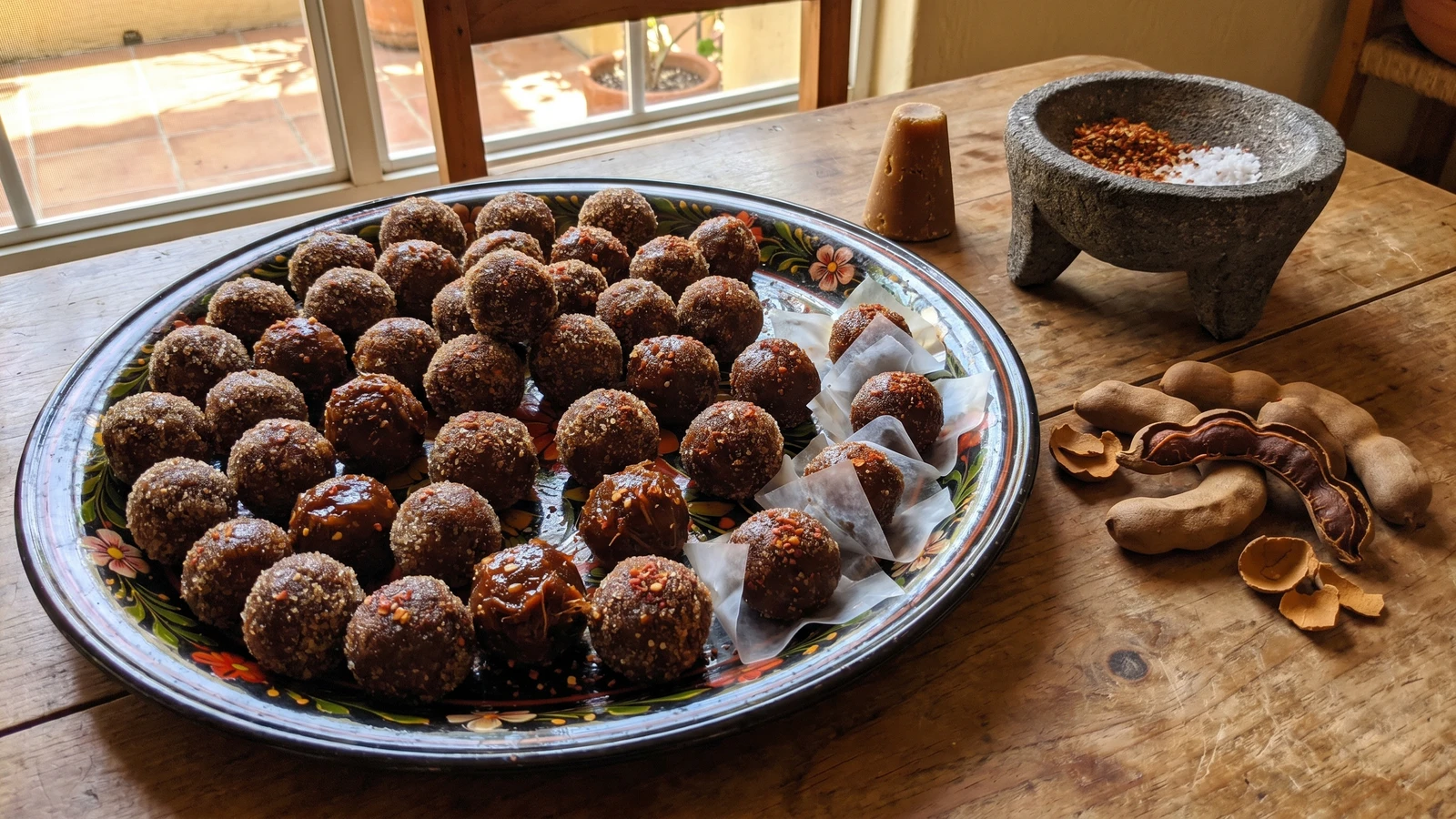
Guerrero's tarugos are sour tamarind pulp worked with piloncillo, salt, and chile piquin into sticky little balls that carry the Pacific heat in one bite.
Guerrero's Costa Grande and Costa Chica know tamarind. From Acapulco down the hot coastal roads, you find the pods in market piles, brown and brittle outside, sour and sticky inside. This candy lives there, in paper cones, plastic bags, school lunchboxes, bus station stalls, and kitchen tables where a woman rolls each ball by hand while talking to three people at once.
The defining ingredient is the tamarind pulp, not the sugar. Piloncillo rounds it, salt sharpens it, and chile piquin gives the bite. Do not drown it in anonymous red powder. Use chile piquin if you can find it, small, bright, and direct. Some Guerrero cooks use chile de arbol ground fine when piquin is scarce, but that is a compromise, not an upgrade.
I learned a version like this from a woman near the Mercado Central in Acapulco who sold tamarind sweets beside bags of jamaica and dried shrimp. She worked the pulp with her hands because the seeds tell you when the fruit has given up enough. A machine can mix it, yes. It cannot teach you that feeling. La cocina no es decoración, es trabajo.
This is budget candy, but do not confuse budget with careless. The balance is the whole point: sour first, then sweet, then salt, then chile at the end. Guerrero understands that order. Cada estado, su propia cocina.
Tamarind is not native to Mexico; it likely reached New Spain through Spanish colonial trade routes that connected Asia, Africa, the Caribbean, and the Pacific coast, including the Manila galleon network that landed in Acapulco from 1565 to 1815. Guerrero's warm coastal climate made tamarind trees practical backyard and market crops, and the fruit became part of local aguas frescas, paletas, sauces, and candies. The chile-salt-sugar coating reflects a Mexican confectionery habit that also shaped chamoy and chile-dusted fruit, but Guerrero's tarugos keep the tamarind pulp at the center.
Quantity
1 pound
shells and strings removed
Quantity
2 cups
Quantity
6 ounces
grated or finely chopped
Quantity
1/2 cup, plus 1/2 cup more
divided, for cooking and rolling
Quantity
1 teaspoon
Quantity
1 1/2 teaspoons, plus 1 teaspoon more
divided, for mixing and rolling
Quantity
1 tablespoon
| Ingredient | Quantity |
|---|---|
| tamarind podsshells and strings removed | 1 pound |
| hot water | 2 cups |
| piloncillograted or finely chopped | 6 ounces |
| granulated sugardivided, for cooking and rolling | 1/2 cup, plus 1/2 cup more |
| kosher salt | 1 teaspoon |
| chile piquin powderdivided, for mixing and rolling | 1 1/2 teaspoons, plus 1 teaspoon more |
| fresh lime juice | 1 tablespoon |
Put the peeled tamarind pods in a bowl and cover with the hot water. Let them sit for 20 minutes, then work the pulp with your fingers until the water turns brown and thick. This is sticky work. Good. Dulce de tamarindo does not begin in a clean little packet. It begins with your hands pulling flavor from the pod.
Press the softened tamarind through a coarse strainer into a heavy saucepan. Scrape hard against the seeds and fibers to collect as much pulp as possible. Discard the seeds and strings. You should have about 1 1/2 cups thick pulp. If you have much more, the candy will take longer to set.
Add the piloncillo, 1/2 cup sugar, salt, chile piquin, and lime juice to the saucepan. Cook over medium-low heat, stirring constantly with a wooden spoon, until the piloncillo melts and the mixture thickens into a dark, glossy paste, 15 to 20 minutes. Drag the spoon through the center. If the line holds for two seconds before closing, it is ready.
Scrape the paste onto a lightly oiled plate or a piece of parchment. Let it cool until you can touch it without burning your fingers, about 15 minutes. It should be tacky and flexible, not runny. If it spreads like syrup, return it to the pan and cook a few minutes more.
Mix the remaining 1/2 cup sugar with the extra teaspoon of chile piquin in a shallow bowl. Lightly dampen your hands, pinch off walnut-size pieces of tamarind paste, and roll them into rough balls. Coat each one in the chile sugar. They should look handmade, not factory perfect. Así se hace y punto.
Let the tamarind balls sit uncovered for 30 minutes so the outside dries slightly and the sugar clings. Store in a covered container with parchment between layers. They keep for about one week at room temperature if your kitchen is cool, or two weeks in the refrigerator.
1 serving (about 29g)
Culinary guides, cultural storytelling, and the editorial depth that makes cooking meaningful.
Discover Culinary ExplorerChef Lupita
Puebla's convent-style acitrón, made from cidra peel instead of endangered biznaga, built through repeated syrup soakings until the cubes turn firm, translucent, and ready for rosca or chiles en nogada.

Chef Lupita
Ciudad de México's Tulyehualco alegría is popped huautli folded into piloncillo honey, pressed with peanuts, pepitas, and raisins, then cut into the rectangular bars that built a pueblo's identity.

Chef Lupita
Oaxaca's pre-Columbian amaranth bar, popped on a hot comal and bound with piloncillo, honey, and the sacred Zapotec grain that the Spanish tried, and failed, to outlaw.

Chef Lupita
Querétaro's mercado candy of popped amaranto pressed with dark piloncillo syrup, pepitas, pecans, and cacahuate, a Bajío sweet that respects the seed before it decorates the table.