
Chef Freja
Boller
Soft, round, barely sweet Danish buns made with milk, butter, and patient yeast. The first thing most Danish children learn to bake, and the smell that means someone is home.
A cooking platform built around craft, culture, and the stories behind what we eat.
Created by Chef Freja
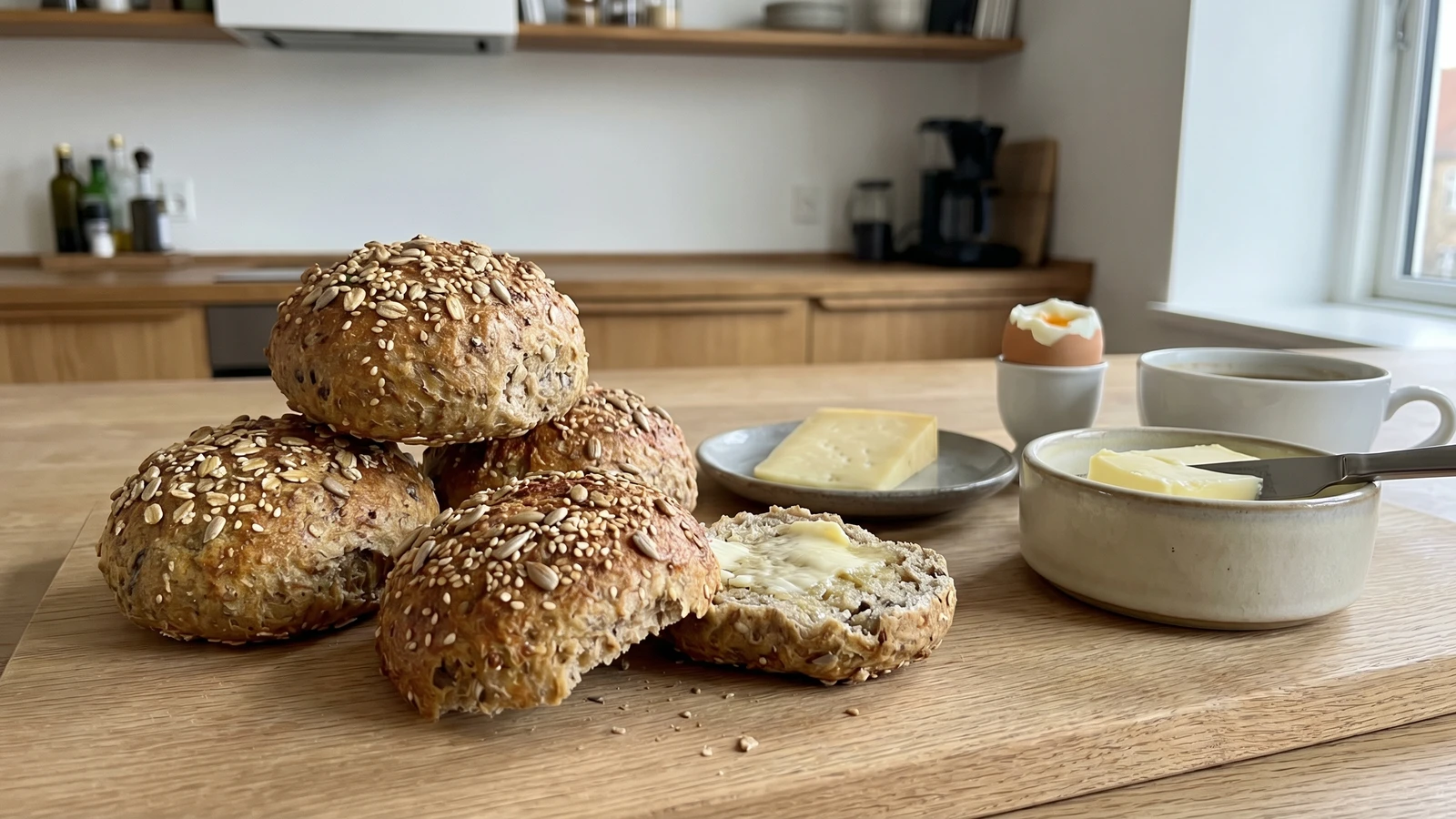
Danish whole grain rolls soaked overnight in buttermilk and heavy with seeds, oats, and dark rye. The roll that starts every Danish morning, split open with butter, cheese, and a boiled egg.
Every Danish morning starts with bread. Not toast, not a croissant, but a roll so dense with seeds and grain that it holds together under a thick layer of butter and a slice of aged cheese. Grovboller are the quiet foundation of the Danish day, the roll you split open while the coffee brews and the sky outside is still deciding what kind of light to give you.
The recipe asks one thing of you the night before: stir the oats and seeds into buttermilk and leave them to soak. That's it. The buttermilk softens everything overnight, and by morning the mixture has become a thick, porridge-like base that gives the rolls their texture. Heavy and moist and full of chew, nothing like the airy white rolls that fall apart when you look at them. The dark rye flour gives them their colour and their earthiness. The seeds give them their crunch. The buttermilk holds it all together.
What matters most is that you trust the dough. It will be wetter than you expect. It will stick to your hands. That's correct. A wet dough makes a moist roll, and a moist roll stays good for days. Shape them with wet hands, don't fight the stickiness, and you'll pull them from the oven with a crackled, seedy crust and a dense interior so satisfying that you'll understand why Danish families bake a batch on Sunday and eat through the week. Cooked with love, eaten with butter. That's the whole story.
Denmark consumes more whole grain per capita than any other country in Europe, a tradition rooted in centuries of rye cultivation on thin Scandinavian soils where wheat struggled to grow. Grovboller in their current form emerged in the 1970s and 1980s as part of a conscious return to whole grain baking, after decades when industrially produced white bread had quietly displaced older traditions. The Danish Whole Grain Partnership, Fuldkornspartnerskabet, established in 2008, formalized what home bakers already knew: that a good grovbolle, heavy with seeds, oats, and dark flour, is not health food but simply Danish food, the way bread has always tasted here when it's made properly.
Quantity
100g, plus extra for topping
Quantity
75g
Quantity
50g
whole or cracked
Quantity
25g
Quantity
25g
Quantity
400ml
Quantity
250g
stone-ground
Quantity
150g
Quantity
100g
Quantity
7g
Quantity
2 teaspoons
Quantity
2 tablespoons
Quantity
50ml
Quantity
1
beaten, for glazing
Quantity
for topping
| Ingredient | Quantity |
|---|---|
| rolled oats | 100g, plus extra for topping |
| sunflower seeds | 75g |
| flaxseedswhole or cracked | 50g |
| sesame seeds | 25g |
| pumpkin seeds | 25g |
| buttermilk | 400ml |
| whole wheat flourstone-ground | 250g |
| strong white bread flour | 150g |
| dark rye flour | 100g |
| instant dry yeast | 7g |
| fine sea salt | 2 teaspoons |
| dark honey | 2 tablespoons |
| warm water (optional) | 50ml |
| eggbeaten, for glazing | 1 |
| seeds and oats (optional) | for topping |
The evening before you bake, combine the rolled oats, sunflower seeds, flaxseeds, sesame seeds, and pumpkin seeds in a large bowl. Pour the buttermilk over them and stir until everything is wet. Cover the bowl and leave it on the counter overnight, at least eight hours. The buttermilk does two things while you sleep: its acid softens the tough seed coats, and its moisture swells the oats into a thick porridge that will give the rolls their dense, lasting crumb. By morning the mixture should look like a heavy, spoonable paste. That's exactly right.
In the morning, add the whole wheat flour, bread flour, rye flour, yeast, salt, and honey to the soaked grain mixture. Stir everything together with a wooden spoon or your hands until you have a heavy, shaggy dough. It will be much wetter than a white bread dough. That's correct. The seeds and oats have absorbed moisture overnight, but they'll keep releasing it slowly during baking, which is what makes these rolls stay moist for days instead of going stale by afternoon. If the dough feels too stiff to bring together, add the warm water a splash at a time. You want a dough that's sticky and heavy, not dry and crumbly.
Cover the bowl with a damp cloth and leave the dough in a warm spot for one to one and a half hours. It won't double the way white bread dough does. Whole grain and rye are heavier, with less gluten to trap gas, so expect a rise of about fifty percent. The surface will look slightly domed and you'll see small bubbles forming at the edges. That's the yeast working through a dense environment, and it's enough.
Wet your hands thoroughly. This is not optional. The dough is sticky and will cling to dry hands and fight you. With wet hands, pull off pieces of dough about the size of a tennis ball and shape them into rough rounds. Don't overwork them. A few quick turns between your palms is enough. Place them on two baking sheets lined with parchment, leaving a few centimetres between each one. They'll spread slightly as they proof.
Brush the tops of the rolls with beaten egg. The egg does two things: it gives the crust its deep colour during baking, and it acts as glue for the topping. Scatter generously with rolled oats and a mix of whatever seeds you have. Press the topping gently into the surface so it stays put. Cover the rolls loosely with a cloth and let them rise for thirty to forty minutes. They should look visibly puffed but not billowy. You'll know when they're right.
Heat the oven to 200C. Place a small oven-safe dish of water on the bottom rack. The steam keeps the crust from setting too fast, giving the rolls time to rise fully in the first few minutes of baking. Slide the trays in and bake for twenty to twenty-five minutes until the tops are deep golden brown and the rolls sound hollow when you tap their bottoms. That hollow sound is how you know the interior has set. If the tap sounds dense and dull, give them five more minutes.
Transfer the rolls to a wire rack and let them cool for at least fifteen minutes before splitting. This is hard. They smell extraordinary. But the interior needs time to finish setting, and cutting too soon gives you a gummy centre that sticks to the knife. Once cooled, split one open. The inside should be dense, moist, and flecked with seeds throughout. Spread it with good butter, lay a slice of aged cheese on top, and serve alongside a soft-boiled egg. This is how Danes greet the morning, and now you know why. Tak for mad.
1 serving (about 100g)
Culinary guides, cultural storytelling, and the editorial depth that makes cooking meaningful.
Discover Culinary ExplorerChef Freja
Soft, round, barely sweet Danish buns made with milk, butter, and patient yeast. The first thing most Danish children learn to bake, and the smell that means someone is home.

Chef Freja
Dark rye crackers from the island of Bornholm, laminated in twenty-seven butter-layered folds and scattered with caraway and sea salt. The kind of thing you keep in a tin for cheese, good butter, and cold dark beer.

Chef Freja
The soft Danish white loaf with a milk-brushed crust and blue poppy seeds that belongs on every weekday breakfast table. Simple dough, gentle rise, toast and butter and jam.

Chef Freja
Danish whole wheat rolls made with grahamsmel, ready in just over an hour. The weekday bun that fills lunch boxes, sits beside soup, and smells like a kitchen where someone cares.