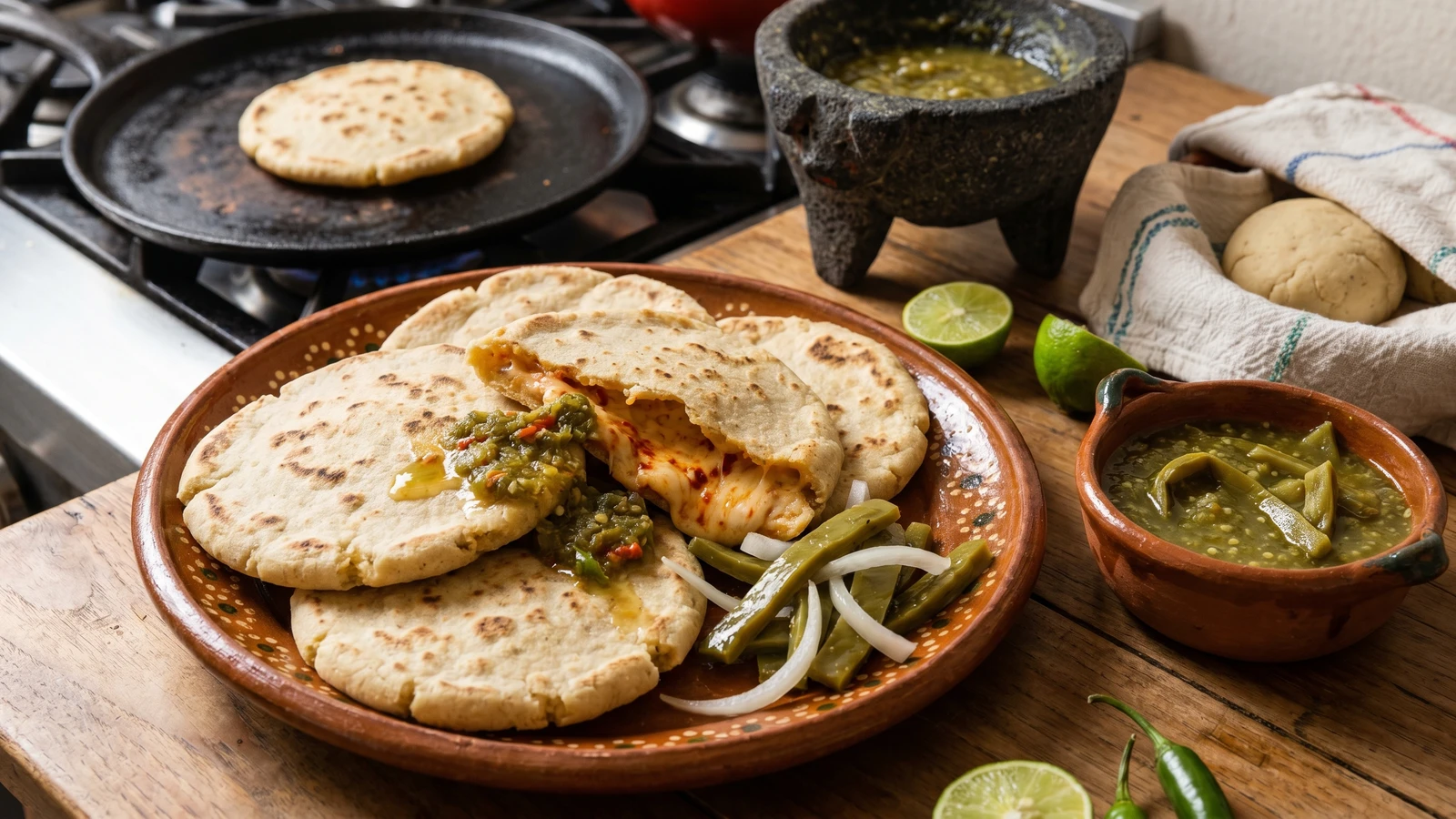
Querétaro's Colón gorditas are thick hand-pressed corn pockets filled with chile-rubbed local cheese, finished with manteca on the comal, and served with salsa martajada and nopalitos.
Appetizers & Snacks
Mexican
Weeknight
Comfort Food
50 min
Active Time
40 min cook•1 hr 30 min total
Yield12 gorditas, 4 to 6 servings
Querétaro, in the semidesert corridor around Colón, is where this gordita belongs. The town sits north of Santiago de Querétaro, in a landscape of ranch milk, dry air, maguey, corn, and women who know exactly how thick a masa pocket needs to be before it hits the comal.
This dish is carried by queso enchilado, the local cow's milk cheese rubbed red with chile guajillo, chile ancho, garlic, and Mexican oregano. The chile is seasoning, not a dare. It gives the cheese color, salt, and a clean bite. If you use yellow cheese, you've made something else. No me vengas con atajos.
In Colón, I learned this version from Doña Dolores, who made them on weekends when the family came through the door in waves. She pressed the masa by hand, filled it without showing off, and cooked each gordita until the edges had a little grip from the manteca. She served them on barro vidriado with salsa de tomatillo and nopalitos. Nothing precious. La cocina no es decoración, es trabajo.
The principle is direct and serious: fresh nixtamal masa, good cheese, a hot comal, and patience. The cheese should soften inside, not run like a pizza. This is Querétaro speaking through corn and dairy. This is a 32-state cuisine. Cada estado, su propia cocina.
Gorditas made from nixtamalized corn descend from pre-Columbian masa cookery, while the cheese filling reflects the cattle and goat dairying introduced to central Mexico after the 16th-century Spanish conquest. Colón belongs to Querétaro's semidesert and Bajío dairy corridor, where small ranch cheeses were rubbed with ground dried chiles for flavor, color, and a drier surface that could travel to market. The gordita de queso enchilado is a post-conquest pairing: Indigenous corn technique wrapped around ranch dairy, recognized locally because the cheese tastes of Colón, not of a supermarket case.
The technique, the tradition, and the story behind every dish.
apple cider vinegar (optional)for optional cheese rub
1 tablespoon
manteca de cerdodivided between chile paste, masa, and comal
6 tablespoons plus 1 teaspoon
kosher saltdivided
2 teaspoons, plus more to taste
fresh nixtamal masa for tortillassoft and pliable
2 pounds
masa harina (optional)only if fresh masa is not available
3 cups
warm water for masa harina (optional)only if using masa harina
2 1/4 cups
additional warm water (optional)as needed for adjusting fresh masa
1/4 to 1/2 cup
fresh epazote leavesfinely chopped
2 tablespoons
tomatilloshusked and rinsed
8 medium
fresh chile serranostemmed
3
white onionfor roasting
1/4 medium
garlic cloveunpeeled, for roasting
1
cilantro leaves and tender stems
1/2 cup
cooked nopalitos (optional)rinsed and drained, for serving
1 cup
white onion (optional)thinly sliced, for serving
1/4 small
lime halves (optional)
for serving
Equipment Needed
•Cast iron comal or thick clay comal
•Tortilla press or two plastic sheets for shaping by hand
•Volcanic stone molcajete for salsa martajada
•Small skillet for frying the chile paste
•Damp cotton servilleta for covering the masa
Instructions
1
Toast the chiles
If you bought queso enchilado from Colón or another Querétaro cheese stall, crumble it and skip to step 4. If your cheese is plain, heat a dry comal over medium. Toast the chile guajillo and chile ancho separately, about 20 to 30 seconds per side, just until the skins puff and the smell turns deep and warm. Do not blacken them. Burned chile tastes bitter, and bitterness does not forgive laziness.
The chile ancho is thicker and sweeter. The guajillo is thinner and turns bitter faster. Watch the guajillo first. Así se hace y punto.
2
Blend the rub
Cover the toasted chiles with hot water and let them soften for 15 minutes. Drain them and blend with the peeled garlic, dried Mexican oregano, 1/2 teaspoon salt, apple cider vinegar, and 2 tablespoons of clean warm water. You want a thick brick-red paste, not a loose salsa. If the blender struggles, add water one teaspoon at a time.
3
Rub the cheese
Melt 1 teaspoon manteca de cerdo in a small skillet over medium-low heat. Add the chile paste and cook 3 minutes, stirring constantly, until it darkens slightly and clings to the spoon. Let it cool completely. Rub it over the slab of firm queso ranchero, let it rest 30 minutes at room temperature, then crumble it. If you make it a day ahead, refrigerate it covered. This is a compromise, not the same as buying cheese from Colón, but it respects the idea.
4
Roast the salsa
Set the tomatillos, chile serrano, onion, and unpeeled garlic on the hot comal. Turn them until the tomatillos soften and turn olive-gold with blackened spots, the serranos blister, and the garlic skin chars. Peel the garlic. Roasting gives the salsa body. Raw tomatillo salsa has its place. This is not that place.
5
Crush the salsa
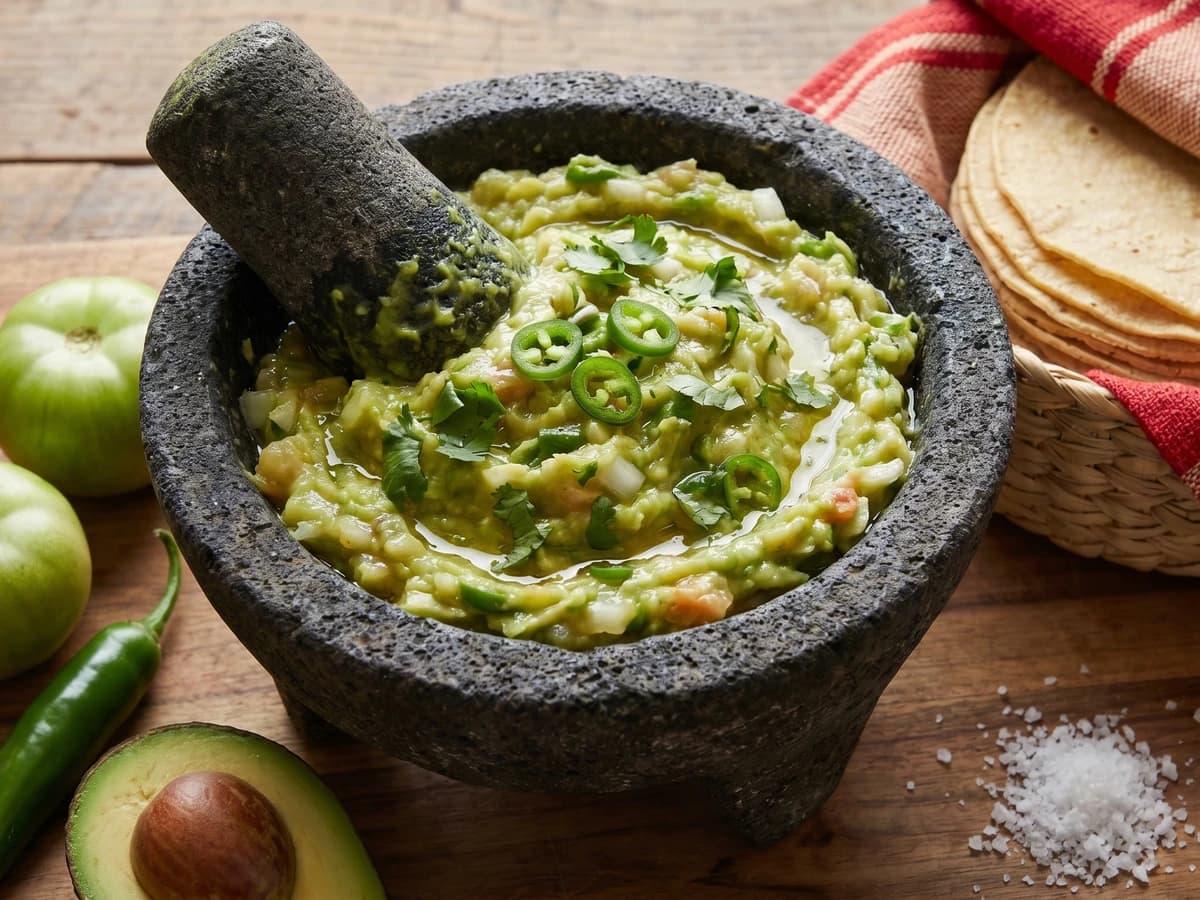
In a molcajete, crush 1/2 teaspoon salt with the roasted garlic and serranos until the chile breaks down. Add the roasted tomatillos one by one and crush until the salsa is martajada, rough and juicy. Stir in the cilantro. If you use a blender, pulse only a few times. Do not turn it into a thin green drink. Texture matters.
6
Prepare the masa
If using fresh nixtamal masa, knead it with 1 teaspoon salt and 3 tablespoons softened manteca de cerdo. Add warm water by the tablespoon only if it cracks at the edges. If using masa harina, mix it with 2 1/4 cups warm water, rest 15 minutes, then knead in the salt and manteca. The masa should feel like soft clay, damp but not sticky. Press a little between your palms. If the edge splits, it needs more water.
Do not use prepared tamal masa. It is too loose and too fatty for these gorditas. Ask the tortillería for masa para tortillas.
7
Mix the filling
Stir the crumbled queso enchilado with the finely chopped epazote. Taste before adding salt. Queso enchilado is already salty, and the point is chile-rubbed dairy, not a mouthful of salt. The cheese will soften in the gordita. It will not stretch. That is correct.
8
Shape the gorditas
Divide the masa into 12 equal balls. Keep them covered with a damp cotton servilleta so they do not dry out. Flatten one ball into a 4-inch round, place about 2 tablespoons of queso enchilado in the center, then close the masa around it like a pouch. Pinch the seam shut and pat it gently into a thick disk, about 1/2 inch high. Do not press it tortilla-thin. A gordita needs enough body to protect the cheese.
9
Cook on comal
Heat the comal over medium. Lay on the gorditas without crowding. Cook 3 to 4 minutes per side, until tan spots appear and the edges look set. Brush the comal with the remaining manteca de cerdo and cook the gorditas 1 to 2 minutes more per side, turning once, until the rims are lightly crisp and glossy. If the outside browns before the center cooks, the comal is too hot. Lower it and be patient.
10
Serve from clay
Pile the gorditas on a barro vidriado platter. Spoon salsa martajada over the top or serve it in a clay cazuelita at the table. Add the nopalitos, thin white onion, and lime halves alongside. Eat while the edges still have their grip from the comal. Stack them too long under cloth and they will soften. Still good, but not Doña Dolores good. Recetas probadas y garantizadas.
Chef Tips
•Buy queso enchilado from a Querétaro or Bajío cheese vendor if you can. Ask for queso de Colón or queso ranchero enchilado, red from chile guajillo and chile ancho, not orange from coloring. If the vendor cannot tell you what chile is on the cheese, keep walking.
•Fresh nixtamal masa is the first choice. Si no conoces el mercado, no conoces la cocina. Masa harina works on a weeknight, but fresh masa from a tortillería gives the gordita the corn smell that makes people turn their head when it hits the comal.
•Queso enchilado is not meant to melt like queso Oaxaca. It softens, holds its salty chile bite, and stays inside the masa. Do not replace it with cheddar, Monterey Jack, or shredded bag cheese. That is not Colón.
•If the tomatillos are pale, hard, and mean that day, do not force salsa verde. Make a salsa roja with roasted jitomate and chile de árbol, or serve the gorditas with pickled nopalitos. Cook what the market is selling today.
•The epazote is there to sharpen the cheese, not perfume the whole dish. Use a little. More is not wisdom.
Advance Preparation
•The queso enchilado can be bought or rubbed 1 to 2 days ahead. Keep it wrapped in the refrigerator and crumble it just before filling the gorditas.
•The salsa can be roasted and crushed one day ahead. Refrigerate it, then taste for salt before serving because tomatillo sharpness settles overnight.
•The masa should be mixed the day you cook. You can shape the filled gorditas up to 2 hours ahead and keep them covered with a damp servilleta at room temperature.
•Cooked gorditas reheat best on a dry comal over medium-low heat, 2 to 3 minutes per side. Do not microwave them unless you enjoy rubbery masa. Saber cocinar es saber vivir.
Frequently Asked Questions
Nutrition Information
1 serving (about 290g)
Calories
540 calories
Total Fat
28 g
Saturated Fat
13 g
Trans Fat
0 g
Unsaturated Fat
15 g
Cholesterol
50 mg
Sodium
1160 mg
Total Carbohydrates
56 g
Dietary Fiber
8 g
Sugars
5 g
Protein
15 g
Where cooking meets culture.
Culinary guides, cultural storytelling, and the editorial depth that makes cooking meaningful.