
Chef Jeong-sun
Agwi-jjim (Braised Monkfish with Bean Sprouts)
Firm monkfish buried under crisp soybean sprouts, minari, and a red gochugaru sauce thickened at the end; Masan's market dish asks for heat, timing, and a steady hand.
A cooking platform built around craft, culture, and the stories behind what we eat.

Created by
Pork small intestine parboiled clean, then stir-fried hard with cabbage, perilla leaves, glass noodles, and gochugaru sauce until the pan gives you chew, gloss, and bul-mat.
The misunderstanding starts with the word gopchang. In a grilling house, people often think of beef small intestine, fat and expensive, cooked plain over flame. But the red pan you meet near a subway exit, the one tangled with cabbage, perilla leaves, and glass noodles, is usually pork small intestine, 돼지곱창 (dwaeji gopchang). That is the dish in this notebook. Street food deserves exact measures too.
I won't tell you this is easy. Intestine asks you to be honest before it rewards you: scrub it, parboil it with aromatics, then cut it evenly so every piece cooks at the same pace. Skip that cleaning and no amount of gochujang will save you. My teacher would have smelled the pot once and sent it away without a word, which was her kindest form of correction.
The sauce should be fierce, but not stupid. Gochugaru gives heat and color, gochujang gives body, cabbage gives sweetness, and perilla leaves lift the richness at the end. Measure the dangmyeon too. A little glass noodle belongs in the pan; a mound of it steals the dish. Write it down. Memory is a borrowed bowl.
Gopchang-bokkeum belongs to Korea's market and drinking-food table rather than palace cooking, with pork versions especially tied to inexpensive neighborhood eateries and night stalls in Seoul and other cities in the late twentieth century. The vegetable-heavy style often called yachae gopchang, stir-fried with cabbage, perilla leaves, and dangmyeon, made a modest cut into a shared anju, food eaten with drinks, and a filling meal with rice. Beef gopchang is more often grilled, while this red stir-fried pan is commonly made with pork small intestine.
Quantity
700g
thawed if frozen
Quantity
2 tablespoons
for scrubbing
Quantity
2 tablespoons
for scrubbing
Quantity
2 tablespoons
divided
Quantity
8 cups
for parboiling
Quantity
1/2 medium
quartered, for parboiling
Quantity
4
smashed, for parboiling
Quantity
3 slices
for parboiling
Quantity
1
cut into large pieces, for parboiling
Quantity
1 teaspoon
for parboiling
Quantity
3 tablespoons
Quantity
1 1/2 tablespoons
Quantity
2 tablespoons
Quantity
1 tablespoon
Quantity
1 tablespoon maesil-cheong or 2 teaspoons sugar
Quantity
1 tablespoon
minced
Quantity
1 teaspoon
grated
Quantity
1 tablespoon
divided
Quantity
1/4 teaspoon
Quantity
2 tablespoons
Quantity
1/2 medium
sliced
Quantity
250g
cut into 2-inch pieces
Quantity
1 small
julienned
Quantity
2
cut into 2-inch lengths
Quantity
1
sliced on the diagonal
Quantity
1
sliced on the diagonal
Quantity
60g
Quantity
12 leaves
sliced thick
Quantity
1 tablespoon
Quantity
1 tablespoon
| Ingredient | Quantity |
|---|---|
| cleaned pork small intestine (dwaeji gopchang)thawed if frozen | 700g |
| coarse saltfor scrubbing | 2 tablespoons |
| all-purpose flourfor scrubbing | 2 tablespoons |
| soju or rice winedivided | 2 tablespoons |
| waterfor parboiling | 8 cups |
| onionquartered, for parboiling | 1/2 medium |
| garlic clovessmashed, for parboiling | 4 |
| fresh gingerfor parboiling | 3 slices |
| scallioncut into large pieces, for parboiling | 1 |
| doenjang (fermented soybean paste)for parboiling | 1 teaspoon |
| gochugaru (Korean chili flakes) | 3 tablespoons |
| gochujang (Korean chili paste) | 1 1/2 tablespoons |
| soy sauce | 2 tablespoons |
| fish sauce or soup soy sauce | 1 tablespoon |
| maesil-cheong (green plum syrup) or sugar | 1 tablespoon maesil-cheong or 2 teaspoons sugar |
| garlicminced | 1 tablespoon |
| gingergrated | 1 teaspoon |
| toasted sesame oildivided | 1 tablespoon |
| black pepper | 1/4 teaspoon |
| neutral oil | 2 tablespoons |
| onionsliced | 1/2 medium |
| green cabbagecut into 2-inch pieces | 250g |
| carrotjulienned | 1 small |
| scallionscut into 2-inch lengths | 2 |
| green chilisliced on the diagonal | 1 |
| red chili (optional)sliced on the diagonal | 1 |
| dried sweet potato glass noodles (dangmyeon) | 60g |
| perilla leaves (kkaennip)sliced thick | 12 leaves |
| toasted sesame seeds | 1 tablespoon |
| perilla seed powder (deulkkae-garu) (optional) | 1 tablespoon |
Put the pork small intestine in a large bowl with the coarse salt, flour, and 1 tablespoon soju. Rub it firmly for 3 minutes, then rinse under cold running water until the water runs clear. The flour grips the surface fat and smell; the salt gives your hands traction. This is not decoration. This is the step that decides whether the dish tastes clean.
Bring 8 cups water to a boil with the quartered onion, smashed garlic, ginger, scallion, doenjang, and the remaining 1 tablespoon soju. Add the intestine and boil gently for 25 to 30 minutes, until it firms but is not tough. Drain, rinse briefly, and cut into 2-inch pieces. The parboil takes away the roughness and gives you a clean chew before the hot pan does its work.
While the intestine boils, soak the dangmyeon in hot tap water for 20 minutes, then drain and cut once or twice with scissors. Use 60g, not a fistful. The noodles should catch sauce and stretch the pan a little, not turn this into japchae wearing a red coat.
Stir together the gochugaru, gochujang, soy sauce, fish sauce, maesil-cheong, minced garlic, grated ginger, 2 teaspoons of the sesame oil, and black pepper. Let it sit 10 minutes so the gochugaru blooms and thickens. Gochujang gives body, but too much makes every bite taste the same. Let the intestine still taste like itself.
Heat a wide skillet or wok over medium-high heat. Add the neutral oil, then the parboiled intestine in one layer. Let it sit 2 minutes before stirring, then cook another 4 to 5 minutes until the edges take color and the fat begins to gloss the pan. If your pan is small, do this in two batches. Crowding gives you boiling; space gives you bul-mat, the taste of fire from the pan.
Add the sliced onion, cabbage, and carrot and stir-fry 3 minutes, just until the cabbage bends but still has a bite. These vegetables are not filler. They sweeten the sauce and cut the richness, which is why they go in before the sauce burns.
Add the sauce and stir hard for 2 minutes, scraping the pan so the sauce coats the intestine and vegetables. Add the soaked noodles and 1/4 cup water, then keep tossing for 3 to 4 minutes until the noodles turn glossy and the sauce clings instead of pooling. If it looks dry before the noodles soften, add water 1 tablespoon at a time. Do not drown it.
Turn off the heat. Fold in the scallions, chilies, perilla leaves, remaining 1 teaspoon sesame oil, sesame seeds, and perilla seed powder if using. Perilla leaves go in last because their fragrance is quick and fragile. Taste one piece now. It should be spicy, savory, a little smoky from the pan, and chewy without any muddy smell.
Serve the gopchang-bokkeum straight from the pan or on a warm platter with rice, lettuce leaves if you like wrapping, and something sharp beside it, such as radish kimchi or cucumber muchim. This is food for leaning in together. 음식을 나누면서 정도 나눕니다. When we share food, we share affection.
1 serving (about 340g)
Culinary guides, cultural storytelling, and the editorial depth that makes cooking meaningful.
Discover Culinary ExplorerChef Jeong-sun
Firm monkfish buried under crisp soybean sprouts, minari, and a red gochugaru sauce thickened at the end; Masan's market dish asks for heat, timing, and a steady hand.

Chef Jeong-sun
A quick Korean rice bowl built on contrast: warm rice, cold popping flying-fish roe, chopped vegetables, gim, sesame oil, and the crisp rice bottom a hot stone bowl gives you.
Chef Jeong-sun
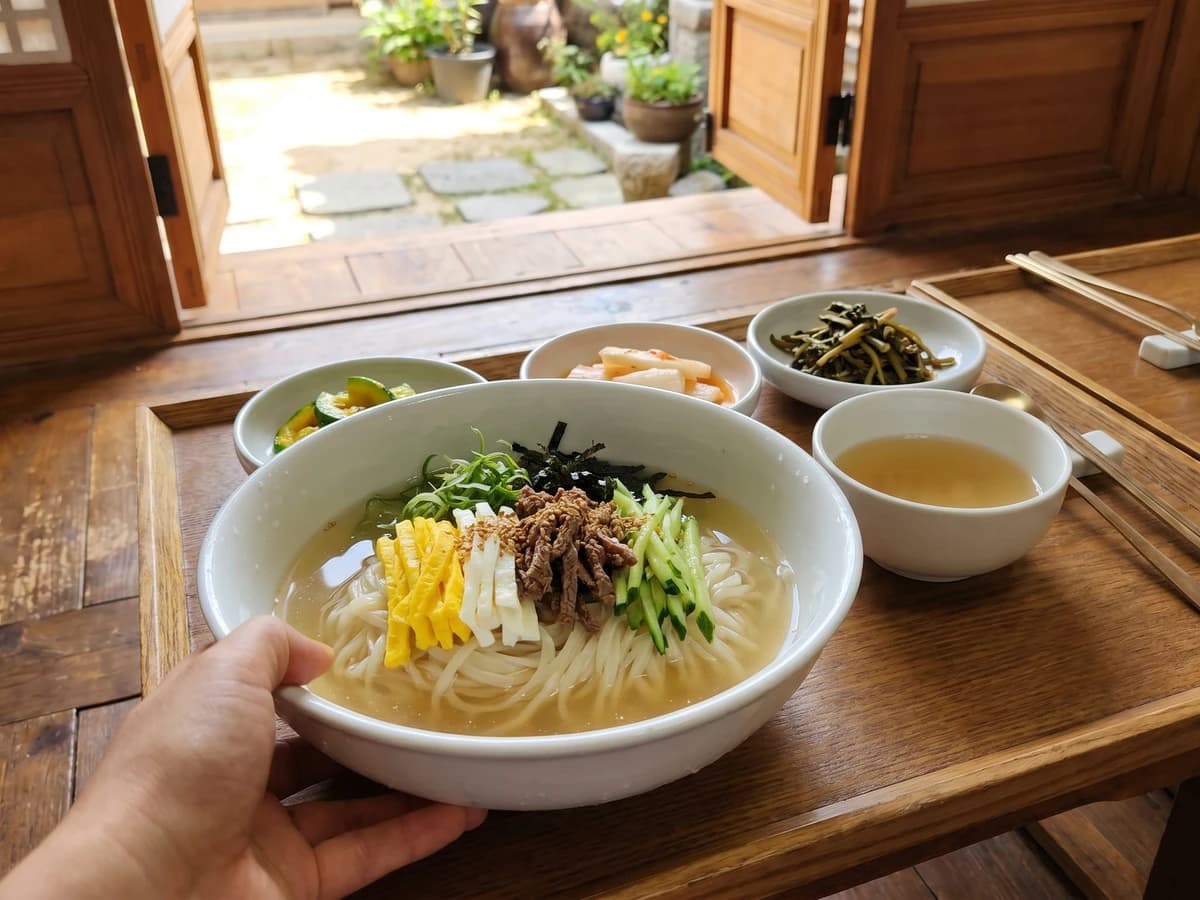
Andong's guest noodles, wheat and roasted soybean flour rolled thin, boiled and rinsed cold, then set in a clear chilled anchovy broth with careful strips of beef, egg, and cucumber.

Chef Jeong-sun
Andong's ritual-table rice served on an ordinary day: separate soy-sesame namul, warm rice, and clear radish soup, mixed without gochujang so every vegetable keeps its own voice.