
Chef Jeong-sun
Aehobak-bokkeum (Korean Stir-Fried Zucchini)
Tender Korean zucchini half-moons cooked quickly over real heat, seasoned with salted shrimp so the squash tastes deeper than oil and still clean enough for a weeknight table.
A cooking platform built around craft, culture, and the stories behind what we eat.
Created by
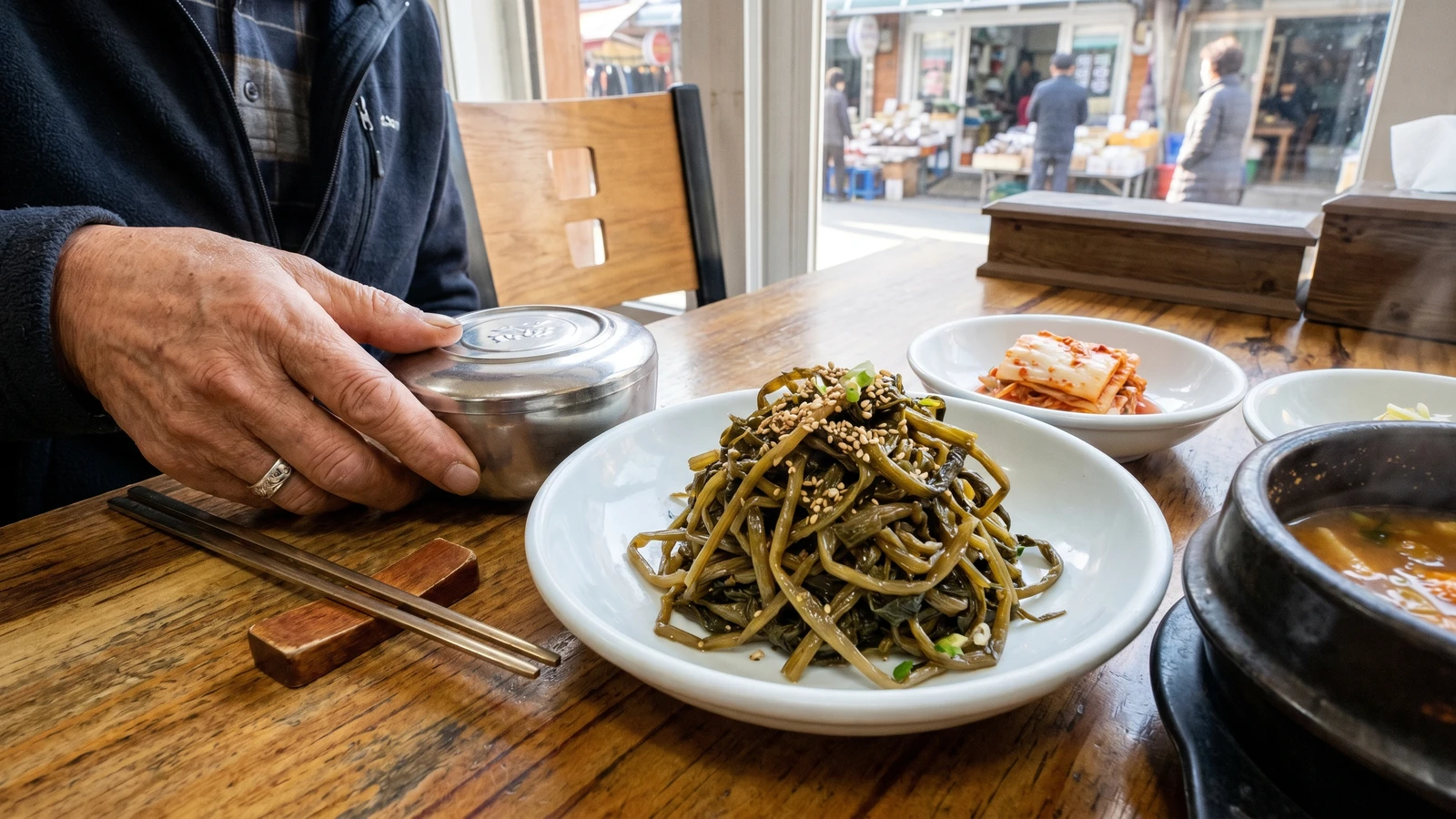
Dried Gangwon thistle softened with patience, seasoned alone with soup soy sauce and perilla oil, then warmed gently until each strand turns tender, nutty, and still clearly itself.
At a Gangwon market in late spring, gondre is sold fresh for a short while, then tied and dried because mountains are honest about winter. The dried bundles are not a punishment. They are the dish. Tonight they ask for time, water, and restraint, not cleverness.
Notebook 42 says 60 grams of dried gondre became 320 grams cooked in my Bukchon kitchen, enough for four banchan servings. That number matters because dried mountain greens do not season by handful. Too much soy makes them taste only of soy; too little leaves them dusty. Season it alone in its bowl, rub the perilla oil and soy through the strands, then give it a covered turn in the pan so the fibers soften all the way through.
Master Seong-nyeo would tap the thick stem with her chopstick and say, 'Not yet,' which was one of her longer speeches. Gondre-namul belongs beside rice, often with doenjang-jjigae and one sharp kimchi, and it rewards the cook who doesn't rush the stubborn parts. The mountain green fed lean winters before it became a regional specialty, and that is enough dignity for one small plate.
Gondre is the Korean name for Cirsium setidens, a perennial mountain thistle associated especially with Gangwon Province and the high, cool terrain around Jeongseon. In that region, dried sanchae (산채, mountain greens) were winter food when fields were narrow and fresh vegetables were scarce, and Jeongseon gondre-bap, rice cooked with softened gondre, became the best-known local dish. The namul keeps the same mountain pantry logic: preservation first, then gentle seasoning with soy and perilla oil so the green remains the main taste.
Quantity
60g
Quantity
as needed for soaking, plus 8 cups for boiling
Quantity
1 1/2 tablespoons
Quantity
1 teaspoon
Quantity
1 teaspoon
finely minced
Quantity
1 tablespoon
finely chopped
Quantity
1 1/2 tablespoons
divided
Quantity
2 tablespoons
Quantity
1 teaspoon
lightly crushed
Quantity
1 tablespoon
Quantity
up to 1/4 teaspoon
| Ingredient | Quantity |
|---|---|
| dried gondre (곤드레, Korean thistle greens) | 60g |
| water | as needed for soaking, plus 8 cups for boiling |
| guk-ganjang (국간장, Korean soup soy sauce) | 1 1/2 tablespoons |
| jin-ganjang (진간장, regular soy sauce) | 1 teaspoon |
| garlicfinely minced | 1 teaspoon |
| scallionfinely chopped | 1 tablespoon |
| deulgireum (들기름, toasted perilla oil)divided | 1 1/2 tablespoons |
| reserved gondre cooking liquid or water | 2 tablespoons |
| toasted sesame seedslightly crushed | 1 teaspoon |
| deulkkae-garu (들깨가루, ground perilla seed) (optional) | 1 tablespoon |
| fine sea salt (optional) | up to 1/4 teaspoon |
Rinse the dried gondre in two changes of cold water, rubbing lightly to loosen dust from the curled leaves. Put it in a large bowl and cover with cold water by at least 3 inches. Soak 8 hours or overnight. Dried mountain greens need time to drink evenly; hot water hurries the leaves while the stems stay wiry.
Drain the soaking water and put the gondre in a pot with 8 cups fresh water. Bring to a boil, then lower to a steady simmer and cook 35 to 45 minutes, until a thick stem bends easily and can be pinched between your fingers. Turn off the heat and let the greens rest in the hot cooking liquid for 15 minutes. This rest is not laziness. It lets the fibers finish softening without breaking the leaves apart.
Drain the gondre, rinse once under cool running water, and squeeze gently. Do not wring it dry like laundry; it should feel moist but not dripping. Trim away any woody stem ends, then cut the greens into 2-inch lengths. You should have about 300 to 350g cooked gondre, roughly 2 packed cups. That number is why the seasoning below works.
Put the cut gondre in a mixing bowl. Add the guk-ganjang, jin-ganjang, garlic, scallion, 1 tablespoon of the perilla oil, the crushed sesame seeds, and the ground perilla seed if using. Mix by hand, separating the strands so the seasoning reaches the stems as well as the leaves. Taste one piece now. It should be lightly seasoned, not salty, because the pan will tighten the flavor.
Set a skillet over medium-low heat and add the remaining 1/2 tablespoon perilla oil. Add the seasoned gondre and stir for 2 minutes, just until the oil glosses the strands. Add the 2 tablespoons reserved cooking liquid or water, cover, and cook 5 to 6 minutes. Uncover and stir another minute, until the greens are moist but not wet. Do not fry hard; perilla oil turns bitter with rough heat, and gondre dries into twine.
Taste once more before serving. If it needs salt, add it 1/8 teaspoon at a time, up to 1/4 teaspoon. Mound the gondre-namul in a small banchan dish and scatter a few more sesame seeds if you like. Serve warm or at room temperature with rice, kimchi, and a plain soup or stew. Let it taste like itself.
1 serving (about 100g)
Culinary guides, cultural storytelling, and the editorial depth that makes cooking meaningful.
Discover Culinary ExplorerChef Jeong-sun
Tender Korean zucchini half-moons cooked quickly over real heat, seasoned with salted shrimp so the squash tastes deeper than oil and still clean enough for a weeknight table.

Chef Jeong-sun
Tender Korean summer zucchini softened gently in the pan with saeujeot for salt and depth, finished with sesame so the vegetable stays sweet, green, and plainly itself.

Chef Jeong-sun
A bittersweet spring green from the southern shore, blanched just until pliant, then seasoned lightly so its clean coastal bitterness stays alive on the rice table.

Chef Jeong-sun
Torn king oyster or shiitake mushrooms, browned until their own water disappears, then finished with soy, garlic, sesame oil, and onion for a quiet banchan that earns its place.