
Chef Jeong-sun
Agwi-jjim (Braised Monkfish with Bean Sprouts)
Firm monkfish buried under crisp soybean sprouts, minari, and a red gochugaru sauce thickened at the end; Masan's market dish asks for heat, timing, and a steady hand.
A cooking platform built around craft, culture, and the stories behind what we eat.

Created by
Busan's late-night hagfish, cleaned hard, softened with soju and a quick parboil, then stir-fried over real heat so the hot-sweet sauce clings without hiding the seafood underneath.
Gomjangeo belongs to the late table. Not the polite one with everyone sitting upright, but the Busan table with a small pan in the middle, a glass of soju nearby, and people leaning in because the food will not wait. It is chewy, spicy, a little stubborn. That is its character, and you should not cook the character out of it.
The misunderstanding begins with the name. People hear jangeo (eel) and expect a soft eel dish. Gomjangeo, often called kkomjangeo (꼼장어), is hagfish, and it asks for different hands. The slime and sea smell must be handled before the pan ever sees it: coarse salt, flour, soju, then a quick parboil. Skip that and you will bury the problem under gochujang. I have no patience for that. Let it taste like itself, clean and springy under the sauce.
Notebook 41 says 450g of cleaned hagfish takes 90 seconds in boiling water and about 5 minutes in the wok. Longer than that and the chew turns tough. The sauce is measured too, because a street-cart dish deserves the same care as a holiday one. 손맛 is real; I measure it anyway, so the next cook can make the same pan.
Despite the eel in the Korean name jangeo, gomjangeo or kkomjangeo is hagfish, a jawless marine fish long sold around Busan's ports. The spicy grilled and stir-fried style became strongly associated with Jagalchi Market and Nampo-dong after the Korean War, when inexpensive seafood and charcoal stalls fed refugees, dock workers, and late drinkers. Busan still serves it as anju (food for alcohol), either over briquettes or in a red bokkeum pan, and its history belongs to the market rather than any court record.
Quantity
450g (1 lb)
cut into 5cm pieces
Quantity
1 tablespoon
for washing
Quantity
2 tablespoons
for washing
Quantity
1/2 cup
for soaking
Quantity
1/2 cup
for soaking
Quantity
4 cups
for parboiling
Quantity
2
for parboiling
Quantity
3 thin slices
for parboiling
Quantity
2 tablespoons
Quantity
1 tablespoon
Quantity
1 1/2 tablespoons
Quantity
1 tablespoon
Quantity
1 tablespoon
for the sauce
Quantity
1 tablespoon
minced
Quantity
1 teaspoon
minced
Quantity
1 teaspoon
Quantity
1/4 teaspoon
Quantity
2 tablespoons
for loosening the sauce
Quantity
1 tablespoon
Quantity
1/2 medium
sliced 1cm thick
Quantity
2 cups
cut into 4cm squares
Quantity
1/2
thinly sliced
Quantity
1
sliced on the diagonal
Quantity
2
cut into 5cm lengths
Quantity
8
thinly sliced
Quantity
1 teaspoon
Quantity
1 teaspoon
Quantity
to serve
Quantity
to serve
| Ingredient | Quantity |
|---|---|
| skinned and cleaned hagfish (gomjangeo or kkomjangeo)cut into 5cm pieces | 450g (1 lb) |
| coarse sea saltfor washing | 1 tablespoon |
| all-purpose flourfor washing | 2 tablespoons |
| sojufor soaking | 1/2 cup |
| cold waterfor soaking | 1/2 cup |
| waterfor parboiling | 4 cups |
| scallion topsfor parboiling | 2 |
| fresh gingerfor parboiling | 3 thin slices |
| gochujang (Korean chili paste) | 2 tablespoons |
| gochugaru (Korean chili flakes) | 1 tablespoon |
| soy sauce | 1 1/2 tablespoons |
| rice syrup (jocheong) or oligo syrup | 1 tablespoon |
| sojufor the sauce | 1 tablespoon |
| garlicminced | 1 tablespoon |
| gingerminced | 1 teaspoon |
| doenjang (fermented soybean paste) | 1 teaspoon |
| freshly ground black pepper | 1/4 teaspoon |
| waterfor loosening the sauce | 2 tablespoons |
| neutral oil | 1 tablespoon |
| onionsliced 1cm thick | 1/2 medium |
| green cabbagecut into 4cm squares | 2 cups |
| small carrotthinly sliced | 1/2 |
| fresh green chilisliced on the diagonal | 1 |
| scallionscut into 5cm lengths | 2 |
| perilla leaves (kkaennip)thinly sliced | 8 |
| toasted sesame oil | 1 teaspoon |
| toasted sesame seeds | 1 teaspoon |
| cooked short-grain rice (optional) | to serve |
| whole perilla leaves or lettuce leaves (optional) | to serve |
Start with hagfish that has been skinned and cleaned by the fishmonger. This is the corner you do not shorten at home unless you already know the animal. Trim away any dark bits left inside and cut the pieces evenly, about 5cm long, so they cook at the same pace.
Put the hagfish in a bowl with the coarse salt and flour. Rub firmly for 2 minutes, using gloved hands if you like. The salt tightens the surface and the flour grabs the remaining slime, which is why the sauce will cling later instead of sliding off. Rinse under cold running water until the water is no longer cloudy, then drain.
Combine 1/2 cup soju and 1/2 cup cold water in a bowl, add the drained hagfish, and soak 10 minutes. Do not soak it all afternoon. You want to quiet the smell, not wash the character out of the seafood. Drain and pat the pieces dry.
Stir together the gochujang, gochugaru, soy sauce, rice syrup, 1 tablespoon soju, garlic, ginger, doenjang, black pepper, and 2 tablespoons water. The teaspoon of doenjang is not there to make stew. It gives the sauce depth and helps settle the seafood smell without making the pan taste like paste.
Bring 4 cups water to a hard boil with the scallion tops and ginger slices. Add the hagfish and boil 90 seconds, just until the pieces begin to firm and curl. Drain immediately and discard the parboiling water. This step tames the smell and sets the texture; it is not meant to cook the hagfish through.
Heat a 30cm wok or wide skillet over high heat until a drop of water jumps on contact. Add the neutral oil, then the onion, cabbage, and carrot. Stir-fry 1 1/2 to 2 minutes, just until the onion edges turn glossy and the cabbage begins to soften. The vegetables should still have bite, because they have more time coming with the sauce.
Add the parboiled hagfish and green chili to the pan. Spoon in about one-third of the sauce and toss hard for 1 minute so the surface of the hagfish takes the seasoning. Add the remaining sauce and stir-fry 3 to 4 minutes, scraping the pan as the sauce reduces. It is ready when the sauce is glossy and clinging, the hagfish is opaque and springy, and the thickest piece reaches 63 C / 145 F if you check with a thermometer.
Add the scallions and half the sliced perilla leaves and toss for 30 seconds. Turn off the heat and fold in the sesame oil. Perilla goes in late because its green, peppery edge disappears if you cook it too long.
Transfer to a shallow pan or platter and scatter with sesame seeds and the remaining perilla. Serve at once with rice, whole perilla leaves or lettuce leaves, and a few plain banchan. This is food for eating while it is still glossy from the pan, not food to admire from across the room.
1 serving (about 350g)
Culinary guides, cultural storytelling, and the editorial depth that makes cooking meaningful.
Discover Culinary ExplorerChef Jeong-sun
Firm monkfish buried under crisp soybean sprouts, minari, and a red gochugaru sauce thickened at the end; Masan's market dish asks for heat, timing, and a steady hand.

Chef Jeong-sun
A quick Korean rice bowl built on contrast: warm rice, cold popping flying-fish roe, chopped vegetables, gim, sesame oil, and the crisp rice bottom a hot stone bowl gives you.
Chef Jeong-sun
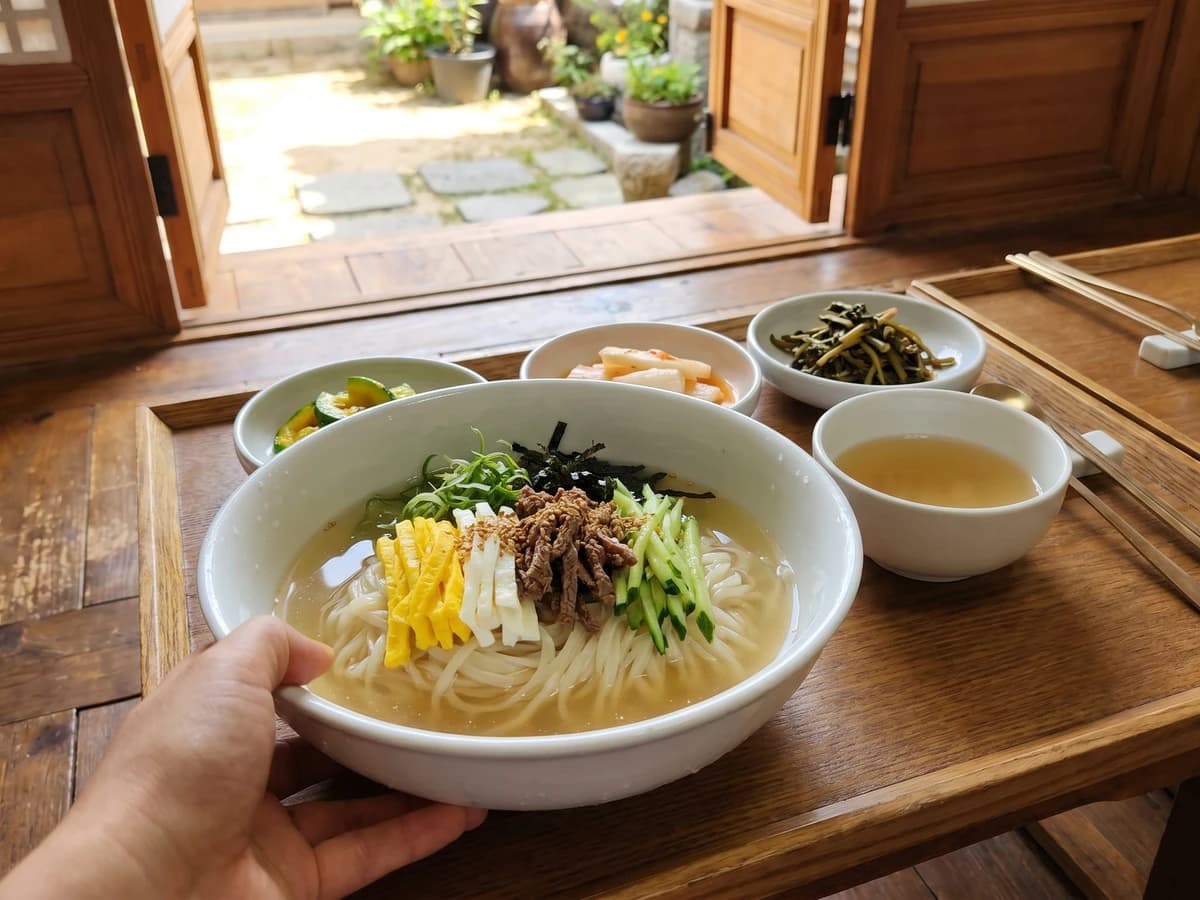
Andong's guest noodles, wheat and roasted soybean flour rolled thin, boiled and rinsed cold, then set in a clear chilled anchovy broth with careful strips of beef, egg, and cucumber.

Chef Jeong-sun
Andong's ritual-table rice served on an ordinary day: separate soy-sesame namul, warm rice, and clear radish soup, mixed without gochujang so every vegetable keeps its own voice.