
Chef Jeong-sun
Aehobak-guk (애호박국, Korean Zucchini Soup)
A clean summer soup of Korean zucchini and salted shrimp, built on quick anchovy-kelp broth and finished before the half-moons lose their shape on a weeknight table.
A cooking platform built around craft, culture, and the stories behind what we eat.

Created by
A thin, mild doenjang broth carrying Swiss chard and tofu, the weeknight soup that asks for restraint: strip the tough stems, simmer the leaves briefly, and stop before the green disappears.
Geundae is best when the market leaves are firm and the ribs are slender, spring into early summer and again when autumn cools the stalls. Later in the season the center stems get tough, and then the cook has to be honest with the knife. Strip them. Keep only what will soften in the same time as the leaf.
This is not doenjang-jjigae. A jjigae is dense and forceful; this is guk (soup), thin enough to drink beside rice on a weeknight when the table needs comfort but not weight. Master Seong-nyeo had me taste the broth before the leaves went in and again after they softened. The second spoon should taste greener, not saltier. That is how you know the geundae still tastes like itself.
The work tonight is small but exact: make a clean anchovy-kelp broth, dissolve the doenjang fully, and stop cooking when the leaves slump. Too much paste makes the soup muddy, and too much heat makes the chard dull. Write the amount down when your own doenjang lands right. Memory is a borrowed bowl.
Jang (fermented soybean seasonings), the base of doenjang-guk, appears in Korean records by the Silla period; Samguk Sagi records jang among provisions for King Sinmun's marriage in 683. Geundae (leaf beet or chard) is a market green, not palace food, and geundae-doenjang-guk belongs to the everyday family of thin soybean-paste soups made with seasonal leaves such as spinach, mallow, napa leaves, and radish greens. Rice-rinsing water and anchovy broth helped a small spoonful of paste carry a rice table, which is why this mild soup stayed in home kitchens rather than formal banquet records.
Quantity
1 bunch, about 250g before trimming
washed, tough stems stripped, leaves cut into 3-inch pieces
Quantity
6 cups, or 5 cups if using rice-rinsing water
Quantity
1 cup
from the second rinse, replacing 1 cup water
Quantity
1 piece, about 4 inches square
Quantity
10
heads and guts removed
Quantity
3 tablespoons, plus 1 teaspoon only if needed
Quantity
1/2 small (about 70g)
thinly sliced
Quantity
150g
cut into 1/2-inch cubes
Quantity
2 cloves
minced
Quantity
1 teaspoon
for final seasoning
Quantity
1/4 teaspoon, only if needed
Quantity
2
thinly sliced
Quantity
1
thinly sliced
| Ingredient | Quantity |
|---|---|
| geundae or Swiss chardwashed, tough stems stripped, leaves cut into 3-inch pieces | 1 bunch, about 250g before trimming |
| water | 6 cups, or 5 cups if using rice-rinsing water |
| second rice-rinsing water (ssalddeumul) (optional)from the second rinse, replacing 1 cup water | 1 cup |
| dried kelp (dasima) | 1 piece, about 4 inches square |
| large dried anchovies (myeolchi)heads and guts removed | 10 |
| doenjang (Korean fermented soybean paste) | 3 tablespoons, plus 1 teaspoon only if needed |
| onionthinly sliced | 1/2 small (about 70g) |
| medium-firm tofucut into 1/2-inch cubes | 150g |
| garlicminced | 2 cloves |
| guk-ganjang (Korean soup soy sauce) (optional)for final seasoning | 1 teaspoon |
| fine sea salt (optional) | 1/4 teaspoon, only if needed |
| scallionsthinly sliced | 2 |
| green chili (optional)thinly sliced | 1 |
Wash the chard in a basin of cold water, lifting the leaves out so the grit stays behind. Fold each leaf along the center rib and strip away any stem thicker than a pencil. Keep only tender stems, sliced 1/4 inch thick, and cut the leaves into 3-inch pieces. You should have about 220g trimmed greens. The measure matters because too many leaves turn a thin guk into a vegetable pot, and too few leave the broth empty.
Put the 6 cups liquid, kelp, and cleaned anchovies in a medium pot. Bring it slowly to a simmer over medium heat. Pull the kelp out as soon as the water trembles and small bubbles gather at the edge, because boiled kelp turns slick and bitter. Simmer the anchovies 8 more minutes, then remove them. You want about 5 cups of clean, savory broth.
Lower the heat to medium-low. Rub the doenjang through a small strainer into the broth, or mash it in a ladle with hot broth until no lumps remain. Start with 3 tablespoons. This is guk (soup), not jjigae (stew), so the broth should be savory and light enough to drink beside rice.
Add the sliced onion and any tender chard stems you kept. Simmer 2 minutes so the stems lose their raw edge. Add the tofu and garlic and simmer 3 minutes more. Tofu should warm through gently; hard boiling makes it rough and pushes the broth out of balance.
Add the chard leaves and press them under the broth. Simmer 2 to 3 minutes, just until the leaves slump and turn deeper green. Stop there. If you cook them until they collapse completely, the soup tastes dull and the chard no longer tastes like itself.
Taste the broth. If it needs salt, add 1 teaspoon guk-ganjang or 1/4 teaspoon fine sea salt, not another spoonful of doenjang unless the soybean flavor is weak. Stir in the scallions and the optional green chili, then turn off the heat. Serve at once with rice and kimchi. This is a soup for tonight's table, not a pot to wait an hour.
1 serving (about 450g)
Culinary guides, cultural storytelling, and the editorial depth that makes cooking meaningful.
Discover Culinary ExplorerChef Jeong-sun
A clean summer soup of Korean zucchini and salted shrimp, built on quick anchovy-kelp broth and finished before the half-moons lose their shape on a weeknight table.
Chef Jeong-sun
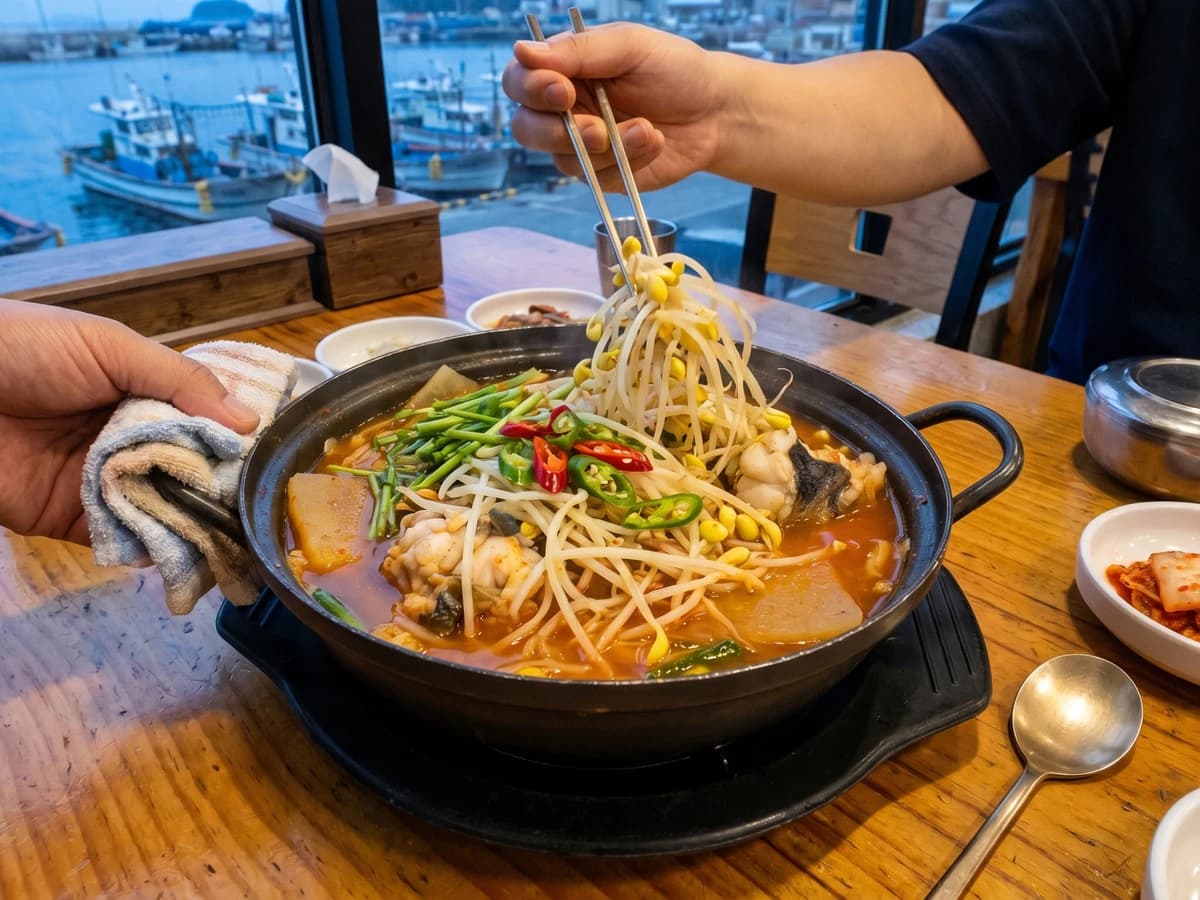
A Masan coast monkfish stew with firm white meat, gelatin at the bones, soybean sprouts for crunch, and a red broth seasoned to carry the fish, not bury it.

Chef Jeong-sun
A weeknight fish roe stew with radish and crown daisy in a clean spicy broth, where the whole success depends on adding the roe late enough that it sets tender, not chalky.

Chef Jeong-sun
Late-summer mallow leaves rubbed with salt until the bitter green water runs off, then simmered in a clean doenjang broth with dried shrimp, the quiet soup a Korean weeknight deserves.