
Chef Fai
Dry Egg Noodles (Ba Mee Haeng)
The four pillars live at the bottom of the bowl before the noodles ever touch it: nam pla for salt, sugar for sweet, vinegar for sour, chili for heat. Every noodle cart in Bangkok runs on this principle.
A cooking platform built around craft, culture, and the stories behind what we eat.
Created by
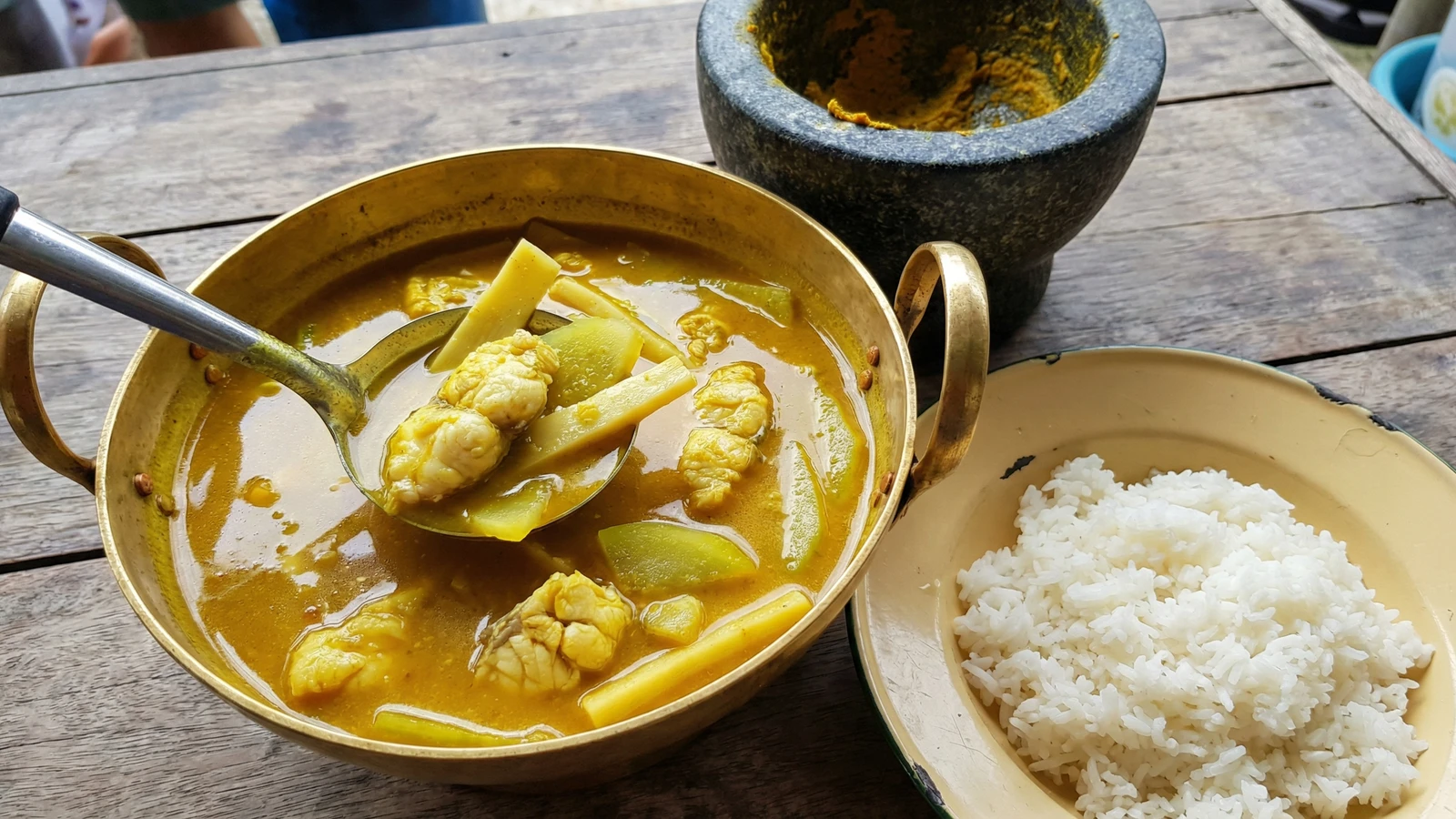
Southern Thailand's thin golden curry where turmeric dominates the kreung tam, tamarind leads the sour pillar, and the broth is clean, fierce, and coastal. No coconut. No sweetness. Just the peninsula.
Gaeng luang is the South talking. No coconut cream to soften the blow. No palm sugar to round the edges. Just a turmeric-stained kreung tam dissolved into a thin, sour, spicy broth with chunks of fish and whatever vegetable the market had that morning. This is everyday eating on the Thai peninsula, and it follows the four pillars with a Southern accent: nam pla for salt, tamarind for sour (not lime, not manao, tamarind), barely any sweet, and dried chilies pounded into the paste in quantities that would horrify a Central Thai cook.
Ajarn always said the kreung tam is everything. In gaeng luang, the kreung tam is golden. Fresh turmeric (kha min) is the backbone, so much of it that the paste stains your mortar, your hands, your cutting board, and your shirt for a week. Southern Thai pastes use turmeric the way Central Thai pastes use cilantro root: as a defining structural element, not a garnish. Add a fistful of dried long chilies (prik haeng), shallots, garlic, and a wallop of shrimp paste (kapi). Pound it in the krok until the whole kitchen smells like the earth and the sea had a conversation.
The broth is thin. That's the point. Gaeng luang is not gaeng massaman. It's not meant to coat your spoon. It's meant to pour over rice and soak through, carrying turmeric heat and tamarind sourness into every grain. The fish goes in at the end, barely cooked, flaking apart in the bowl. Green papaya or bamboo shoots add crunch against the soft fish. That contrast is the architecture of the dish.
Southern Thai food doesn't hold back, and neither does this curry. If you grew up in Nakhon Si Thammarat or Songkhla, this is what your grandmother made on a Tuesday. Not for special occasions. For lunch. The principles don't change just because the dish is humble. The kreung tam still gets pounded. The balance still gets tasted. The fish still goes in at the right second. Principles, not recipes.
Gaeng luang (แกงเหลือง, literally "yellow curry") is native to Thailand's southern provinces, where turmeric grows abundantly and enters the kreung tam of nearly every local dish. The non-coconut, broth-based curries of the South (gaeng luang, gaeng som pak tai, gaeng tai pla) form a distinct family that predates the richer coconut curries and reflects the peninsula's fishing culture: quick-cooking curries designed around the daily catch. The name refers simply to the vivid golden color from fresh turmeric, distinguishing it from the region's other everyday curries by sight alone.
Quantity
400g
cut into 2-inch pieces
Quantity
4 cups
Quantity
150g
peeled, cut into thin wedges
Quantity
100g
sliced thin
Quantity
3 tablespoons
dissolved in 3 tablespoons warm water and strained
Quantity
2 tablespoons
Quantity
1 teaspoon
Quantity
10
soaked in warm water 15 minutes, seeded, and drained
Quantity
80g
peeled and sliced
Quantity
8
peeled and sliced
Quantity
6 cloves
peeled
Quantity
1 tablespoon
Quantity
1 teaspoon
Quantity
1 teaspoon
| Ingredient | Quantity |
|---|---|
| firm white fish fillets (snapper, sea bass, or barramundi)cut into 2-inch pieces | 400g |
| water or light fish stock | 4 cups |
| green papaya (malakor)peeled, cut into thin wedges | 150g |
| bamboo shoots (no mai)sliced thin | 100g |
| tamarind paste (nam makham piak)dissolved in 3 tablespoons warm water and strained | 3 tablespoons |
| fish sauce (nam pla) | 2 tablespoons |
| palm sugar (nam tan pip) | 1 teaspoon |
| dried long red chilies (prik haeng)soaked in warm water 15 minutes, seeded, and drained | 10 |
| fresh turmeric root (kha min)peeled and sliced | 80g |
| shallots (hom daeng)peeled and sliced | 8 |
| garlic (kratiam)peeled | 6 cloves |
| shrimp paste (kapi) | 1 tablespoon |
| black peppercorns (prik thai dam) | 1 teaspoon |
| salt | 1 teaspoon |
Start with the salt and peppercorns in your granite mortar (krok hin). Grind them to powder. Add the drained dried chilies and pound to a rough paste. Then the shallots and garlic, pounding each addition before the next goes in. Now the turmeric. This is where the paste turns gold. Pound until the turmeric is fully broken down and the paste is vivid yellow-orange with no fibrous chunks remaining. Finally, add the shrimp paste (kapi) and pound it through. The finished kreung tam should be wet, fragrant, and so golden it stains the pestle. If your hands aren't yellow, you didn't use enough turmeric.
Bring the water or fish stock to a rolling boil in a pot. Add the entire kreung tam and stir to dissolve it completely. The liquid should turn a deep, cloudy gold within seconds. Let it boil for 3 minutes so the turmeric and chili flavors fully infuse the broth. You'll smell it: earthy, peppery, with the fermented punch of kapi rising through. That's the foundation building.
Add the green papaya wedges and bamboo shoots to the boiling broth. These go in first because they need more time than the fish. Cook for 5 minutes until the papaya is tender but still holds its shape. It should bend, not collapse. The bamboo shoots soften and absorb that golden broth. Poke a papaya wedge with a knife. If it slides through with slight resistance, you're there.
Add the strained tamarind water, fish sauce, and palm sugar. Stir once. Now taste. This is the critical moment. The balance should read: sour first, salty second, spicy underneath, and sweet barely registering. Tamarind is the lead singer here. It should hit your tongue before anything else. If the sourness doesn't make you wince slightly, add more tamarind. Fish sauce for depth. The palm sugar is just there to keep the tamarind from becoming abrasive. A teaspoon. Maybe less. Southern food leans sour and spicy. Don't sweeten it into Central Thai territory.
Lay the fish pieces gently into the simmering broth. Don't stir. Don't poke. Don't touch them for 3 minutes. White fish is fragile. It flakes apart if you look at it wrong. Let the curry do the work. The broth will cook the fish through in 3 to 4 minutes depending on thickness. You'll see the flesh turn opaque from the edges inward. When the thickest piece is white all the way through and just starting to flake at the surface, you're done. Kill the heat immediately.
Ladle the curry into bowls, making sure each bowl gets fish, vegetables, and plenty of that golden broth. Serve with steamed jasmine rice on the side. Pour the broth over the rice and let it soak through. That's how it's eaten: the rice absorbs the turmeric-stained, tamarind-sour liquid until every grain is golden and flavored. No garnish needed. The dish is complete.
1 serving (about 350g)
Culinary guides, cultural storytelling, and the editorial depth that makes cooking meaningful.
Discover Culinary ExplorerChef Fai
The four pillars live at the bottom of the bowl before the noodles ever touch it: nam pla for salt, sugar for sweet, vinegar for sour, chili for heat. Every noodle cart in Bangkok runs on this principle.

Chef Fai
The kreung tam fried in cracked coconut cream until the oil bleeds red. That's the technique. Concentrated, semi-dry, spooned thick over crispy fish. This is what happens when the four pillars meet restraint.

Chef Fai
Isan foraging in a bowl: wild taro stems stripped of their sting, simmered in padaek broth with a pounded chili paste and yanang leaf extract. The land feeds you if you know the rules.

Chef Fai
Lanna's kreung tam breaks from Central Thai rules: ginger over galangal, cumin and coriander from Burmese spice routes, tamarind for sour instead of lime. The North has its own system, and this curry is its crown.