
Chef Fai
Thick Shrimp Dry Curry (Gaeng Khua Goong)
The khua technique is the Southern kreung tam pushed to its limit: paste dry-fried in thick coconut cream until the fat breaks and the oil pools golden. Then the shrimp. Then silence at the table.
A cooking platform built around craft, culture, and the stories behind what we eat.
Created by
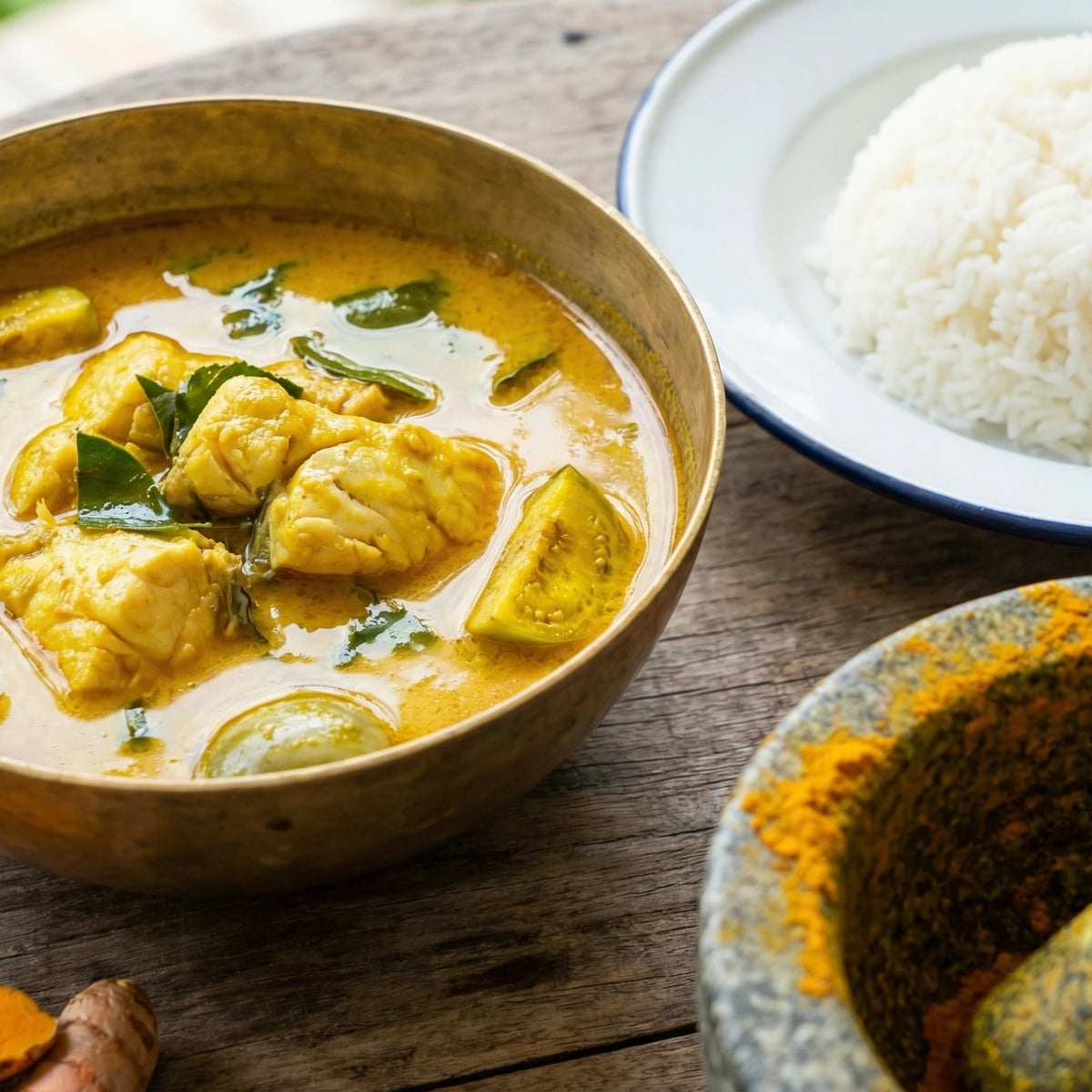
A turmeric-stained kreung tam pounded hard, stirred into thin coconut milk with white fish. Southern Thai peninsula cooking where the paste is golden, the broth is sour, and sweetness barely registers.
The south doesn't cook like Bangkok. That's the first thing you need to understand.
Every region in Thailand works from the same four pillars: nam pla for salt, nam tan pip for sweet, tropical acid for sour, prik for spice. But the south cranks the dial hard toward sour and spicy, and leaves sweet almost untouched. That imbalance is the signature. It's not an accident. It's a principle adapted to place, to the peninsula's climate, its proximity to the sea, its Muslim and Malay neighbors who brought spice trade knowledge that the rest of Thailand never absorbed the same way.
Gaeng kati pla is the Southern kreung tam at its most direct. Fresh kamin (turmeric) dominates everything. Not a pinch. Not a teaspoon. A fistful. Pounded with dried long chilies, shallots, garlic, kapi (shrimp paste), and white peppercorns in quantities that would make a Central Thai cook nervous. When you're done pounding, the paste is deep gold, almost orange, and it stains your mortar, your hands, your cutting board. That stain is how you know you're in the south. Every kitchen in Nakhon Si Thammarat has turmeric-yellow everything.
The coconut milk here is thin. Not the thick, creamy head you crack for a green curry. Southern gaeng kati uses the second pressing, the watery extraction that gives body without richness. The fish poaches gently in that turmeric-gold broth, absorbing the paste. You don't boil it hard. You don't stir it roughly. White fish is delicate. Treat it like it just came off a fishing boat in Songkhla, because that's exactly the context this dish was built for.
Ajarn always said: "The kreung tam tells you where you are." Green chili paste, you're in the center. Dried spice paste, you're in the north. Turmeric paste that stains everything gold? You're on the peninsula. The south.
Gaeng kati pla belongs to the everyday repertoire of Thailand's southern provinces, particularly Nakhon Si Thammarat, Songkhla, and Surat Thani, where fresh-caught fish and coconut palms are abundant. The dish reflects the peninsula's position on ancient maritime spice routes: turmeric (kamin) arrived from South Asian trade and became the defining spice of Southern Thai cooking in a way unmatched by any other region. Unlike the non-coconut Southern curries (gaeng som, gaeng luang), gaeng kati represents the subset of Southern dishes where coconut milk tempers the region's characteristic sourness and heat, making it the everyday comfort curry of fishing communities along the Gulf of Thailand and the Andaman coast.
Quantity
500g
cut into 2-inch pieces
Quantity
3 cups
Quantity
1/2 cup
Quantity
3 tablespoons, plus more to taste
Quantity
1 tablespoon
dissolved in 2 tablespoons warm water
Quantity
1 teaspoon
Quantity
2
torn
Quantity
1 cup
quartered
Quantity
for serving
Quantity
80g
peeled and sliced
Quantity
7
soaked in warm water 15 minutes, seeded
Quantity
5
Quantity
8
peeled
Quantity
6 cloves
Quantity
1 tablespoon
Quantity
1 teaspoon
Quantity
1 stalk
tender inner part only, thinly sliced
Quantity
3 slices
roughly chopped
| Ingredient | Quantity |
|---|---|
| firm white fish fillets (snapper, sea bass, or barramundi)cut into 2-inch pieces | 500g |
| thin coconut milk (hua kati bao, second pressing) | 3 cups |
| thick coconut cream (hua kati) | 1/2 cup |
| fish sauce (nam pla) | 3 tablespoons, plus more to taste |
| tamarind paste (nam makham piak)dissolved in 2 tablespoons warm water | 1 tablespoon |
| palm sugar (nam tan pip) | 1 teaspoon |
| kaffir lime leaves (bai makrut)torn | 2 |
| Thai apple eggplant (makhuea pro)quartered | 1 cup |
| steamed jasmine rice | for serving |
| fresh turmeric root (kamin)peeled and sliced | 80g |
| dried long chilies (prik haeng)soaked in warm water 15 minutes, seeded | 7 |
| bird's eye chilies (prik khi nu) | 5 |
| shallots (hom daeng)peeled | 8 |
| garlic | 6 cloves |
| shrimp paste (kapi) | 1 tablespoon |
| white peppercorns | 1 teaspoon |
| lemongrass (takhrai)tender inner part only, thinly sliced | 1 stalk |
| galangal (kha)roughly chopped | 3 slices |
Start with the dried ingredients. Pound the white peppercorns in the granite mortar until fine. Add the soaked and drained dried long chilies and the fresh bird's eye chilies. Pound to a rough paste. Now the hard aromatics: lemongrass, galangal, garlic, shallots. Add them in that order, pounding each addition down before adding the next. The mortar will fight you. Keep going. Now the turmeric. This is where everything turns gold. Pound the fresh kamin into the paste until it's fully incorporated. Your hands, the pestle, the rim of the mortar, everything is stained yellow now. Good. That's the south. Finally, add the kapi and pound until the paste is cohesive, fragrant, and deep golden-orange. The aroma should be sharp turmeric, smoky dried chili, and the funk of the shrimp paste hitting you all at once.
Heat the thick coconut cream in a wide pot or deep pan over medium heat. Stir until it begins to split and the oil separates. You'll see clear pools of coconut oil forming on the surface and the cream will look broken, almost curdled. That's exactly right. Add the entire kreung tam paste. Fry it in the cracked coconut cream, stirring constantly, for 3 to 4 minutes. The paste should darken slightly, the raw turmeric smell should soften, and the oil should take on a golden tint. When the aroma shifts from sharp and raw to deep and roasted, you're there.
Pour in the thin coconut milk. All of it. Stir to combine with the fried paste. The liquid will turn a beautiful turmeric gold. Bring it to a gentle simmer, not a boil. Drop in the torn kaffir lime leaves and the quartered eggplant. Let it simmer for 5 minutes until the eggplant is just tender but still holds its shape. Season now: fish sauce first, then the tamarind water, then the palm sugar. Taste. The balance should lean sour and salty with heat building in the background. The sweetness should barely register, just enough to round the edges. This isn't Central Thai. The south keeps sweet on a short leash.
Lower the fish pieces gently into the simmering broth. Do not stir. Do not poke. Do not flip. Let the curry do the work. The fish poaches in 5 to 7 minutes depending on thickness. You'll know it's done when the flesh turns opaque and flakes easily if you press a piece gently with a spoon. White fish is forgiving, but overcooking turns it to mush. Pull the pot off the heat the moment the fish is done.
Final taste. The curry should be: turmeric-forward, sour from the tamarind, salty from the nam pla, gently spicy, with the coconut milk providing body but not richness. Adjust. More fish sauce if it needs depth. A squeeze of tamarind if the sour dropped. Ladle into bowls, making sure each portion gets fish, eggplant, and plenty of broth. Serve over jasmine rice. The broth soaks into the rice. That's the design. No garnish necessary. This is home food. It doesn't need decoration.
1 serving (about 370g)
Culinary guides, cultural storytelling, and the editorial depth that makes cooking meaningful.
Discover Culinary Explorer
Chef Fai
The khua technique is the Southern kreung tam pushed to its limit: paste dry-fried in thick coconut cream until the fat breaks and the oil pools golden. Then the shrimp. Then silence at the table.

Chef Fai
Southern Thailand's thin golden curry where turmeric dominates the kreung tam, tamarind leads the sour pillar, and the broth is clean, fierce, and coastal. No coconut. No sweetness. Just the peninsula.

Chef Fai
The kreung tam that absorbed the spice trade. Cardamom, star anise, cinnamon, cumin, all pounded into a Southern Thai paste, slow-braised with lamb in coconut cream. Muslim south. Indian roots. Thai principles intact.

Chef Fai
Southern red curry isn't Central red curry with a new name. The kreung tam is heavier on dried chili and turmeric, lighter on sweet, and built for a palate that doesn't flinch. The south doesn't hold back.