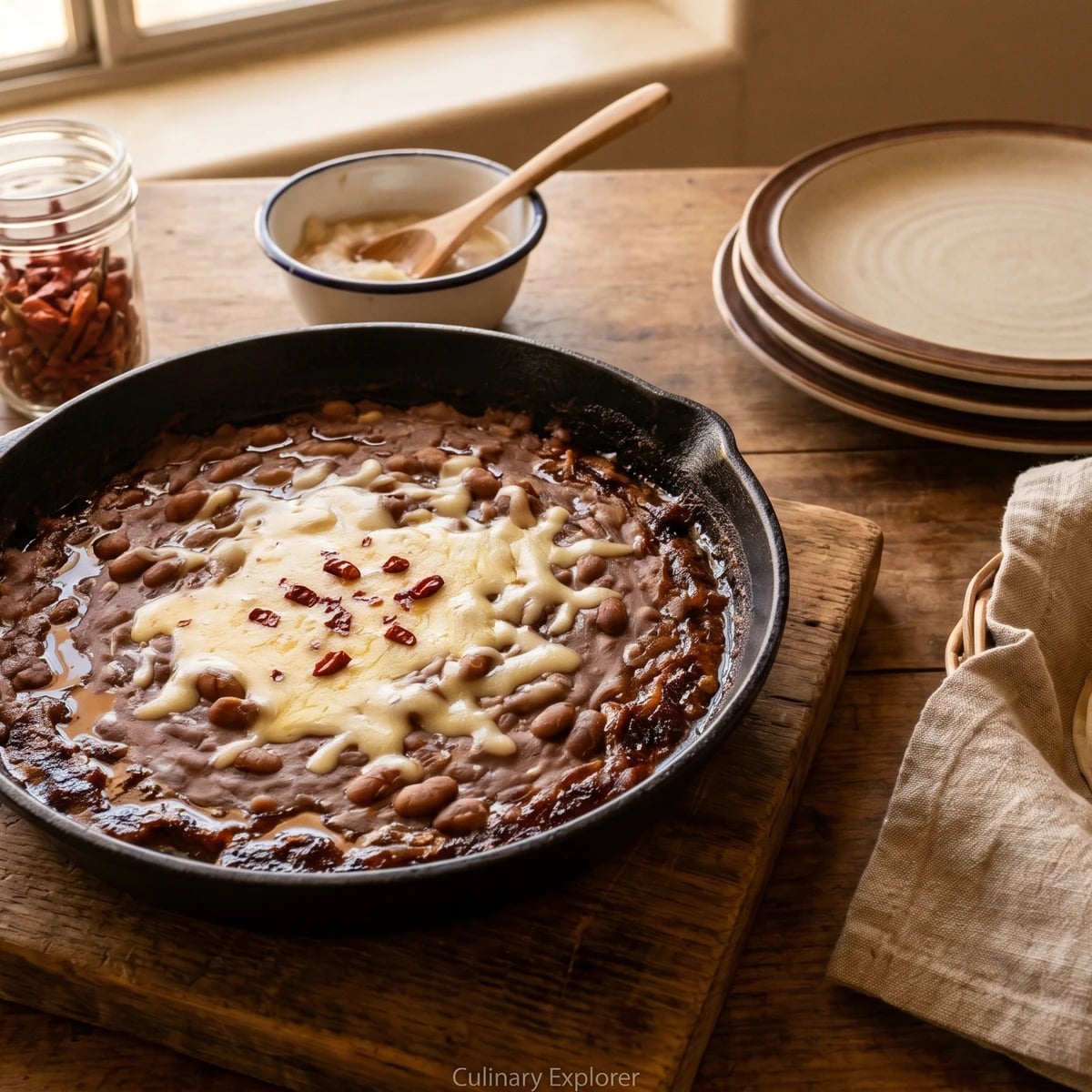
Sonora's pinto beans cooked from dry, then smashed and fried in real manteca de cerdo until the edges crisp and the lard does its work, served with warm flour tortillas the size of a dinner plate.
Side Dishes
Mexican
Weeknight
Budget Friendly
Comfort Food
15 min
Active Time
2 hr 30 min cook•2 hr 45 min total
Yield6 to 8 servings
Sonora is wheat country and cattle country. The flour tortilla, not the corn, is the bread of this northern state, and the bean that anchors the table is the pinto, cooked from dry, smashed in lard, and fried until the edges turn dark at the bottom of the cazuela.
These are not the gray, smooth, oil-fried refritos that come out of a can. These are frijoles refritos sonorenses, and they have texture. Whole beans scattered through the smashed paste. Real manteca de cerdo doing the heavy lifting, not vegetable oil pretending. La manteca es el sabor. If that bothers you, you are not making this dish today. Make something else and come back when you are ready.
The chiltepin is the chile of Sonora, a tiny round wild pepper that grows in the desert and gets crushed between your fingers, never blended. A pinch in the lard at the start perfumes the whole skillet. Queso Chihuahua or queso menonita on top, melting against the heat of the beans. A stack of flour tortillas the size of a dinner plate beside the pan. That is a sonorense breakfast. That is a sonorense lunch. That is dinner on a Tuesday in Hermosillo.
My mother was from Jalisco and she fried beans in lard until the day she died. She wrote in the margin of her notebook: "the lard is not optional, do not let anyone tell you it is." She was right. Cada estado, su propia cocina, and Sonora's kitchen runs on manteca.
The pinto bean is one of the great northern Mexican staples, cultivated across Chihuahua, Sonora, Durango, and Zacatecas, and it became the dominant table bean of the noroeste in part because it thrives in the arid soils where black beans and other southern varieties struggle. Refried beans as a technique, frijoles refritos, derive their name not from being fried twice but from the intensifier prefix "re-" in colloquial Mexican Spanish, meaning well-fried or thoroughly fried, a linguistic detail that English mistranslates almost universally. Sonora's reliance on lard rather than vegetable oil traces to its ranching economy: the same hogs that produced chicharron and carne adobada also rendered the manteca that flavored every other dish on the table, a closed-loop pantry born of geography long before it became a culinary virtue.
The technique, the tradition, and the story behind every dish.
dried chiltepin (optional)crushed between your fingers
2
queso Chihuahua or queso menonita (optional)
1/2 cup, crumbled
warm flour tortillas (optional)
for serving
Equipment Needed
•12-inch cast-iron skillet or wide clay cazuela
•Heavy stockpot or clay olla for cooking the beans
•Bean masher or sturdy wooden spoon
•Fine-mesh colander set over a large bowl, to save the broth
Instructions
1
Sort and soak the beans
Spread the dried pintos on a sheet pan and pick out any small stones, broken beans, or shriveled ones. The bag will have at least one. Rinse under cold water. Cover with cool water by three inches and soak for six hours or overnight. The bean swells, the cook time drops, and the texture turns creamy instead of chalky. Sonoran cooks soak. No me vengas con atajos.
2
Cook the beans low and slow
Drain the soaked beans and transfer to a heavy pot or, better, a clay olla if you have one. Cover with fresh cold water by two inches. Add the whole half onion, the smashed garlic, and the epazote if you are using it. Bring to a gentle simmer over medium heat. Skim the gray foam in the first ten minutes. Lower the heat until the surface barely moves. Cover partially and cook for one and a half to two hours, until the beans are tender all the way through and the broth has turned a soft pink-brown.
Salt at the end, not the beginning. Salt added too early can make the skins tough. Add the tablespoon of salt in the last fifteen minutes of cooking and taste the broth. The broth should taste like food, not like water.
3
Save the broth, fish out the aromatics
Pull the spent onion half, the garlic, and the epazote stems out and discard them. Drain the beans through a colander set over a bowl. Keep every drop of that bean broth. You will need it to loosen the refritos as you fry them. Cooks who pour the broth down the drain are starting from a deficit.
4
Render the lard and sweat the onion
In a wide cast-iron skillet or a heavy 12-inch cazuela, melt the manteca over medium heat until it shimmers. Half a cup looks like too much. It is not. La manteca es el sabor. Vegetable oil will not do this work. Add the diced onion and the crushed chiltepin if you are using it. Cook, stirring, for five to seven minutes, until the onion is soft and translucent and the lard smells sweet. The chiltepin will perfume the fat without dominating it.
5
Add the beans and start smashing
Add the drained beans to the skillet by the heaping cupful, stirring after each addition so they coat in the seasoned lard. When all the beans are in, lower the heat to medium-low. Take a bean masher or the back of a sturdy wooden spoon and start smashing. Work the beans against the bottom and sides of the skillet. You are not making a puree. You want a rough, chunky paste with whole beans still scattered through it. Sonoran refritos have texture. The smooth canned version is something else entirely.
If you want them silkier, blend half the beans before smashing them in. If you want them rustic, smash them all by hand in the pan. Both are correct. Asi se hace y punto.
6
Fry, fold, loosen, repeat
Now you fry them. Spread the smashed beans across the skillet so the surface area touches the hot lard. Let them sit for a minute until you hear them sizzle and see the bottom catch. Fold the crisped layer back into the rest with the spoon. Spread again. Fold again. Each fold pulls a little more flavor out of the lard and into the beans. Loosen with a splash of the reserved bean broth whenever the paste tightens up too much. You are looking for the consistency of a thick, glossy spread that holds the line of the spoon for a moment before settling back.
7
Taste, finish, and serve
Taste for salt. Beans absorb salt, so the seasoning has to be assertive or the whole skillet will read flat. Adjust. If the beans look dry, add another spoonful of lard. If they look stiff, more bean broth. Pull the skillet off the heat and scatter the crumbled queso Chihuahua across the top so it softens against the warm beans. Serve straight from the skillet with a stack of warm flour tortillas. In Sonora, the tortilla is the spoon. Recetas probadas y garantizadas.
Chef Tips
•Use real manteca de cerdo from a Mexican carniceria or rendered yourself from pork fatback. The shelf-stable hydrogenated lard in the white tub at the supermarket is not the same product. It tastes like nothing. If you cannot find good lard, render your own from a pound of pork fat over low heat in an afternoon. You will have lard for months.
•Chiltepin is the wild chile of Sonora and Chihuahua and there is no substitute that captures its dry, sharp heat. If you cannot find it, leave it out before reaching for cayenne or red pepper flakes. A bad substitution is a compromise, not an upgrade.
•These beans get better the next day. Make a double batch, refrigerate half, and reheat in a skillet with a fresh spoonful of lard. The flavor deepens and the texture tightens up beautifully.
•If you serve these with corn tortillas, you have made a fine plate of beans. If you want a Sonoran plate of beans, you serve them with flour. Hand-pressed, large, thin, with the brown freckle of the comal across the surface. The flour tortilla is northern. Asi se hace y punto.
Advance Preparation
•The cooked beans (before frying) can be made up to three days ahead and refrigerated in their broth. Reheat gently, then proceed with the frying step.
•Fully refried beans keep refrigerated for four days and reheat well in a skillet with a fresh spoonful of lard and a splash of water or broth to loosen.
•Refried beans freeze for up to two months in a tightly sealed container. Thaw in the refrigerator overnight and reheat over low heat with a little extra lard.
Frequently Asked Questions
Nutrition Information
1 serving (about 180g)
Calories
395 calories
Total Fat
18 g
Saturated Fat
7 g
Trans Fat
0 g
Unsaturated Fat
10 g
Cholesterol
22 mg
Sodium
620 mg
Total Carbohydrates
44 g
Dietary Fiber
10 g
Sugars
3 g
Protein
16 g
Where cooking meets culture.
Culinary guides, cultural storytelling, and the editorial depth that makes cooking meaningful.