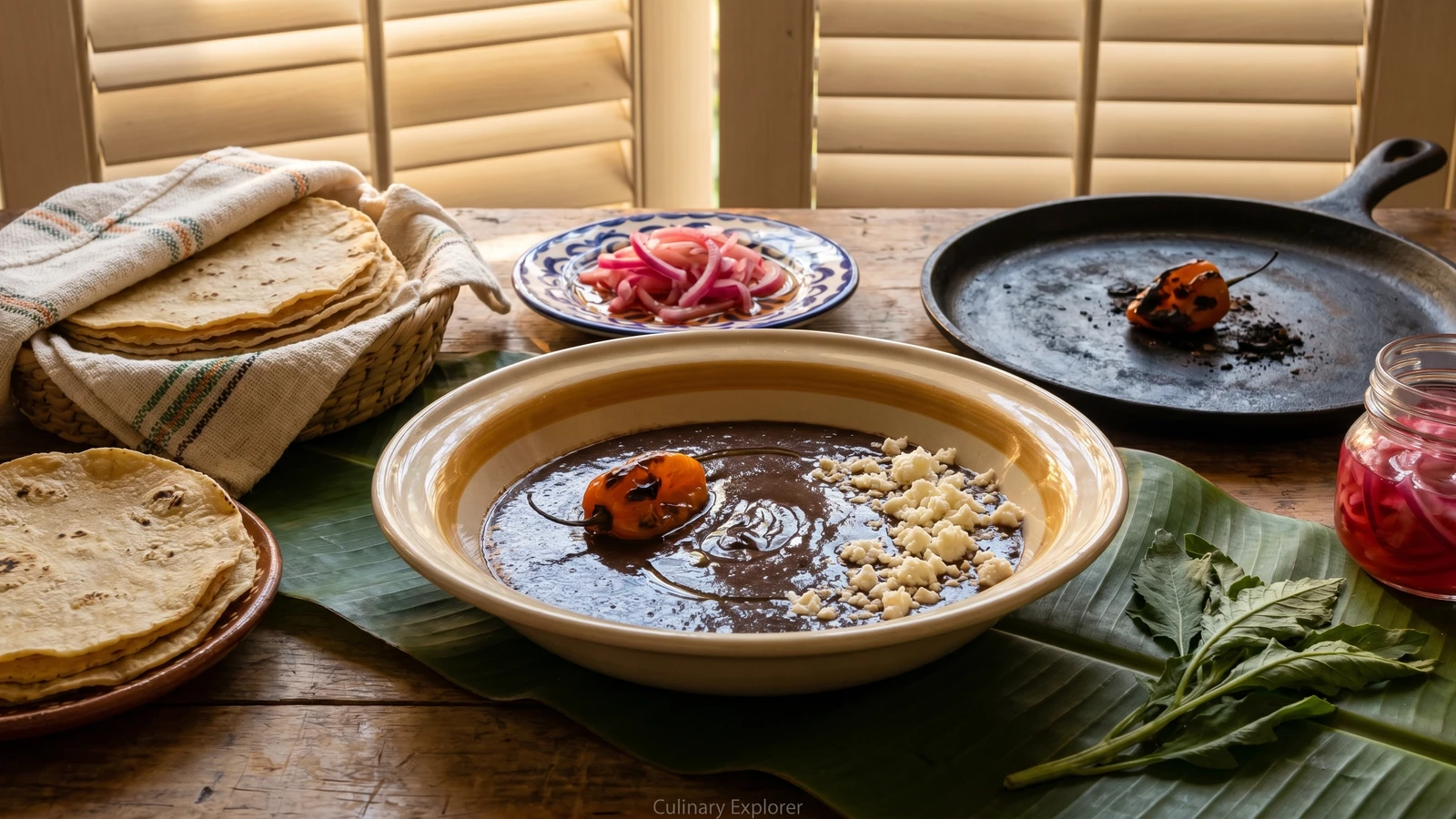
Yucatan's silky strained black bean spread, simmered with epazote, blended smooth, passed through a sieve, and fried in lard with a charred habanero. The base of panuchos and the quiet anchor of the Peninsula's table.
Appetizers & Snacks
Mexican
Make Ahead
Batch Cooking
Comfort Food
20 min
Active Time
2 hr 30 min cook•2 hr 50 min total
YieldAbout 3 cups (8 servings)
This is a Yucatecan dish. Frijol colado belongs to the Peninsula, the same Peninsula that gives you cochinita pibil, papadzules, and panuchos. The bean is the small black bean of the Yucatan, the epazote grows wild in the dooryards of Merida and Valladolid, and the habanero is the chile of the region, not a substitute for one. Cada estado, su propia cocina, and this one belongs to the Peninsula entirely.
Colado means strained. That is the whole instruction in the name. You cook the beans with epazote and garlic until they are soft enough to crush against the pot, you blend them, and then you pass the puree through a fine-mesh sieve until every skin is left behind. What comes through is silk. What stays in the strainer is the difference between frijol refrito and frijol colado. The Yucatecan version is smoother, darker, glossier, and it carries the floral heat of a habanero charred whole on the comal and dropped into the lard. The chile does not go into the puree. It perfumes the fat. That is the Peninsula's grammar.
You will see this spread underneath the chicken on a panucho, alongside huevos motulenos, on the breakfast table next to a stack of warm tortillas. It is not a side dish. It is a base, a foundation, a starting point for half of the Peninsula's repertoire. My mother never made this. She was from Jalisco and she cooked frijoles de la olla and frijoles puercos, but she had taped into her notebook a recipe card from a senora in Progreso, in pencil, with one line underlined twice: cuela todo, no dejes ni una cascara. Strain everything, do not leave a single skin. La cocina no es decoracion, es trabajo. The sieve is the work.
Frijol colado is part of a Peninsular tradition of strained and refined bean preparations that predates the conquest, when the Maya cooked the small black bean (known in Yucatec Maya as bu'ul) as a daily staple and developed pureed versions for ceremonial and infant foods. The technique of passing the cooked beans through a woven sieve to remove the skins survives in the rural cocinas of Yucatan, Campeche, and Quintana Roo, where it forms the structural base of papadzules (the pre-Columbian dish of tortillas filled with hard-boiled egg and bathed in pumpkin-seed sauce) and the 20th-century panucho, in which a puffed tortilla is split open and stuffed with the strained bean paste before frying. The Yucatan Peninsula's culinary isolation from central Mexico, shaped by geography and reinforced by the 19th-century Caste War, preserved this technique as a regional signature long after central Mexican cooks moved toward chunkier refried-bean styles.
The technique, the tradition, and the story behind every dish.
pickled red onion (cebolla morada en escabeche) (optional)
Quantity
for serving
crumbled queso fresco or queso de bola rallado (optional)
Quantity
for serving
Ingredient
Quantity
dried black beans (frijol negro)preferably the small Yucatecan variety
1 pound
water
10 cups, plus more as needed
white onionleft whole
1/2 medium
garlic clovespeeled
4
fresh epazote
2 large sprigs
kosher salt
1 tablespoon, plus more to taste
manteca de cerdo (pork lard)
3 tablespoons
fresh chile habanero
1 whole
white onion (for frying)finely chopped
1/4 medium
hand-pressed corn tortillas (optional)
for serving
pickled red onion (cebolla morada en escabeche) (optional)
for serving
crumbled queso fresco or queso de bola rallado (optional)
for serving
Equipment Needed
•Heavy 6-quart pot for simmering the beans
•High-powered blender
•Fine-mesh strainer (chinois or sieve)
•Rubber spatula or ladle for pressing the puree
•Cast iron comal for charring the habanero
•Wide heavy skillet or clay cazuela for frying the strained beans
Instructions
1
Pick through and rinse the beans
Spread the dried black beans on a sheet pan and pick out any pebbles, broken beans, or pieces of dirt. The Yucatecan small black bean is the right one for this dish. It cooks down to a darker, glossier paste than larger black beans. Rinse the picked beans under cold water in a colander until the water runs clear.
Do not soak Yucatecan black beans overnight. The Peninsula cooks them straight from dry. Soaking dulls the flavor and the bean paste comes out flatter.
2
Build the pot
Place the rinsed beans in a heavy 6-quart pot. Add the 10 cups of water, the half onion left whole, the garlic cloves, and the epazote. Do not add salt yet. Salt at the start tightens the skins and the beans stay tough no matter how long you simmer. Bring to a boil over high heat, then lower to a gentle simmer.
3
Simmer until soft
Cook uncovered or partially covered at a lazy simmer for two hours, maybe a little more. The beans are ready when one crushes completely against the side of the pot with the back of a spoon. No bite, no resistance. If the water drops below the level of the beans, add more hot water, never cold. Cold water shocks the beans and slows them down. Add the salt only in the last fifteen minutes.
4
Blend the beans
Fish out the epazote sprigs and discard them. Leave the cooked onion and garlic in the pot. They go into the blender. Working in batches, transfer the beans and their cooking liquid to a blender. Blend on high until completely smooth, about a minute per batch. The puree should look like dark chocolate sauce, glossy and even.
Vent the blender lid with a folded towel. Hot bean puree builds pressure fast and will paint your ceiling if you seal it shut.
5
Strain the puree
Set a fine-mesh strainer over a clean bowl. Pour the blended beans through and press with the back of a ladle or a rubber spatula. Push everything through except the skins. The skins are what stand between you and the silk texture that defines frijol colado. Discard them. This is the step that separates frijol colado from any other black bean puree. Asi se hace y punto. The name itself, colado, means strained. Skip it and you have made something else.
Take your time on the sieve. A senora in Merida will work the spatula across the mesh for ten minutes to get every drop of paste out. Patience here is the whole dish.
6
Char the habanero
Place the whole habanero on a hot dry comal over medium-high heat. Roll it with tongs until the skin blisters and blackens in patches on every side, about three to four minutes. The kitchen will smell sharp and a little floral. That perfume is what the habanero brings to the bean. Do not pierce or cut the chile. You want the flavor to bleed into the lard slowly, not a wall of heat all at once.
7
Fry the beans
In a wide heavy skillet or a cazuela, melt the manteca de cerdo over medium heat. La manteca es el sabor. Add the finely chopped onion and cook until translucent, about three minutes. Lay the charred whole habanero in the lard. Let it perfume the fat for thirty seconds. Pour in the strained bean puree. It will sputter. Lower the heat and cook, stirring with a wooden spoon, until the puree thickens, darkens, and pulls away from the sides of the pan in a sheet when you drag the spoon across, eight to ten minutes.
8
Adjust and rest
Taste for salt. The puree should taste deeply of bean, lightly of lard, and carry a quiet floral heat from the habanero pulled through the fat. If you want more habanero presence, leave the whole chile in the pot a few minutes longer. If you want it cleaner, fish it out now. Pull the pan off the heat and let the frijol colado rest five minutes. It will thicken further as it sits.
9
Serve
Spoon into a clay cazuelita and bring it to the table warm. Serve with hand-pressed corn tortillas, pickled red onion, and crumbled queso. This is the spread that fills panuchos, that anchors a Yucatecan breakfast plate next to huevos motulenos, and that goes on the table at any hour because the Peninsula treats frijol colado the way Mexico City treats salsa: it belongs everywhere. Recetas probadas y garantizadas.
Chef Tips
•The small Yucatecan black bean (frijol negro de la Peninsula) is the right bean. If you can only find larger Mexican black beans, they will work, but the paste will be a shade less dark and a shade less sweet. A substitution is a compromise, not an upgrade.
•Fresh epazote is non-negotiable. Dried epazote tastes like hay. If you cannot find it fresh, find a friend with a garden, because epazote grows like a weed and one plant feeds a neighborhood. Skip the dried version entirely.
•The habanero stays whole. Do not cut it, do not seed it, do not blend it. The Peninsula's cooks know exactly how to control habanero heat: char it, let the fat take what it takes, and pull it out when the perfume is where you want it. No me vengas con atajos.
•Manteca is the fat. Not olive oil, not vegetable oil, not butter. Manteca de cerdo. Render your own from pork fat or buy good Mexican-style manteca from a carniceria. The flavor of frijol colado comes from the marriage of bean, epazote, and lard. Change the fat and you change the dish.
Advance Preparation
•Frijol colado can be made up to four days ahead and refrigerated in a covered container. The flavor deepens overnight. Reheat gently in a skillet with an extra spoonful of manteca, stirring until the paste loosens and warms through.
•The strained bean puree, before frying, can be frozen for up to three months. Thaw in the refrigerator overnight and then proceed with the lard, onion, and habanero step.
•If you are building panuchos, make the frijol colado one day ahead. A cold, firm paste is much easier to stuff into a puffed tortilla than a warm, loose one.
Frequently Asked Questions
Nutrition Information
1 serving (about 85g)
Calories
245 calories
Total Fat
6 g
Saturated Fat
2 g
Trans Fat
0 g
Unsaturated Fat
3 g
Cholesterol
5 mg
Sodium
480 mg
Total Carbohydrates
37 g
Dietary Fiber
9 g
Sugars
2 g
Protein
13 g
Where cooking meets culture.
Culinary guides, cultural storytelling, and the editorial depth that makes cooking meaningful.