Culinary Explorer

A cooking platform built around craft, culture, and the stories behind what we eat.
Discover Culinary Explorer
Fried Oysters

Fried Oysters

Created by Chef Remy

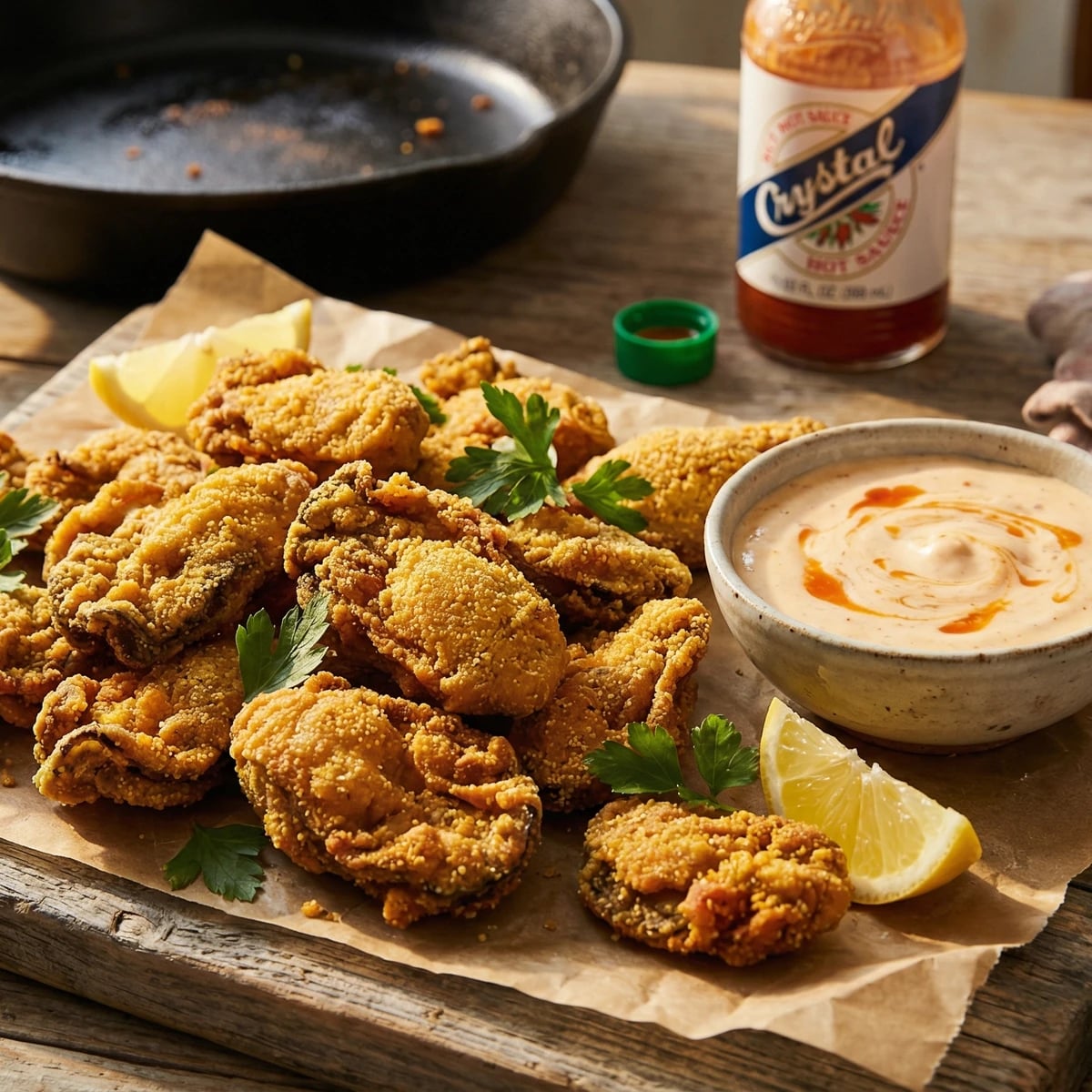
Briny Gulf oysters cloaked in seasoned cornmeal, fried until golden and impossibly crisp at the edges, served with a fiery Crystal hot sauce aioli that cuts through the richness and makes you reach for another

Main Dishes
Creole
Dinner Party
Game Day
Special Occasion
25 min
Active Time
15 min cook40 min total
Yield4 servings

Aperfectly fried oyster is a thing of beauty. The shell-shocked look on someone's face when they bite through that shatteringly crisp cornmeal crust and hit the warm, briny oyster inside tells you everything. That contrast between crunch and cream, between the boldly seasoned coating and the pure taste of the Gulf, that's what we're chasing here.

At Lagniappe, we go through more oysters than I can count. The secret isn't complicated: fresh Gulf oysters, seasoned cornmeal, and oil at the right temperature. That's the holy trinity of fried oysters. But the details matter. You season the oysters before they hit the breading. You let that buttermilk bath wake them up and give the cornmeal something to hold onto. You fry them fast and hot so they stay plump instead of turning to rubber.

My grandmother Evangeline used to say that oysters are a gift from the water that demands respect. You don't drown them in batter. You don't overcook them. You give them just enough coating to create that crust, and you pull them from the oil the moment the edges start to curl. That curl is your signal. Miss it, and you've got chewy disappointment. Catch it, and you've got something transcendent.

The Crystal hot sauce aioli isn't optional. That Louisiana hot sauce has a vinegar bite that plays against the richness of the fried oyster like nothing else. One dip, and you understand why New Orleans has been eating oysters this way for generations.

The technique, the tradition, and the story behind every dish.

Discover Culinary Explorer

Ingredients

fresh shucked Gulf oysters

Quantity

1 pint (about 24)

drained

yellow cornmeal

Quantity

1 cup

all-purpose flour

Quantity

1/2 cup

Cajun seasoning

Quantity

1 tablespoon

kosher salt

Quantity

1 teaspoon

black pepper

Quantity

1/2 teaspoon

freshly ground

cayenne pepper

Quantity

1/4 teaspoon

buttermilk

Quantity

1 cup

large egg

Quantity

1

vegetable or peanut oil

Quantity

about 3 cups

for frying

mayonnaise

Quantity

1/2 cup

Crystal hot sauce

Quantity

2 tablespoons, or more to taste

garlic

Quantity

1 clove

minced fine

fresh lemon juice

Quantity

1 teaspoon

lemon wedges (optional)

Quantity

for serving

Equipment Needed

  • Heavy-bottomed Dutch oven or deep pot (at least 5-quart)
  • Deep-fry or candy thermometer
  • Spider strainer or slotted spoon
  • Wire cooling rack
  • Sheet pans

Instructions

  1. 1

    Drain and season oysters

    Spread the drained oysters on a paper towel-lined sheet pan and pat them gently dry. Excess moisture is the enemy of a crisp crust. It creates steam that fights against browning. Season the oysters lightly with a pinch of salt and black pepper right there on the pan. This is building flavor in layers, the bayou way. The seasoning goes on the oyster, in the breading, and you'll taste the difference.

    Fresh Gulf oysters should smell like clean seawater, nothing fishy or off. If they smell wrong, they are wrong. Trust your nose.
  2. 2

    Build the breading station

    In a shallow bowl, whisk together the cornmeal, flour, Cajun seasoning, salt, black pepper, and cayenne until everything is evenly distributed. That cornmeal is doing the heavy lifting here, giving you that distinctive crunch that flour alone can never deliver. In another shallow bowl, beat the buttermilk and egg together until smooth. The buttermilk adds tang and helps the breading stick like it means it.

  3. 3

    Make the hot sauce aioli

    In a small bowl, stir together the mayonnaise, Crystal hot sauce, minced garlic, and lemon juice. Taste it. If you want more heat, add more hot sauce. This is your dipping sauce, and it should have enough bite to wake up your palate without burning it down. Set it aside. The flavors will get acquainted while you fry.

    Crystal hot sauce has that perfect Louisiana vinegar punch. Tabasco works too, but Crystal is the New Orleans choice. That's what we use at Lagniappe.
  4. 4

    Heat the oil

    Pour three inches of oil into a heavy-bottomed pot or Dutch oven. A cast iron Dutch oven holds heat best, which means your temperature stays steady between batches. Heat the oil to 375 degrees. Use a thermometer. Guessing at oil temperature is how people end up with greasy, soggy oysters. At 375, the oysters will sizzle immediately and cook fast enough that the coating crisps before the oyster overcooks.

  5. 5

    Bread the oysters

    Working with one oyster at a time, dip it into the buttermilk mixture, letting the excess drip off for a second. Then dredge it through the cornmeal mixture, pressing gently so the breading adheres. Place breaded oysters on a clean sheet pan. Don't stack them or the breading will get soggy where they touch. Bread all your oysters before you start frying so you can work in efficient batches.

    Keep one hand for wet ingredients and one for dry. Otherwise you end up with breaded fingers and frustrated cursing.
  6. 6

    Fry until golden

    Carefully lower six to eight oysters into the hot oil using a slotted spoon or spider. Don't crowd the pot. Crowding drops the oil temperature and steams the oysters instead of frying them. Fry for two to three minutes, turning once if needed, until the coating is deep golden brown and the edges of the oysters start to curl. That curl tells you they're done. Listen for that steady sizzle. If it goes quiet, your oil is too cool.

    The difference between a perfect fried oyster and an overcooked one is about thirty seconds. Stay at the stove. Watch the color. Watch the curl.
  7. 7

    Drain and season immediately

    Transfer fried oysters to a wire rack set over a sheet pan. Paper towels work but a rack keeps the bottoms from getting soggy. Season with a light sprinkle of salt while they're still glistening with oil. The salt sticks better to hot food. Let the oil come back to 375 degrees before frying the next batch. Patience here means consistency.

  8. 8

    Serve immediately

    Pile those golden beauties on a platter and serve with the Crystal hot sauce aioli and lemon wedges. Fried oysters wait for no one. They're best in the first five minutes when the crust is at peak crispness and the oyster inside is still warm and tender. Get them to the table fast and watch them disappear.

Chef Tips

  • Gulf oysters are the only choice for authentic New Orleans flavor. They're brinier and plumper than Pacific varieties. If your fishmonger doesn't carry them, ask. Good ones will order them for you.
  • The cornmeal should be fine to medium grind, not coarse polenta. Coarse cornmeal creates a gritty coating that doesn't adhere well and falls off in the oil.
  • If you don't have buttermilk, add a tablespoon of lemon juice to regular milk and let it sit for five minutes. It's not quite the same, but it works.
  • At Lagniappe, we serve fried oysters on French bread with lettuce, tomato, and remoulade for a proper po'boy. Transform these into a sandwich if you're feeling ambitious.

Advance Preparation

  • The hot sauce aioli can be made up to three days ahead and refrigerated. The garlic flavor mellows and melds beautifully.
  • Fried oysters cannot be made ahead. They must go from oil to mouth within minutes. This is not a dish for meal prep.
  • You can bread the oysters up to thirty minutes before frying and keep them refrigerated on a sheet pan. Any longer and the coating gets gummy.

Frequently Asked Questions

Nutrition Information

1 serving (about 145g)

Calories
495 calories
Total Fat
36 g
Saturated Fat
6 g
Trans Fat
0 g
Unsaturated Fat
28 g
Cholesterol
75 mg
Sodium
1100 mg
Total Carbohydrates
27 g
Dietary Fiber
2 g
Sugars
2 g
Protein
8 g

Note: Chef personas and recipes are created with AI assistance. Cook with care: follow safe food-handling practices, check doneness with a thermometer when needed, and adapt for allergies and your kitchen.

Where cooking meets culture.

Culinary guides, cultural storytelling, and the editorial depth that makes cooking meaningful.

Discover Culinary Explorer

More from Chef Remy's Main Dishes

Browse the full collection