Culinary Explorer

A cooking platform built around craft, culture, and the stories behind what we eat.
Discover Culinary Explorer
Francesinha

Francesinha

Created by

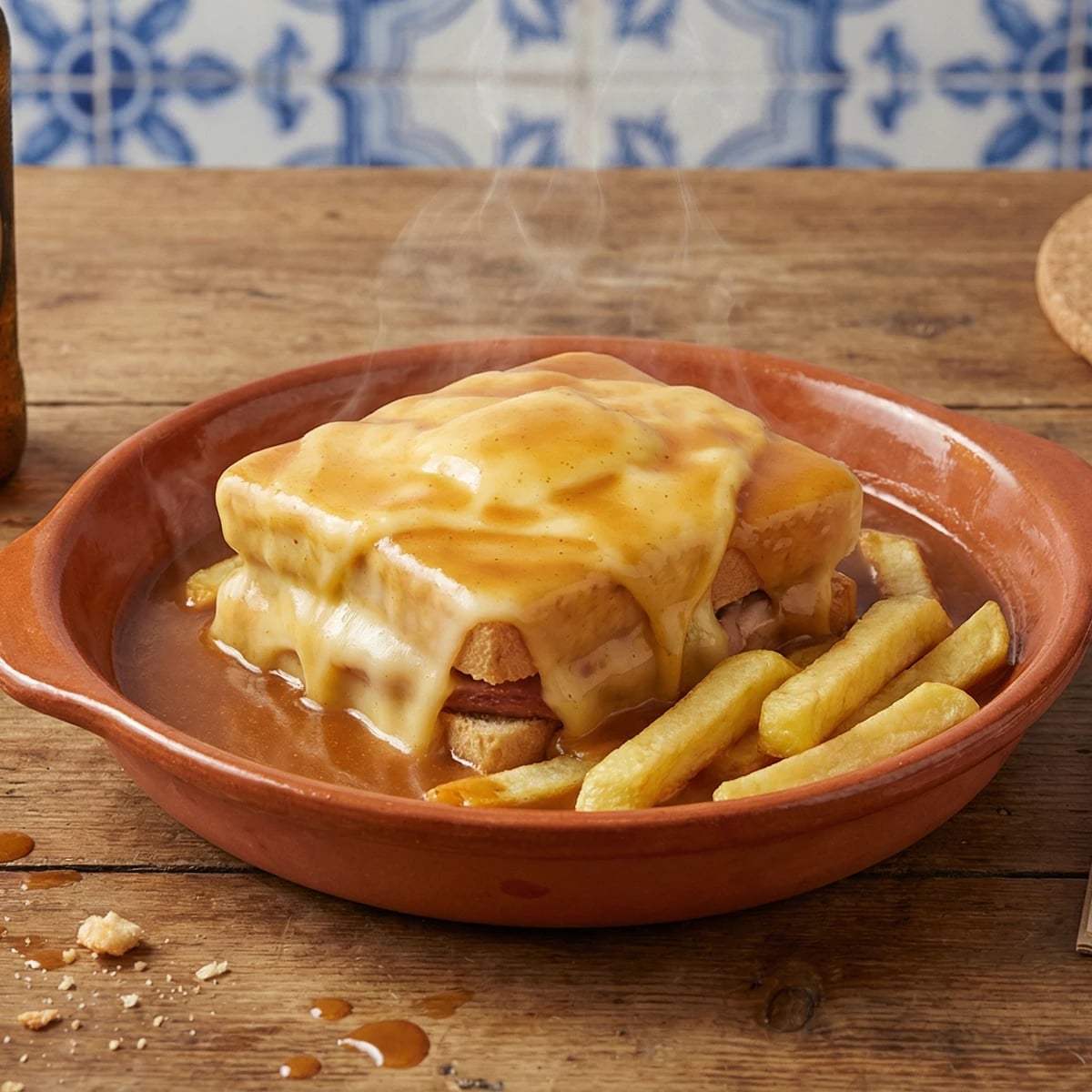
Porto's magnificent beast of a sandwich, layers of meat under molten cheese and a secret spicy sauce that every restaurant guards like family treasure. This is not diet food. This is glory.

Sandwiches & Wraps
Portuguese
Comfort Food
Special Occasion
45 min
Active Time
1 hr cook1 hr 45 min total
Yield4 servings

Ineed to be honest with you. This is not a sandwich you eat. This is a sandwich that happens to you.

The first time I had a proper francesinha was in Porto, at a tiny place near Ribeira where the tables were plastic and the walls were covered with football scarves. The waiter brought this thing swimming in sauce, cheese still bubbling, and I understood immediately why tripeiros (that's what we call people from Porto) get into actual arguments about whose francesinha is best. Every restaurant has their secret sauce. Every cook swears theirs is the original. They're all lying and they're all right.

This isn't traditional grandmother food in the way my açorda is. The francesinha was invented in the 1950s or 60s, depending on who you ask, by a man who'd worked in France and came home missing the croque-monsieur. What he created was something entirely Portuguese: more meat, more cheese, more sauce, more everything. It's excess made edible, and I mean that as the highest compliment.

At Mesa da Avó, I don't serve francesinha because it's not my story to tell. But when friends from Porto come to Lisbon and get homesick, this is what they ask me to make. The sauce is the soul. Get the sauce right and everything else follows.

The francesinha was created in Porto in the 1950s or early 1960s by Daniel da Silva, a returned emigrant who had worked in France and wanted to adapt the croque-monsieur for Portuguese tastes. He added more meats, covered it in cheese, and invented the spicy beer sauce that defines the dish. Within a decade, it became Porto's signature food, and today the city has hundreds of restaurants competing for the title of best francesinha.

The technique, the tradition, and the story behind every dish.

Discover Culinary Explorer

Ingredients

thick-cut white bread

Quantity

8 slices

thin beef steaks

Quantity

4 (about 120g each)

presunto or cured ham

Quantity

4 slices

linguiça sausages

Quantity

4

sliced lengthwise

fresh pork sausages

Quantity

4

queijo flamengo

Quantity

8 slices

butter

Quantity

2 tablespoons

salt and black pepper

Quantity

to taste

butter (for sauce)

Quantity

2 tablespoons

onion

Quantity

1 medium

finely diced

garlic

Quantity

2 cloves

minced

tomato paste

Quantity

1 tablespoon

Portuguese beer

Quantity

330ml

beef stock

Quantity

1 cup

bay leaf

Quantity

1

Worcestershire sauce

Quantity

1 tablespoon

whisky (optional)

Quantity

1 tablespoon

piri-piri sauce

Quantity

1 teaspoon, or to taste

sweet paprika

Quantity

1 teaspoon

batatas fritas

Quantity

for serving

Equipment Needed

  • Large skillet for cooking meats
  • Saucepan for the sauce
  • 4 individual oven-safe dishes or 1 large baking dish
  • Oven-safe serving plates (traditional)

Instructions

  1. 1

    Build the sauce foundation

    Melt the butter in a saucepan over medium heat. Add the diced onion and cook until soft and golden, about 8 minutes. Add the garlic and cook for another minute. Stir in the tomato paste and let it toast for 30 seconds, until it darkens slightly and smells sweet.

    Every restaurant in Porto guards their sauce recipe like state secrets. This version is a composite of what I've pieced together from cooks who let things slip after too much vinho verde.
  2. 2

    Finish the sauce

    Pour in the beer and let it bubble for a minute. Add the beef stock, bay leaf, Worcestershire sauce, whisky if using, piri-piri, and paprika. Bring to a simmer and let it cook for 20 to 25 minutes until slightly thickened. Taste and adjust the salt and heat. The sauce should be savory, slightly spicy, and complex. Remove the bay leaf. Keep warm.

    The sauce should coat a spoon but still be pourable. Too thick and it won't soak properly into everything. Too thin and it just slides off.
  3. 3

    Cook the meats

    Season the beef steaks with salt and pepper. In a large skillet over high heat, cook them quickly, about 2 minutes per side for medium. Set aside. In the same pan, cook the fresh sausages until browned and cooked through, about 8 minutes. Cook the linguiça slices until the edges crisp and the fat renders, about 3 minutes per side. Everything should be slightly charred and deeply savory.

  4. 4

    Toast the bread

    Melt butter in a clean pan or on a griddle. Toast the bread slices until golden on both sides. You want structure here. This bread is about to bear a lot of weight and a lot of sauce.

  5. 5

    Assemble the sandwiches

    Preheat your oven to 200°C (400°F). Place four bread slices in individual oven-safe dishes or one large baking dish. Layer on each: a slice of presunto, a steak, a fresh sausage, the linguiça slices. Top with the second slice of bread. Cover each sandwich completely with two slices of queijo flamengo, draping over the sides.

  6. 6

    Melt and serve

    Place the dishes in the oven for 5 to 8 minutes until the cheese is fully melted, bubbling, and starting to brown in spots. Remove from oven. Immediately ladle the warm sauce around and over each sandwich. The cheese should still be bubbling when it hits the table. Serve with batatas fritas on the side or, in true Porto fashion, with the fries swimming in the sauce alongside the sandwich.

    In Porto, they often crack a raw egg on top before the final bake. If you want the full experience, do it. The egg cooks in the oven and adds richness. But it's optional.

Chef Tips

  • The beer matters. Use a Portuguese lager like Super Bock or Sagres. Other beers work, but they taste like other beers, not like Porto.
  • Queijo flamengo is a mild, semi-soft cheese that melts beautifully. If you can't find it, use a mild Gouda or Edam. Never use cheddar. Não mexas nisso.
  • Some versions include roast beef or mortadela. I've seen shrimp. I've seen versions that made me weep for the soul of the dish. Keep it to the four meats: ham, steak, fresh sausage, cured sausage. This is enough.
  • The whisky is not universal but it's traditional in many recipes. It adds depth without being identifiable. A tablespoon disappears into the sauce but you'd miss it if it wasn't there.
  • Leftover sauce keeps for 3 days refrigerated. It's also excellent on eggs, on rice, on anything that needs to be improved dramatically.

Advance Preparation

  • The sauce can and should be made ahead. Make it up to 2 days before and refrigerate. The flavors deepen overnight. Reheat gently before serving.
  • The meats can be cooked a few hours ahead and kept covered at room temperature. Reheat briefly before assembling.
  • Do not assemble until ready to serve. Once the cheese goes on and the sauce goes over, this dish waits for no one.

Frequently Asked Questions

Nutrition Information

1 serving (about 650g)

Calories
1820 calories
Total Fat
105 g
Saturated Fat
40 g
Trans Fat
1 g
Unsaturated Fat
58 g
Cholesterol
285 mg
Sodium
3350 mg
Total Carbohydrates
112 g
Dietary Fiber
6 g
Sugars
7 g
Protein
86 g

Note: Chef personas and recipes are created with AI assistance. Cook with care: follow safe food-handling practices, check doneness with a thermometer when needed, and adapt for allergies and your kitchen.

Where cooking meets culture.

Culinary guides, cultural storytelling, and the editorial depth that makes cooking meaningful.

Discover Culinary Explorer

More from Chef Margarida's Sandwiches & Wraps

Browse the full collection