
Chef Klaus
Berlin Currywurst
The Berlin Imbiss counter on a plate: fried sausage cut thick, a tomato curry sauce cooked until glossy, and enough fries or bread to chase every bit.
A cooking platform built around craft, culture, and the stories behind what we eat.
Created by
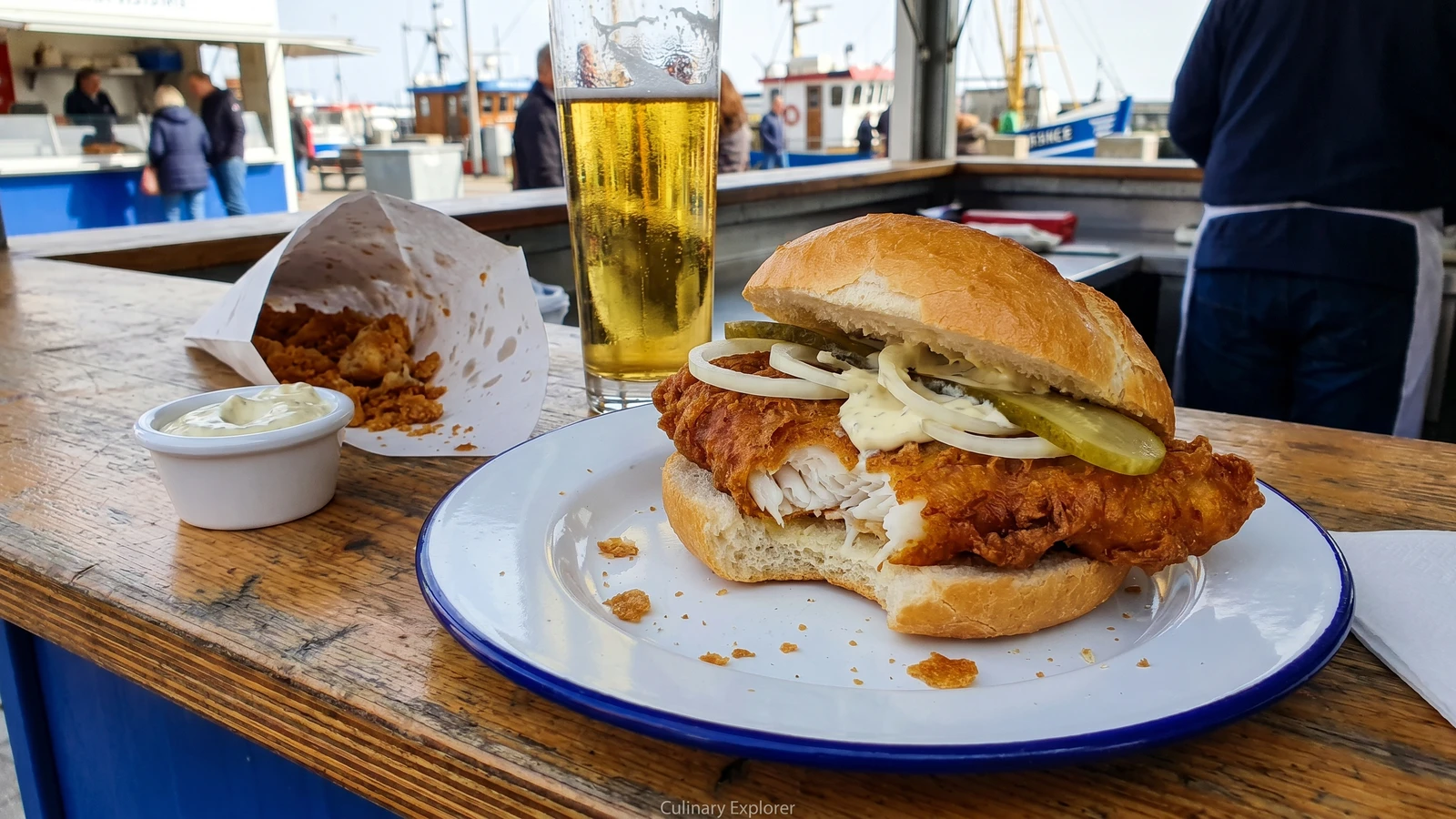
The hot fish roll of the northern coast: pale cod or saithe in a crisp batter, tucked into a split Brötchen with sharp onion, pickle, and made remoulade.
Fischbrötchen belongs to the northern water: Hamburg harbour, Kiel, Bremerhaven, the North Sea bude, the Baltic stall after a walk in the wind. Most are cold, Matjes, Bismarckhering, Krabben, but Backfisch is the hot one, the weeknight one if you keep the pan honest. A crisp roll, fried fish, raw onion, pickle, remoulade. That's enough.
Im Norden anders, im Süden anders. On the coast the fish goes into bread and gets eaten standing up; further south, Backfisch is more often a plate with potato salad. Some stalls use cod, others saithe or pollock. Some want mustard in the sauce, some want capers. I don't mind the argument. I mind a soft crust and sauce from a squeeze bottle. Nicht aus dem Glas.
The technique is simple and unforgiving: the fish must be dry, the batter must be cold, and the oil must be hot enough that the coating sets before the fish overcooks. Wet fish loosens the batter. Warm batter drinks oil. Cool oil gives you a greasy blanket instead of a crust. Fry to order, lay it straight into the roll, and eat before the bread thinks about surrendering.
Fischbrötchen grew out of the North Sea and Baltic harbour trade, where cured herring, smoked fish, and later hot fried fish could be sold quickly from stalls near landing places and markets. Hamburg, Bremerhaven, Kiel, and other northern port cities each claim their own best version, but the form is the same record of the coast: fish preserved, fried, or cured, put into bread for people who were moving. Backfisch itself became a common German fairground and market food in the nineteenth and twentieth centuries, when reliable frying fats and urban fish distribution made hot fish practical away from the boat.
Quantity
600g
skinned and cut into 4 portions
Quantity
1 teaspoon, plus more to finish
Quantity
to taste
freshly ground
Quantity
1 tablespoon
Quantity
120g, plus 3 tablespoons for dredging
Quantity
40g
Quantity
1 teaspoon
Quantity
200ml
Quantity
1
cold
Quantity
1 litre
for frying
Quantity
4
split
Quantity
4
washed and dried well
Quantity
1 small
sliced into thin rings
Quantity
4
sliced lengthwise
Quantity
150g
Quantity
2 tablespoons
finely chopped
Quantity
1 tablespoon
chopped
Quantity
1 tablespoon
chopped
Quantity
1 teaspoon
Quantity
1 teaspoon
Quantity
to serve
| Ingredient | Quantity |
|---|---|
| cod, saithe, haddock, or pollock filletsskinned and cut into 4 portions | 600g |
| fine salt | 1 teaspoon, plus more to finish |
| black pepperfreshly ground | to taste |
| lemon juice | 1 tablespoon |
| plain flour | 120g, plus 3 tablespoons for dredging |
| potato starch or cornstarch | 40g |
| baking powder | 1 teaspoon |
| cold pale beer or sparkling water | 200ml |
| eggcold | 1 |
| neutral oilfor frying | 1 litre |
| crisp Brötchen or Kaiser rollssplit | 4 |
| lettuce leaveswashed and dried well | 4 |
| white onionsliced into thin rings | 1 small |
| pickled cucumberssliced lengthwise | 4 |
| mayonnaise | 150g |
| pickled cucumberfinely chopped | 2 tablespoons |
| caperschopped | 1 tablespoon |
| parsley or chiveschopped | 1 tablespoon |
| German mustard | 1 teaspoon |
| cucumber pickle brine | 1 teaspoon |
| lemon wedges (optional) | to serve |
Stir the mayonnaise with the chopped pickle, capers, herbs, mustard, and pickle brine, then taste it before you add salt. The pickle and capers already carry salt and acid, so the sauce needs checking, not guessing. Keep it cold while you fry; cold remoulade against hot fish is the point.
Pat the fish dry until the paper comes away clean, then season with salt, pepper, and lemon juice. Let it stand 10 minutes, then pat it dry again. The lemon wakes the fish up, but surface moisture makes batter slide off in the pan. Dry first, dry again.
Whisk the 120g flour, potato starch, and baking powder in a bowl, then beat in the cold beer or sparkling water and the cold egg just until the batter is loose and a little lumpy. Don't beat it smooth. A few lumps keep the batter light, and cold batter sets faster in hot oil before it can drink fat.
Heat the oil in a heavy pot to 180C. Use a thermometer if you have one, because guessing at frying oil is how good fish gets ruined. At 180C the crust sets fast and the fish cooks gently inside; cooler oil soaks the batter, hotter oil browns the outside before the middle flakes.
Dredge each fish portion lightly in the extra flour, shake off every loose bit, dip it in batter, and lower it into the oil away from you. Fry two pieces at a time for 3 to 4 minutes, turning once, until the crust is deep gold and the fish flakes at the thickest point. Crowding drops the oil temperature, and then you are boiling fish in fat. We are not doing that.
Drain the fish on a rack, not paper, because paper traps moisture under the crust and softens what you just worked for. Spread remoulade on the cut rolls, lay in dry lettuce as a small shield, then add the Backfisch, onion rings, and pickle slices. Finish with a pinch of salt and a squeeze of lemon. Würzen, Fett, Salz zum Schluss.
1 serving (about 380g)
Culinary guides, cultural storytelling, and the editorial depth that makes cooking meaningful.
Discover Culinary ExplorerChef Klaus
The Berlin Imbiss counter on a plate: fried sausage cut thick, a tomato curry sauce cooked until glossy, and enough fries or bread to chase every bit.

Chef Klaus
A northern fish-stall roll built on sharp Bismarck herring, raw onion, and pickle, with one rule deciding the whole thing: the vinegar cure goes on cold and gets its time.

Chef Klaus
Franconia's sour-poached bratwurst skips the grill: raw sausages, onion, vinegar, wine, and one quiet rule, keep the sud below the boil.

Chef Klaus
A Berlin Brühwurst belongs in hot water, not boiling water: warm it gently, keep the skin tight, then eat it in a roll with sharp mustard.