
Chef Juliana
Ambrosia Baiana
You think curdled milk means you ruined dessert. Good. Tonight you'll do it on purpose, with lemon, yolks, cravo, and sugar, until the pot turns into golden gruminhos.
A cooking platform built around craft, culture, and the stories behind what we eat.
Created by
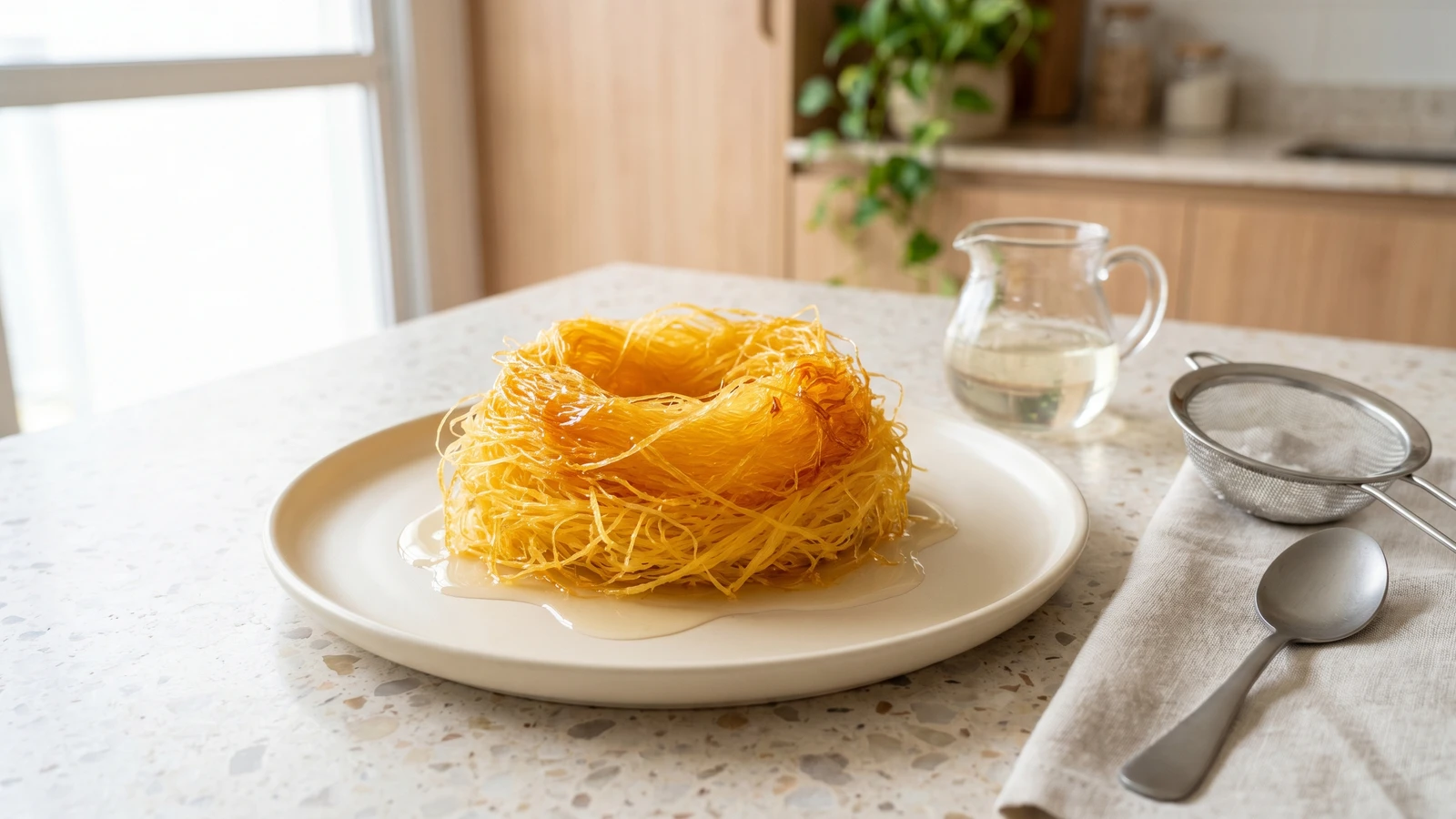
Your bisavó looked like a witch because nobody wrote down the method. Sugar at ponto de fio, yolks through a peneira, gentle batches: gold threads you can actually make at home.
You look at those gold threads draped over the Natal turkey and hear the little voice: isso não é pra mim. I know that voice. It makes everything with hot sugar sound like a secret society, and it is usually wrong. Your bisavó wasn't doing witchcraft. She was pressing gemas through a peneira into hot calda, and she had learned the rhythm.
A gente spends most days solving the pê-efe, rice, beans, something savory, something green, because that plate keeps a house fed. But a country also remembers itself in the celebration food that lands on the same table. Fios de ovos are sweet, yes, and they often sit beside the turkey or over a dessert at Natal, but the lesson is the same as arroz soltinho: comida de verdade is built from a method, not from a packet.
The method here is plain. Fresh yolks, at room temperature so they flow. A real calda cooked to ponto de fio, so each thin stream of yolk lands in syrup strong enough to hold its shape before it can scramble. A gentle boil, small batches, and the discipline not to dump everything in like you're late for the bus. I did that once. Yellow rag soup. Very educational.
Brazil learned this sugar-and-yolk language through many hands, and I'll speak carefully here: the cooks of Bahia and Pernambuco carry these sweets with more authority than I do. What I can give you is the home version in cups and spoons, a receita que funciona. Cozinhar não é dom, é um aprendizado. Anota aí.
Fios de ovos belong to the Portuguese convent-sweet family that grew from the sixteenth century onward, when egg whites were used to starch hábitos and clarify wine, leaving yolks for sugar work. In Brazil, the technique traveled into colonial sugar kitchens, especially in Bahia and Pernambuco, where Portuguese convent methods met abundant açúcar and the skill of African and Afro-Brazilian cooks in casas-grandes and urban homes. By the twentieth century, the golden threads had become a celebration garnish for cakes, puddings, and the Natal turkey, one of the sweet-salty habits of the Brazilian table.
Quantity
12
fresh and at room temperature
Quantity
1 tablespoon
optional, for sturdier threads
Quantity
3 cups
Quantity
1 1/2 cups
for the syrup
Quantity
1 cup
as needed to adjust the syrup
Quantity
2 cups
for briefly loosening the cooked threads
| Ingredient | Quantity |
|---|---|
| large egg yolksfresh and at room temperature | 12 |
| beaten egg white (optional)optional, for sturdier threads | 1 tablespoon |
| granulated sugar | 3 cups |
| waterfor the syrup | 1 1/2 cups |
| hot wateras needed to adjust the syrup | 1 cup |
| cool waterfor briefly loosening the cooked threads | 2 cups |
Separate the eggs while they are cold, because the yolks are firmer and less likely to break. Put 12 yolks in a small bowl, cover, and let them sit until they lose the refrigerator chill, about 20 to 30 minutes. Room-temperature yolks run through the peneira in a smooth ribbon; cold yolks are thick, clog the holes, and make you squeeze harder, which breaks the texture before you begin.
Pierce the yolks and pour them into a fine-mesh sieve set over a clean bowl. Let them fall through by gravity, nudging only the liquid with a spoon, and leave the thick membranes behind. Don't scrape those membranes through. They carry the stronger egg smell and they block the funnel, so your neat threads turn into bursts and blobs. If you're using the optional spoonful of beaten egg white, stir it in now for sturdier strands, knowing the color will be a little less deep.
Put the sugar and 1 1/2 cups water in a wide 3-liter saucepan. Stir off the heat just to wet every grain, then bring it to a boil over medium heat. Once it boils, stop stirring. Cook until the syrup reaches 103 to 105 C (217 to 221 F), or until a cooled drop pinched between your fingers pulls into a fine thread before breaking. That's ponto de fio. It matters because the syrup has to be dense enough to catch the yolk in a strand; if it's thin, the yolk spreads and scrambles into flecks, and if it's too thick, the strands glue together.
Lower the heat so the calda boils steadily, with small bubbles across the surface, not an angry rolling boil. Fill the fios de ovos funnel or squeeze bottle with about 1/4 cup strained yolk. Hold it 10 to 15 cm above the syrup and move in slow circles, letting the yolk fall in thin lines. Keep the stream moving so the strands do not pile on top of themselves. Small batches keep the pan hot and give each thread room to set; dumping the bowl in makes sweet scrambled eggs, and nobody invited that to Natal.
Let the threads cook untouched for 45 to 60 seconds, until they float, turn opaque golden, and hold together when nudged. Slide a slotted spoon or two forks under them, lift the loose nest, and dip it into the bowl of cool water for 5 seconds. Drain in a sieve. The quick water dip stops the cooking and loosens excess syrup, so the fios stay tender and separate; leave them in hot calda too long and they turn rubbery.
Before the next batch, look at the syrup. If the bubbles are thick and lazy or the first threads stuck together, add 1/4 cup hot water and bring it back to ponto de fio. If the threads broke apart or sank, boil the syrup 1 to 2 minutes longer before trying again. Sugar keeps concentrating as water evaporates, so you adjust the pan instead of blaming your hand. Very adult, very annoying, and exactly how cooking works.
Repeat with the remaining yolks, draining each batch well. Spread the fios de ovos on a tray and separate them gently with two forks while they are still flexible. For dessert, spoon 2 to 3 tablespoons of cooled calda over the threads so they shine. For the Christmas turkey, drain them drier and drape them at the last minute, because a wet nest slides around and makes drama on the platter. Serve at room temperature.
1 serving (about 100g)
Culinary guides, cultural storytelling, and the editorial depth that makes cooking meaningful.
Discover Culinary ExplorerChef Juliana
You think curdled milk means you ruined dessert. Good. Tonight you'll do it on purpose, with lemon, yolks, cravo, and sugar, until the pot turns into golden gruminhos.

Chef Juliana
You are not ruining the milk. You're curdling it on purpose, slowly, until sugar, eggs, cinnamon, and patience turn cheap ingredients into dessert.

Chef Juliana
You think curdled milk means failure. Not here. Milk, yolks, sugar, and lemon cook into golden curds in amber whey, a Minas sweet where the ponto teaches the whole recipe.

Chef Juliana
You already trust rice for dinner. Trust it for dessert: cook it gently with milk, coconut, and canela until each grain turns soft, creamy, and impossible to blame on lack of talent.