
Chef Juliana
Arroz Branco Soltinho
You think rice is hard. It isn't. Two parts water to one of rice, a real refogado, and the discipline to stop stirring. Anota aí.
A cooking platform built around craft, culture, and the stories behind what we eat.
Created by
You think this pot is too much for you. It isn't. Soak, simmer, refogar, and serve it with rice, couve, farofa, and orange. That's Saturday handled.
You hear feijoada and that little voice starts: isso não é pra mim. Too many meats, too many hours, too much Brazil in one pot. Good. Now we can take that fear apart properly, because this isn't magic. Cozinhar não é dom, é um aprendizado. It's beans, salt, smoke, onion, garlic, and time behaving exactly as they should when a gente gives them a method.
I learned to cook as a grown woman, with a cheap caderno open on the counter and onions I ruined with great confidence. So believe me when I say the long recipe is not the hard recipe. Feijoada asks for patience, not performance. You soak the beans so they cook evenly and sit easier. You simmer the salted and smoked meats slowly so they season the pot instead of bullying it. You build a real refogado, onion and garlic in good fat, because no packet in the world can do what browned bits and a proper base do.
Then comes the trick that turns bean water into feijão de verdade: mash a ladle of cooked beans into the refogado and stir it back into the pot. That's how the caldo gets thick and glossy, not watery. Same with the meats: brown what can be browned, a little at a time. Crowd the pan and it sweats, greys, and sulks. Give it space and it gives you flavor.
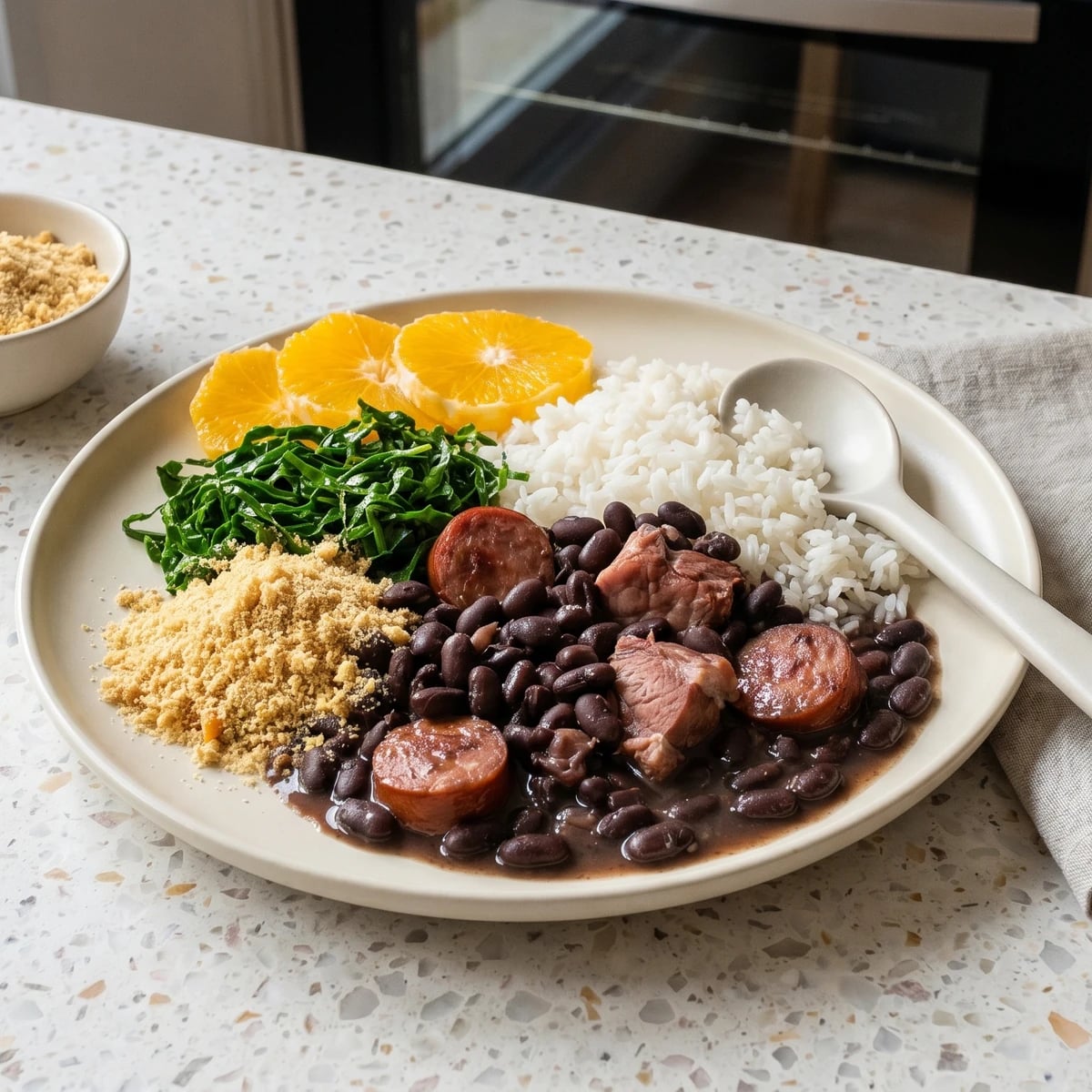
Serve it the Brazilian way, with arroz soltinho, farofa, couve, and orange. That's the pê-efe turned into a celebration: rice, beans, meat, something green, and the sharp little slice of fruit that makes the whole heavy, beautiful plate make sense. Comida de verdade. Big pot, plain steps, no mystique.
Feijoada is a black-bean-and-pork stew eaten across Brazil, most closely tied to Rio de Janeiro's Saturday table, served with white rice, farofa, sautéed couve, and orange slices. The popular story that it was invented by enslaved people from the master's scraps is now disputed by many food historians, who connect it instead to older European bean-and-meat stews adapted through Brazilian ingredients and habits. What made it unmistakably Brazilian was the full plate around it: black beans, pork, cassava flour, greens, rice, and citrus together.
Quantity
2 cups
soaked overnight
Quantity
10 cups, plus more as needed
Quantity
1 pound
soaked overnight and rinsed
Quantity
8 ounces
soaked overnight and rinsed
Quantity
8 ounces
Quantity
8 ounces
sliced 1/2 inch thick
Quantity
8 ounces
sliced 1/2 inch thick
Quantity
4 ounces
diced
Quantity
3 tablespoons, as needed
Quantity
2 medium
finely chopped
Quantity
6 cloves
minced
Quantity
3
Quantity
1 teaspoon
Quantity
1 to 2 teaspoons, only as needed
Quantity
4 cups
for serving
Quantity
2 cups
for serving
Quantity
1 bunch
thinly sliced and sautéed, for serving
Quantity
3
peeled and sliced, for serving
| Ingredient | Quantity |
|---|---|
| dried black beanssoaked overnight | 2 cups |
| water | 10 cups, plus more as needed |
| salted pork ribs or salted pork piecessoaked overnight and rinsed | 1 pound |
| carne-seca or salted beef (optional)soaked overnight and rinsed | 8 ounces |
| smoked pork shoulder, smoked ham hock, or smoked pork chop | 8 ounces |
| smoked linguiça calabresa or kielbasasliced 1/2 inch thick | 8 ounces |
| paio or another smoked sausagesliced 1/2 inch thick | 8 ounces |
| bacondiced | 4 ounces |
| neutral oil or lard | 3 tablespoons, as needed |
| onionsfinely chopped | 2 medium |
| garlicminced | 6 cloves |
| bay leaves | 3 |
| freshly ground black pepper | 1 teaspoon |
| salt | 1 to 2 teaspoons, only as needed |
| cooked white ricefor serving | 4 cups |
| farofafor serving | 2 cups |
| couve or collard greensthinly sliced and sautéed, for serving | 1 bunch |
| orangespeeled and sliced, for serving | 3 |
Put the black beans in a large bowl, cover with at least 3 inches of water, and leave them overnight. They should swell and wrinkle less by morning. Soaking isn't decoration for the recipe. It helps the beans cook more evenly and sit easier, which matters when the pot is rich.
Put the salted pork and carne-seca, if using, in a separate bowl, cover with cold water, and soak overnight in the fridge. Change the water once or twice if you can. The meat should still taste seasoned, not aggressively salty. Skip this and the whole pot becomes a salt lick, and nobody needs that drama at lunch.
Drain the beans and put them in a heavy pot with 10 cups water, the bay leaves, the desalted pork, the carne-seca if using, and the smoked pork. Bring to a boil, skim off any grey foam, then lower to a gentle simmer with the lid slightly open. The pot should burble, not rage. Hard boiling breaks the beans before the meats soften.
While the beans simmer, warm a wide pan over medium heat and cook the bacon until it gives up its fat and starts to brown. Lift it out and brown the sliced sausages in the same pan, a single layer at a time, until the edges take color. Don't pile them in. Crowd the pan and they release water, steam grey, and taste tired instead of smoky and browned.
In the same pan, add enough oil or lard to make about 3 tablespoons fat. Add the onions and cook, stirring, until they murchar, soften, and turn golden at the edges, about 8 minutes. Add the garlic for 1 minute, just until it smells sweet. This is the foundation, not a perfume. Burn the garlic and bitterness follows you into the pot.
After the beans have simmered about 1 1/2 hours, scoop 1 cup of tender beans and a little liquid into the refogado pan. Mash them with a spoon until thick and rough, scraping up the brown bits from the pan. This mashed ladle is what gives the caldo body. No powder, no packet, no little factory miracle. A bean can thicken its own broth.
Stir the mashed refogado, bacon, and browned sausages into the bean pot. Simmer gently until the beans are creamy, the meats are tender, and the caldo coats a spoon, about 1 to 1 1/2 hours more. Add hot water by the cup if the beans start to sit above the liquid. Taste before salting. With salted and smoked meats, the pot may already know what it's doing.
Turn off the heat and let the feijoada rest 20 minutes. The surface should look glossy and dark, with beans holding together and the caldo settling thick around the meats. Resting lets the salt even out and the broth pegar ponto. Serve with arroz soltinho, farofa, sautéed couve, and orange slices. The orange isn't garnish pretending to be fancy. It's there to cut the richness and finish the plate.
1 serving (about 640g)
Culinary guides, cultural storytelling, and the editorial depth that makes cooking meaningful.
Discover Culinary Explorer
Chef Juliana
You think rice is hard. It isn't. Two parts water to one of rice, a real refogado, and the discipline to stop stirring. Anota aí.

Chef Juliana
You don't need shiny tools or bar confidence. Half a lime, sugar, cachaça, and ice make the Brazilian drink that sits happily beside feijoada, churrasco, birthdays, and the table a gente actually uses.

Chef Juliana
You don't need bravery for couve, you need a sharp knife, a hot pan, and ninety honest seconds. Bright greens give feijoada the fresh bite that keeps the plate awake.

Chef Juliana
You don't need courage for farofa. You need a pan, cassava flour, good fat, and ten minutes of attention so every grain turns golden, savory, and loose.