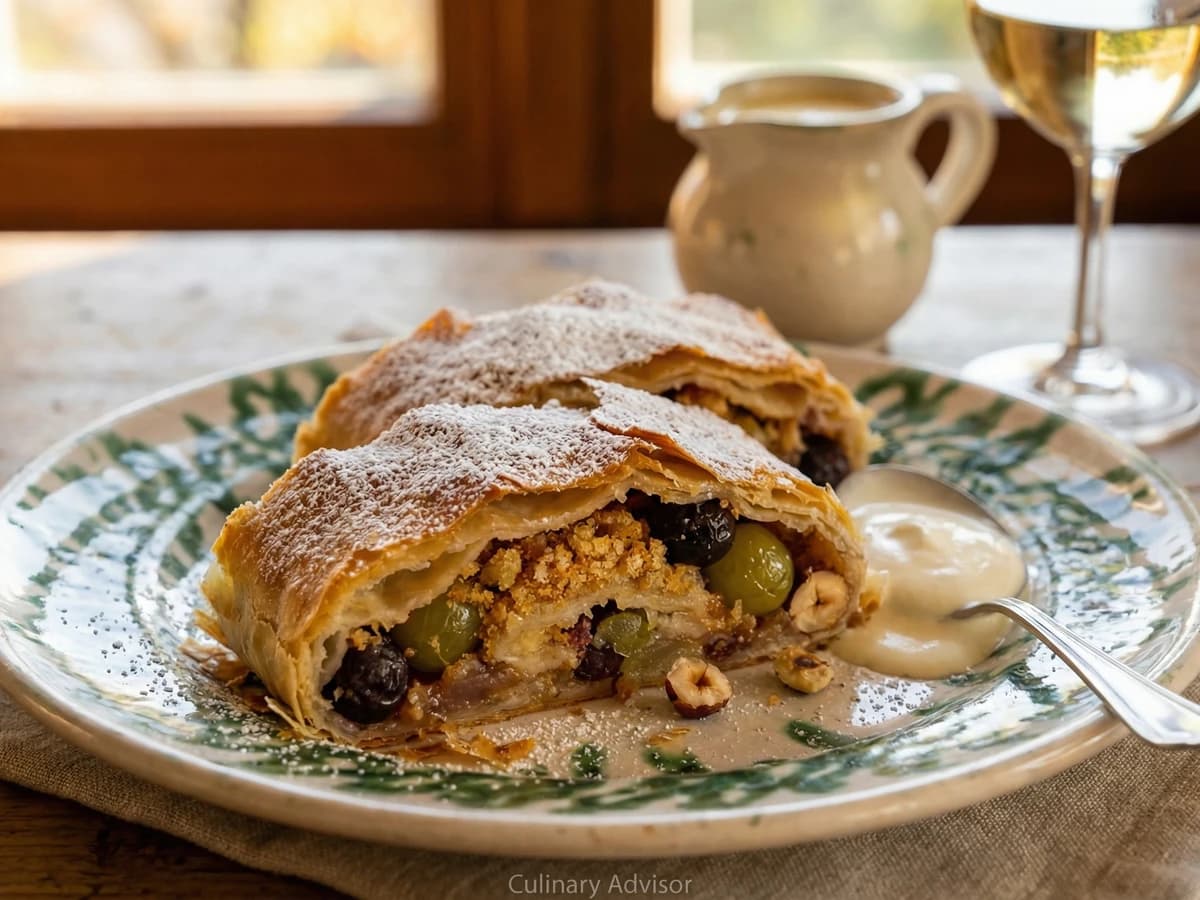
Rum-scented yeast doughnuts fried golden with a pale ring around the equator, filled with warm Marillenmarmelade and dusted in powdered sugar. Austria's Carnival wouldn't start without them.
Pastries & Cookies
Austrian
Holiday
Celebration
Special Occasion
45 min
Active Time
30 min cook•3 hr total
Yield12-14 Krapfen
Every January, bakeries across Austria start putting Krapfen in the window. Not one or two. Towers of them. Golden, powdered-sugar-dusted spheres lined up in rows so tight they lean against each other like tired dancers. By the time Fasching arrives, the whole country has been eating them for weeks and nobody is tired of them yet.
In my grandmother Eva's kitchen, Gretel always made Krapfen in February. She'd set the dough in a bowl near the radiator and check it every twenty minutes, lifting the cloth to see if it had doubled. The smell of yeast and rum filled the hallway before anything even hit the oil. When the first batch came out, she'd tear one open to check the inside: light, almost threadlike in texture, with a thin golden crust and that pale band circling the middle like a belt. That ring, she told me, is how you know the frying went right. The dough floats in the fat, and the strip that sits just above the surface stays pale while the top and bottom turn deep gold. If your Krapfen doesn't have that ring, your oil was too deep or your dough too heavy.
The filling is Marillenmarmelade, apricot jam, and nothing else. Some bakeries have started injecting vanilla cream or Nutella or strawberry nonsense into them, and I won't pretend that doesn't make me a little sad. A Krapfen filled with apricot jam is a perfect thing. The slight tartness of the fruit cuts through the richness of the fried dough and the sweetness of the powdered sugar. Every element has a job. When you start swapping in chocolate hazelnut spread, you've lost the balance that made the original work.
The dough itself is simple but it demands respect. Good butter, fresh eggs, a splash of rum, and enough kneading that the gluten develops properly. If you rush the rise, the Krapfen will be dense. If you rush the frying, they'll be raw inside. This is a recipe that rewards patience at every step, and by the time you bite through that crisp shell into the soft, jam-filled center, you'll understand why Austrians eat millions of them every Carnival season.
Faschingskrapfen trace back to Viennese court kitchens of the 17th century, though fried dough filled with fruit preserves existed in Austrian baking long before that. The association with Fasching (Carnival) cemented itself in the 18th and 19th centuries when Krapfen became inseparable from the masked balls and celebrations leading up to Lent. The legendary Viennese baker Cäcilia Krapf is often credited with popularizing the round, filled version in the early 1700s, and some food historians believe the name Krapfen itself derives from her surname, though this is disputed. What isn't disputed is the numbers: Austrians consume over 50 million Krapfen during Carnival season every year.
The technique, the tradition, and the story behind every dish.
•Large heavy-bottomed pot for frying (at least 20cm wide, 12cm deep)
•Kitchen thermometer
•Round cutter (7-8cm diameter)
•Piping bag with long narrow nozzle
•Slotted spoon
•Wire cooling rack
•Stand mixer with dough hook (optional, but helpful)
Instructions
1
Activate the yeast
Warm the milk until it feels like bathwater against your wrist, around 37°C. Stir in a teaspoon of the sugar and sprinkle the yeast over the surface. Leave it for ten minutes. When the surface is foamy and it smells yeasty and alive, it's ready. If nothing happens after ten minutes, your yeast is dead and you need fresh. Better to find out now than after you've mixed everything together.
If you can find fresh yeast (Germwürfel), use 21g crumbled directly into the warm milk. Fresh yeast gives a slightly more delicate flavor and it's what every Viennese Bäckerei uses.
2
Build the dough
In a large bowl, combine the flour, remaining sugar, Vanillezucker, and salt. Make a well in the center. Pour in the yeast mixture, egg yolks, rum, and lemon zest. Stir from the center outward, gradually pulling flour from the walls until you have a shaggy, sticky mass. Add the softened butter in pieces and start kneading. This dough needs a good ten minutes of work, either by hand on a floured surface or with a stand mixer fitted with a dough hook on medium speed. You're done when the dough is smooth, elastic, and pulls cleanly away from the bowl. Slap it against the counter. It should stretch without tearing.
The rum isn't decorative. It adds a warm, rounded flavor to the dough and helps keep the crumb moist. Don't substitute vanilla extract. They do completely different things.
3
First rise
Shape the dough into a ball, place it in a lightly oiled bowl, and cover with a clean tea towel. Set it somewhere warm, not hot, and let it rise until doubled. This takes about an hour, sometimes a bit longer if your kitchen runs cool. Gretel always said dough rises on its own schedule, not yours. Don't rush it. A properly risen dough gives you light, airy Krapfen. A half-risen one gives you fried bread rolls.
4
Shape the Krapfen
Turn the risen dough out onto a lightly floured surface. Roll it out to about 1.5 centimeters thick. Use a round cutter, about 7 to 8 centimeters across, and stamp out circles. Press firmly and cleanly. Don't twist the cutter or you'll seal the edges and the dough won't rise evenly. Gather the scraps gently, re-roll once, and cut more. You should get twelve to fourteen rounds. Place them on a floured tea towel, spaced apart so they don't touch, and cover loosely with another cloth.
Some traditional recipes cut two rounds and sandwich them with a dot of jam before frying, but the bakery method of filling after frying gives a neater shape and is much more forgiving for home cooks. I'd recommend filling after.
5
Second rise
Let the cut rounds proof for another twenty to thirty minutes under the cloth. They should puff up visibly and feel pillowy when you press a finger gently against the side. This second rise is what creates the airy interior. Skip it and your Krapfen will be dense little cannonballs.
6
Heat the frying fat
Pour the lard or oil into a deep, heavy pot. You need at least eight centimeters of fat. Heat it to 170°C. Use a thermometer. Guessing the temperature of frying fat is how people burn Krapfen and kitchens. At 170°C, a small piece of dough dropped in should sink, then rise to the surface within a few seconds and start bubbling gently. Too hot and the outside scorches before the inside cooks. Too cool and the dough absorbs grease like a sponge.
Lard is traditional and gives the best flavor and the crispest shell. If you'd rather not use it, clarified butter is the next best choice. Neutral oil works but the Krapfen won't taste the same. This is one of those places where the fat matters.
7
Fry the Krapfen
Gently lift each round and slide it into the fat, top side down, placing no more than three or four in the pot at a time. Crowding cools the fat and gives you greasy Krapfen. Put a lid on the pot immediately. This is the secret to the pale ring. The trapped heat causes the top of the dough to rise and puff before it touches the oil. After two to three minutes, when the underside is deep golden, flip each Krapfen carefully with a slotted spoon. Fry the second side uncovered for another two to three minutes until golden all around. That pale band should be clearly visible around the middle: darker gold on top and bottom, a lighter ring where the dough stayed above the fat line.
Covering the pot on the first side is the single most important step for a proper Krapfen. The trapped moisture puffs the exposed top of the dough so it rises above the fat level. When you flip it, that puffed section stays pale because it was never submerged. That's your Randl, and it's the mark of a well-made Krapfen.
8
Drain and cool
Lift the Krapfen out with a slotted spoon and place them on a wire rack set over a tray. Don't use paper towels yet; they'll stick to the warm surface. Let them cool for five minutes. They should feel light in your hand, not heavy. A heavy Krapfen absorbed too much fat, which means your oil wasn't hot enough. Adjust the temperature between batches and give the fat a minute to come back up before adding more dough.
9
Fill with Marillenmarmelade
Sieve the apricot jam to remove any chunks so it flows smoothly through the piping tip. Load it into a piping bag fitted with a long, narrow nozzle, or use a squeeze bottle with a thin tip. Poke a small hole into the pale ring of each Krapfen, push the nozzle about two centimeters into the center, and squeeze gently. You'll feel the Krapfen get heavier as the jam goes in. Stop when it just starts to resist. Too much and it bursts. About a tablespoon per Krapfen is right.
Marillenmarmelade, apricot jam, is the only proper filling for a Faschingskrapfen. The tartness of the apricot balances the rich, sweet dough. If you can find a good Austrian or Hungarian brand, use it. Otherwise, make your own by cooking down dried apricots with a little sugar and water until jammy.
10
Dust and serve
Dust the filled Krapfen generously with powdered sugar. Don't be shy. The sugar should cling to the surface and drift off when you pick one up. Pile them on a plate and serve the same day, ideally still slightly warm. A fresh Krapfen has a thin, crisp shell that gives way to soft, yeasty dough, and then that burst of tart apricot jam in the center. There is no better thing to eat at Carnival. Mahlzeit!
Chef Tips
•The dough should be enriched but not overly buttery. Krapfen dough is lighter than brioche. If it feels like you're making brioche, you've added too much fat and the dough won't fry properly. It should be soft and elastic, not rich and heavy.
•Buy a kitchen thermometer if you don't own one. I mean it. Frying at the right temperature is the entire difference between a Krapfen that's golden and light and one that's greasy and raw inside. 170°C is your number. Guard it.
•Krapfen are best the day they're made. By the next morning, the shell softens and the magic fades. If you must keep them overnight, store them unfilled and undusted in an airtight container, then fill and dust just before serving. They won't be the same, but they'll still be better than anything from a supermarket.
•Gretel always said: the first Krapfen out of the oil is your test. Tear it open. The inside should be light and almost webby, with fine, even air pockets. If it's dense or doughy in the center, your oil is too hot and the outside is cooking before the inside catches up. Lower the heat slightly.
Advance Preparation
•The dough can be made the night before and left to rise slowly in the fridge overnight. Pull it out an hour before shaping to bring it back to room temperature. Cold dough is easier to handle but needs time to relax before cutting.
•Marillenmarmelade can be sieved and loaded into the piping bag ahead of time. Keep it at room temperature so it flows easily.
•Krapfen cannot be fried ahead. They must be fried, filled, and served the same day. Plan your timing so the last batch comes out of the oil about thirty minutes before you want to eat.
Frequently Asked Questions
Nutrition Information
1 serving (about 95g)
Calories
385 calories
Total Fat
18 g
Saturated Fat
8 g
Trans Fat
0 g
Unsaturated Fat
10 g
Cholesterol
80 mg
Sodium
105 mg
Total Carbohydrates
49 g
Dietary Fiber
1 g
Sugars
17 g
Protein
6 g
Where cooking meets culture.
Culinary guides, cultural storytelling, and the editorial depth that makes cooking meaningful.