Culinary Explorer

A cooking platform built around craft, culture, and the stories behind what we eat.
Discover Culinary Explorer
Falscher Hase

Falscher Hase

Created by

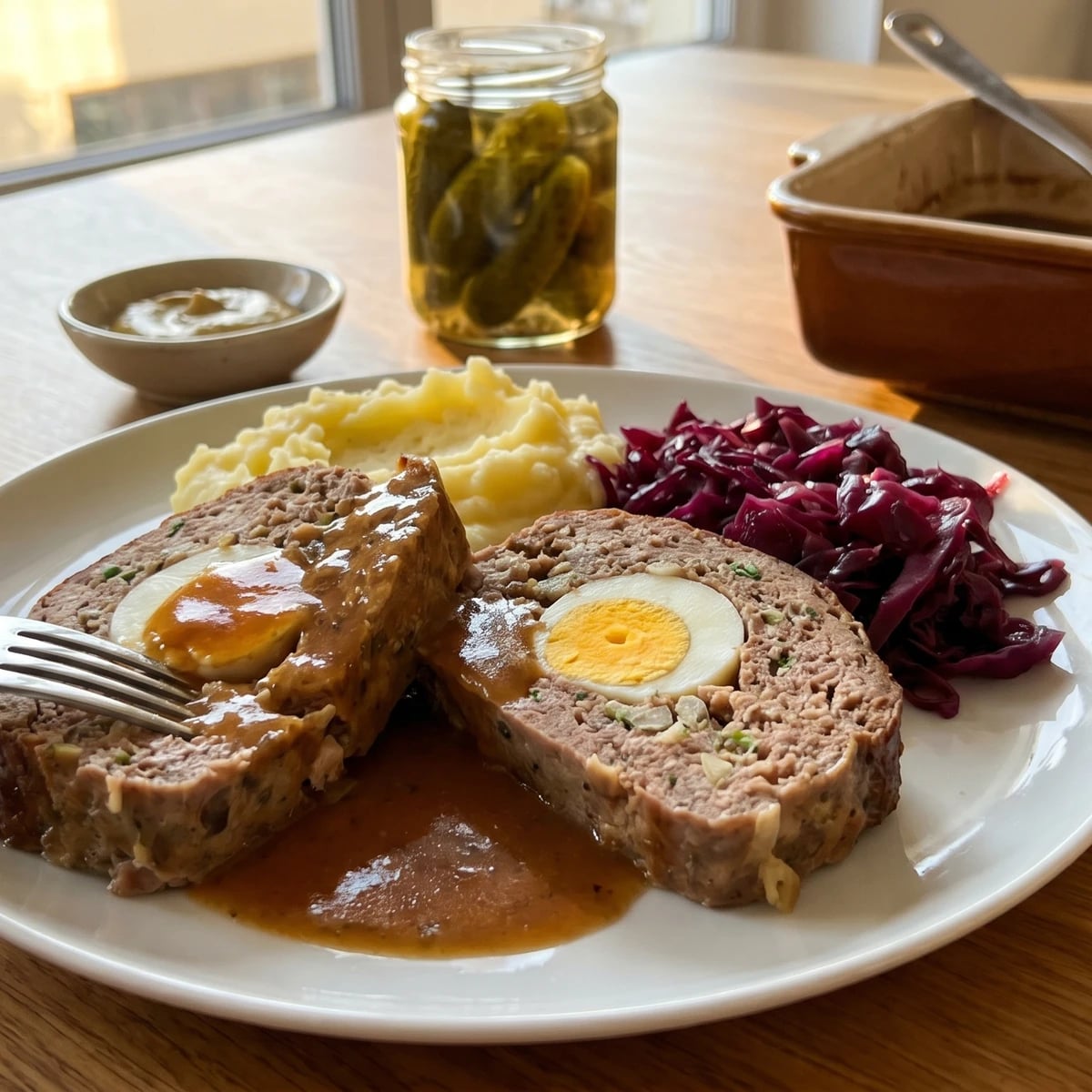
No hare, no apology: a Prussian thrift roast of seasoned mince wrapped around hard-boiled eggs, baked until the crust browns and the slices hold clean.

Main Dishes
German
Weeknight
Budget Friendly
Comfort Food
25 min
Active Time
1 hr 10 min cook1 hr 35 min total
Yield6 servings

Falscher Hase is the roast you make when there is no hare, which is most weeks. It sits in the Prussian and eastern German kitchen as a thrift roast, a Hackbraten, meatloaf, dressed for Sunday with hard-boiled eggs through the middle. On a weeknight it feeds the table with potatoes and pickles. On Sunday it gets red cabbage and a proper pan sauce. Nicht aus dem Glas.

The regions split on the hand in it. In Prussia and Saxony, you often see the eggs hidden whole through the centre, so every slice shows a pale yellow eye. Further south, the meatloaf may be looser, richer with soaked rolls and sometimes wrapped in bacon. Im Norden anders, im Süden anders. This one keeps the eastern thrift logic: pork and beef, stale bread, onion, mustard, egg, and the pan doing its work.

The technique that decides it is the binding. Soak the stale roll properly, then squeeze it dry before it goes into the mince. Wet bread makes a slack loaf that leaks and crumbles; dry squeezed bread catches the meat juices and holds the slice together. Mix only until the meat turns tacky under your hand, then stop, or the roast eats tight and rubbery.

Shape it firmly around the eggs and bake it uncovered so the outside browns before the inside overcooks. The sauce comes from the tray, stock, browned onion, and the crust stuck to the pan. Weggeworfen wird nichts. That's the flavour you already paid for.

Falscher Hase belongs to the German family of mock roasts that became common in middle-class and working kitchens by the late 19th and early 20th centuries, when minced meat and stale bread could imitate the form of a more expensive game roast. The name, false hare, points both to the long oval shape of a hare roast and to the thrift of serving a Sunday-looking dish without wild game. It is especially associated with Prussian, Saxon, and eastern German cooking, though related Hackbraten versions spread across the country with regional changes in seasoning, bacon, and sauce.

The technique, the tradition, and the story behind every dish.

Discover Culinary Explorer

Ingredients

large eggs

Quantity

4

3 hard-boiled and peeled, 1 raw

stale white bread roll

Quantity

1, about 60g

whole milk

Quantity

120ml

lard or neutral oil

Quantity

1 tablespoon

onion

Quantity

1 medium

finely diced

mixed minced pork and beef

Quantity

700g

German medium-hot mustard

Quantity

2 teaspoons

fine salt

Quantity

1 teaspoon

freshly ground black pepper

Quantity

1/2 teaspoon

sweet paprika

Quantity

1 teaspoon

dried marjoram

Quantity

1/2 teaspoon

fine dry breadcrumbs

Quantity

2 tablespoons

plus more if needed

butter

Quantity

1 tablespoon

carrot

Quantity

1 small

diced

onion for the sauce

Quantity

1 small

sliced

beef stock

Quantity

250ml

dark beer or water

Quantity

100ml

tomato paste

Quantity

1 teaspoon

potato starch slurry (optional)

Quantity

1 teaspoon starch mixed with 1 tablespoon cold water

Equipment Needed

  • Large mixing bowl
  • Small frying pan
  • Roasting dish or loaf-shaped baking dish
  • Instant-read thermometer
  • Fine sieve

Instructions

  1. 1

    Soak the roll

    Tear the stale roll into pieces and soak it in the milk for 10 minutes, then squeeze it hard in your fist until it is damp, not dripping. The bread is there to hold meat juice, not pour milk into the loaf; leave it wet and the roast splits and weeps in the oven.

  2. 2

    Cook the onion

    Warm the lard in a small pan and cook the diced onion gently until soft and pale gold, then let it cool. Raw onion stays sharp inside a meatloaf and pushes water into the mince; cooked onion gives sweetness and keeps the slice clean.

    Do not brown the onion hard here. Dark onion tastes fine in sauce, but inside the loaf it turns bitter before the meat is cooked through.
  3. 3

    Mix the meat

    Put the mince, squeezed bread, cooled onion, raw egg, mustard, salt, pepper, paprika, marjoram, and breadcrumbs in a bowl. Mix with your hand until the meat feels tacky and holds together when pressed, then stop. That tackiness is the protein binding; keep working after that and you build a tight little brick. Das ist kein Bierzelt.

  4. 4

    Shape around eggs

    Heat the oven to 180C. Pat half the meat mixture into a long oval in a buttered roasting dish, lay the 3 hard-boiled eggs end to end down the centre, then cover with the remaining meat and seal the sides firmly. Press out air pockets around the eggs because trapped air opens cracks, and cracks let the juices run where they should stay.

  5. 5

    Build the tray

    Scatter the carrot and sliced onion around the loaf, dot the loaf with butter, and stir the tomato paste into the vegetables. The vegetables and paste brown in the tray and give the sauce its base; without them you are boiling stock and calling it gravy. Nicht aus dem Glas.

  6. 6

    Bake the loaf

    Bake uncovered for 45 minutes, until the crust is browned and the loaf feels firm. Pour the stock and dark beer or water around the loaf, not over the crust, and bake another 15 to 20 minutes, until the centre reaches 70C. Liquid goes in late so the crust has time to form; add it too early and the loaf stews pale.

  7. 7

    Rest and sauce

    Lift the loaf to a board and rest it 10 minutes before slicing, because the juices need to settle back into the meat or they run across the board. Scrape the browned tray bits into the liquid, strain into a small pan, and simmer until rounded. Thicken with a little potato starch slurry if it needs body, then taste for salt and pepper. Würzen, Fett, Salz zum Schluss.

Chef Tips

  • Use mixed pork and beef. Beef alone eats dry, pork alone eats soft; together they give flavour and enough fat to keep the loaf kind.
  • The stale roll matters. Fresh bread turns gummy, dry packet crumbs alone make the loaf dull, and a soaked stale roll gives the old kitchen's answer: yesterday's bread doing today's work.
  • Hard-boil the eggs just set, then cool and peel them before shaping. Overcooked eggs bring a grey ring to every slice, and the dish already has enough brown without help.
  • Serve with boiled potatoes, mashed potatoes, pickled cucumbers, or red cabbage. The sharp things on the table are not decoration; they cut the fat and wake the plate up.
  • Cold leftovers slice better than hot ones. Put a slice on rye with mustard the next day. Weggeworfen wird nichts.

Advance Preparation

  • The hard-boiled eggs can be cooked and peeled one day ahead, then kept covered in the refrigerator.
  • The meat mixture can be mixed and shaped around the eggs up to 8 hours ahead; cover it and keep it cold, then let it sit 20 minutes at room temperature before baking so the centre cooks evenly.
  • Cooked Falscher Hase keeps 3 days in the refrigerator. Reheat slices gently in the sauce so the meat warms without drying.

Frequently Asked Questions

Nutrition Information

1 serving (about 240g)

Calories
445 calories
Total Fat
30 g
Saturated Fat
12 g
Trans Fat
0 g
Unsaturated Fat
16 g
Cholesterol
215 mg
Sodium
780 mg
Total Carbohydrates
13 g
Dietary Fiber
2 g
Sugars
3 g
Protein
28 g

Note: Chef personas and recipes are created with AI assistance. Cook with care: follow safe food-handling practices, check doneness with a thermometer when needed, and adapt for allergies and your kitchen.

Where cooking meets culture.

Culinary guides, cultural storytelling, and the editorial depth that makes cooking meaningful.

Discover Culinary Explorer

More from The Berlin & Prussian Table

Browse the full collection