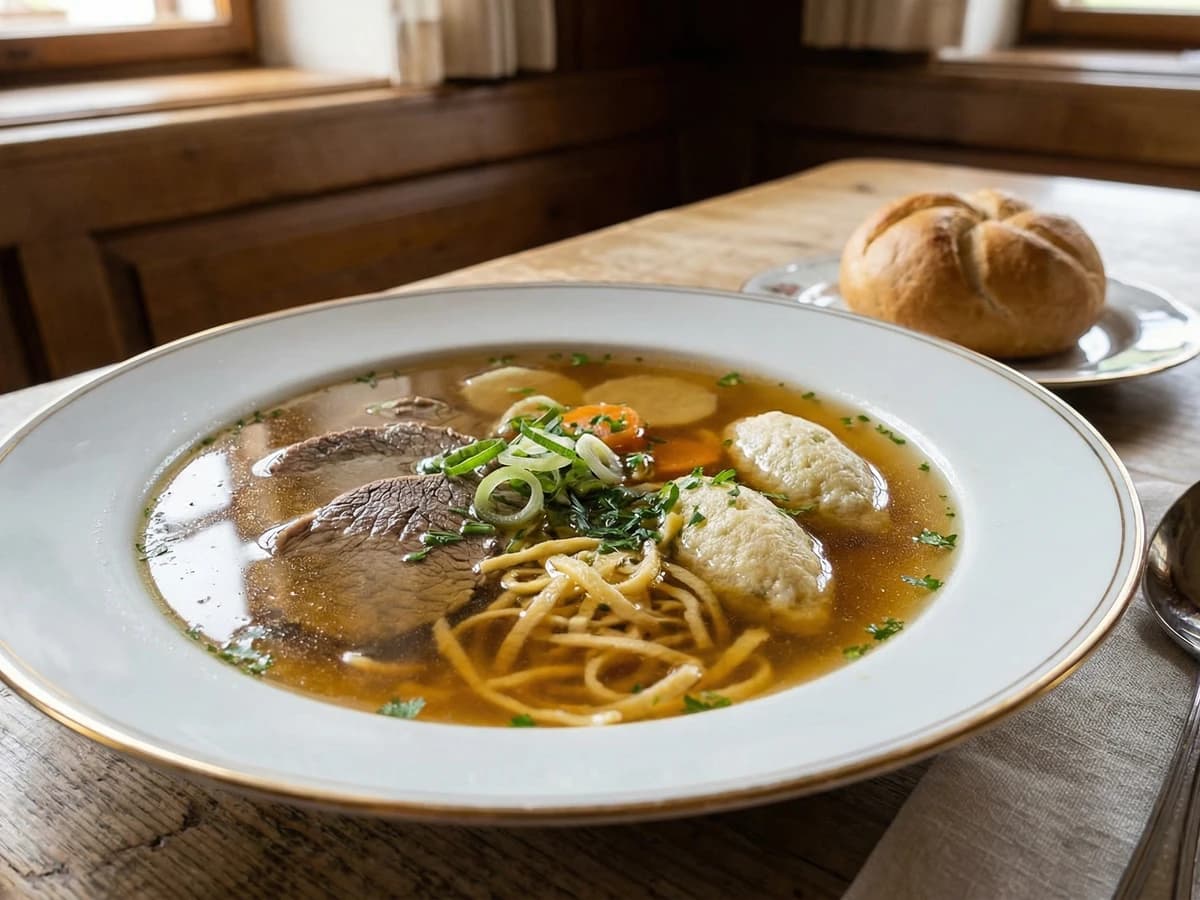
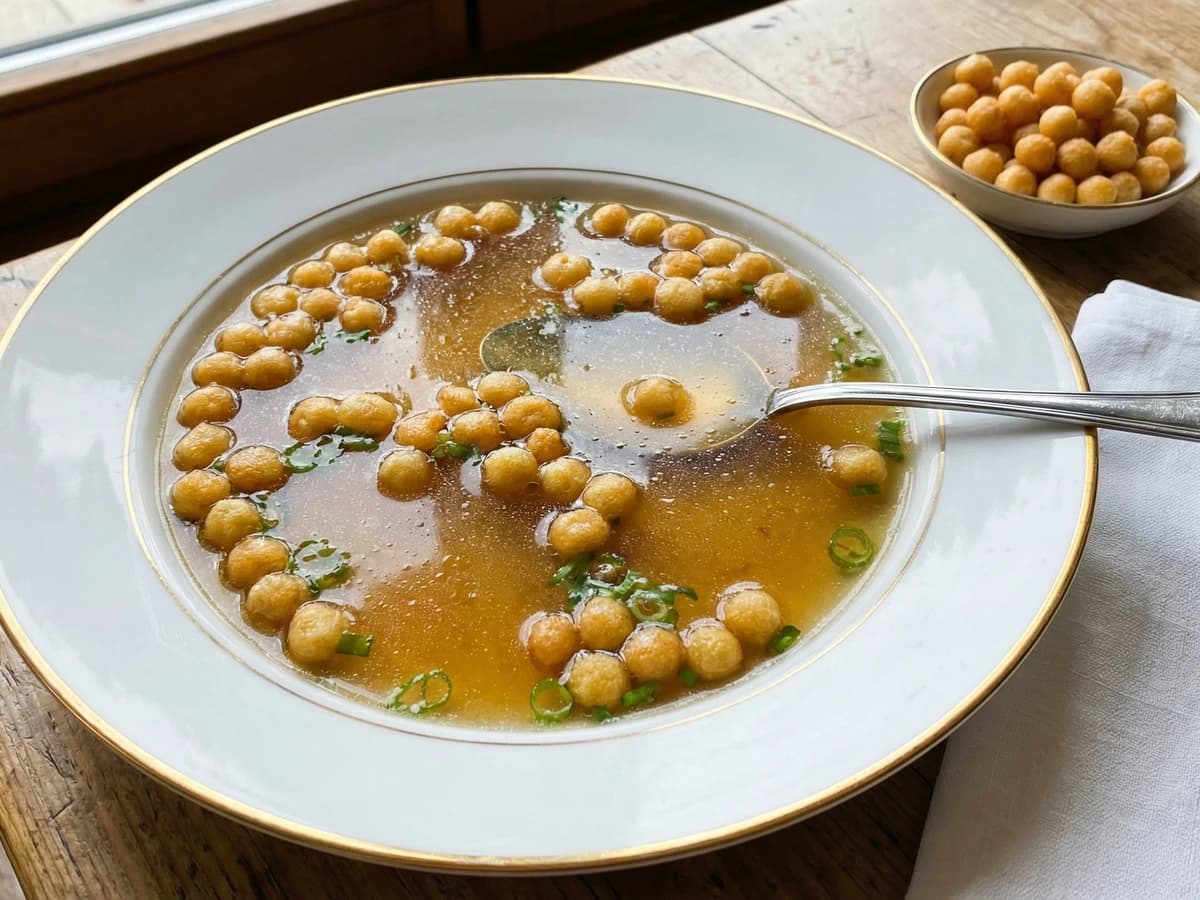
Austria's caraway-scented potato soup, thickened by nothing but the potatoes falling apart in the pot. Good stock, honest ingredients, and the kind of warming bowl that costs almost nothing and gives back everything.
Soups & Stews
Austrian
Weeknight
Comfort Food
Budget Friendly
20 min
Active Time
40 min cook•1 hr total
Yield4 servings
In my grandmother Eva's kitchen in Kent, potato soup was a Thursday evening fixture. Not because Thursday was special, but because Thursday was ordinary, and this is a soup that belongs to ordinary days. Eva would peel the Erdäpfel while Gretel sat at the table with a cup of tea, telling her the caraway needed to be toasted first. Gretel always said the difference between a forgettable potato soup and one you remember all winter is whether you took thirty seconds to toast the Kümmel.
Erdäpfelsuppe is one of those dishes that exposes everything. There's nowhere to hide. You have potatoes, onions, a few roots, stock, and two seasonings: caraway and marjoram. That's the whole list. If your stock is thin, the soup will be thin. If your potatoes are waxy when they should be floury, you won't get that beautiful natural thickness where the starch breaks down and turns the broth creamy without a gram of flour or cream doing the work. The potatoes thicken this soup by falling apart. That's the principle. You cook them until they give up their structure, and then you help them along with a rough mash or a quick pass with a stick blender, leaving some pieces chunky so the texture stays interesting.
I serve this at my restaurant in Salzburg from October through March, sometimes with a few Frankfurter slices floating on top, sometimes with nothing but a swirl of good sour cream and a piece of dark bread on the side. It costs almost nothing to make. It feeds a family. It tastes better the next day, when all the caraway and marjoram have had time to settle in and get comfortable. This is good Austrian home cooking at its most honest.
Erdäpfelsuppe belongs to Austria's Hausmannskost tradition, the robust home cooking that sustained working families through Alpine winters long before restaurant culture existed. The word Erdäpfel (earth apple) is the Austrian term for potato, distinct from the German Kartoffel, and its use traces the ingredient's path into Austrian kitchens after Maria Theresia promoted potato cultivation in the 18th century. Regional variations run deep: Styrians add pumpkin seed oil as a finishing drizzle, Upper Austrians swear by a splash of vinegar, and the Viennese insist on a proper Rindsuppe base rather than water.
The technique, the tradition, and the story behind every dish.
floury potatoes (Mehlige Erdäpfel)peeled and cut into rough 2cm pieces
800g
onionfinely diced
1 large
carrotpeeled and finely diced
1 medium
celeriacpeeled and finely diced
1/4 (about 100g)
leekwhite and light green parts, sliced thin
1 small
garlicminced
2 cloves
good beef or vegetable stock
1.2 liters
whole caraway seeds (Kümmel)
1 teaspoon
dried marjoram
1 teaspoon
bay leaves
2
unsalted butter
2 tablespoons
neutral oil (sunflower or rapeseed)
1 tablespoon
white wine vinegar
1 tablespoon
salt
to taste
freshly ground black pepper
to taste
sour creamfor serving
4 tablespoons
fresh chivesfinely cut
for garnish
dark bread or Bauernbrot (optional)
for serving
Equipment Needed
•Large heavy-bottomed pot (4-liter minimum)
•Potato masher or stick blender
•Sharp peeler
Instructions
1
Toast the caraway
Put a large heavy pot over medium heat. Add the caraway seeds to the dry pot and toast them for about sixty seconds, shaking the pot once or twice, until they smell warm and nutty and your kitchen starts to smell like an Austrian Gasthaus. The moment you catch that fragrance, pull them off. Toasting wakes up the essential oils that make caraway taste like caraway instead of like a dusty spice jar. Set them aside on a small plate.
Gretel always said if you can't smell the caraway from across the room, you haven't toasted it enough. But the window between toasted and burnt is about ten seconds, so stay close.
2
Sweat the vegetables
In the same pot, melt the butter with the oil over medium heat. The oil stops the butter from burning. Add the onion and cook, stirring occasionally, until it turns soft and translucent. This takes about five minutes. You don't want color here. You want sweetness. Add the carrot, celeriac, and leek. Cook for another three minutes, letting the roots soften at the edges. Add the garlic last and stir for thirty seconds, just until it smells fragrant. Garlic burns fast and burned garlic will ruin every spoonful.
3
Add potatoes and stock
Add the potatoes, toasted caraway seeds, marjoram, and bay leaves to the pot. Pour in the stock. It should just cover the potatoes. If it doesn't, add a splash of water. Bring everything to a gentle simmer, then reduce the heat until the surface barely trembles. You want lazy bubbles, not a rolling boil. A hard boil breaks the potatoes apart too fast and turns the soup gluey instead of creamy. There's a difference.
Use floury potatoes, not waxy. In Austria, we'd use Mehlige Erdäpfel. If you're in Britain, look for Maris Piper or King Edward. In America, Russets work well. Waxy potatoes hold their shape, which is exactly what you don't want here. You need the starch to break down and thicken the broth naturally.
4
Simmer until the potatoes give in
Let the soup simmer gently for twenty-five to thirty minutes. You'll know it's ready when a potato piece offers no resistance to a fork, when it practically falls apart at the suggestion of pressure. The broth will already look cloudier and slightly thickened from the released starch. Fish out the bay leaves.
5
Rough-mash the soup
Take a potato masher and press it through the soup four or five times, right in the pot. You want roughly half the potatoes to dissolve into the liquid and half to remain in soft, ragged chunks. This is the texture you're after: creamy from starch, but with enough pieces that your spoon finds something to land on. If you own a stick blender, give the soup two or three short pulses instead. Don't puree it smooth. This is Erdäpfelsuppe, not Erdäpfelcreme. It should look like someone's grandmother made it, not like it came from a hotel kitchen.
If the soup is too thick after mashing, add stock or water a splash at a time. If it's too thin, simmer uncovered for another five minutes. The potatoes will keep releasing starch and the liquid will reduce.
6
Season and brighten
Stir in the white wine vinegar. This is the step most people skip and it makes all the difference. A tablespoon of vinegar won't make the soup taste sour. It lifts the whole pot, sharpening the edges so the caraway and marjoram sing instead of sitting flat. Taste, and add salt and black pepper until it makes you close your eyes. A good Erdäpfelsuppe should taste deeply savory with a warm caraway hum underneath.
7
Serve with care
Ladle into warm bowls. Drop a spoonful of cold sour cream into the center of each serving and let it sit there, white against the golden soup. Scatter chives over the top. Serve with thick slices of dark bread or Bauernbrot on the side, the kind with a crust that fights back when you tear it. Mahlzeit!
Chef Tips
•The stock matters more here than in almost any other soup. Because the ingredient list is so short, a weak stock leaves you with a weak soup. Use homemade if you have it. If you're using store-bought, taste it first. If it doesn't taste like something you'd drink on its own, it won't carry the Erdäpfelsuppe.
•Reheat this soup the next day. I mean it. Erdäpfelsuppe on day two is a different, better thing. The caraway deepens, the marjoram rounds out, and the starch continues to thicken the broth overnight. Add a splash of stock when reheating if it's gone too thick.
•Some Austrian cooks finish Erdäpfelsuppe with a few slices of Frankfurter or Debreziner sausage floated on top. This turns a starter into a full meal. Slice the sausage thin and let it warm through in the hot soup for a minute before serving.
•If you can find Styrian pumpkin seed oil, drizzle a thin thread over the sour cream just before serving. It's dark green, nutty, and gorgeous against the pale soup. Not traditional everywhere in Austria, but very much traditional in Styria, and once you've tried it you'll understand why they put it on everything.
Advance Preparation
•Erdäpfelsuppe can be made up to three days ahead and refrigerated. It thickens considerably as it sits, so thin it with stock when reheating.
•The soup freezes well for up to two months. Freeze without the sour cream and chive garnish. Defrost overnight in the fridge and reheat gently, adding a splash of stock to restore the consistency.
Frequently Asked Questions
Nutrition Information
1 serving (about 575g)
Calories
345 calories
Total Fat
13 g
Saturated Fat
6 g
Trans Fat
0 g
Unsaturated Fat
7 g
Cholesterol
25 mg
Sodium
1100 mg
Total Carbohydrates
48 g
Dietary Fiber
7 g
Sugars
6 g
Protein
8 g
Where cooking meets culture.
Culinary guides, cultural storytelling, and the editorial depth that makes cooking meaningful.