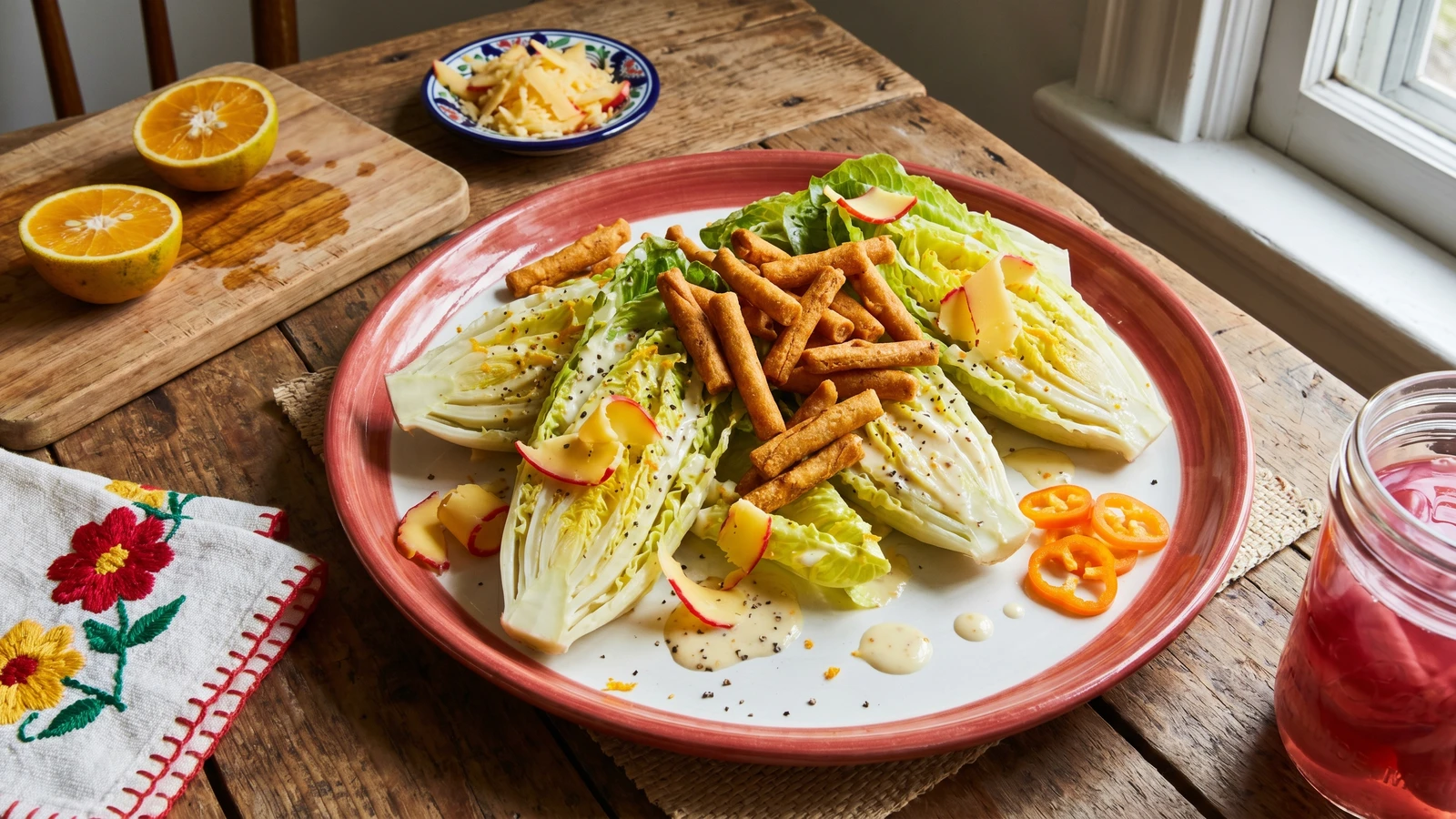
Mérida's regional Caesar, dressed with naranja agria where the lemon would go, queso de bola where the parmesan would go, and codzitos fried in lard where the croutons would go.
Salads
Mexican
Dinner Party
Date Night
Special Occasion
30 min
Active Time
20 min cook•50 min total
Yield4 to 6 servings
This is from Mérida, not from Tijuana. The Caesar was born in Baja California in 1924, at Caesar Cardini's restaurant on Avenida Revolución, and Mexico has been adapting it ever since. The Yucatán took the idea and rebuilt it around its own pantry, because that is what the peninsula does with every dish that crosses the Gulf. Cada estado, su propia cocina.
The peninsula does not cook with lemon. It cooks with naranja agria, the bitter Seville-style orange that the Spanish brought to Mérida in the 16th century and that took to the peninsular climate the way achiote and habanero did. Naranja agria is the acid of cochinita pibil, of escabeche, of recado blanco. Putting it in a Caesar dressing is not invention. It is the peninsula speaking its own language. If you can find lima agria too, halve it and set it on the table for the diner who wants to brighten their plate at the last second.
The cheese is queso de bola, the Edam aged in red wax that arrived through the port of Sisal during Yucatán's henequen trade with the Dutch and Belgians in the 19th century. Queso de bola is the cheese of queso relleno, of papadzules served on the side, of the holiday table in Mérida. It has salt, bite, and a yielding texture that grates beautifully into a dressing. Do not use parmesan here. Parmesan belongs to Tijuana's Caesar. This one belongs to Mérida.
And where the croutons would go, you put codzitos: thin tortillas rolled into pencil-width cigars and fried in manteca de cerdo until rigid. My mother did not make this salad, she was jalisciense, but I learned it from a señora named Doña Adelfa who ran a fonda off Calle 62 in Mérida and who corrected me three times on the lard temperature before she nodded. Codzitos in lard. Not vegetable oil. La manteca es el sabor. Saber cocinar es saber vivir.
The Caesar salad was created in 1924 by Italian-Mexican restaurateur Caesar Cardini at his restaurant Hotel Caesar's in Tijuana, Baja California, reportedly improvised on a busy Fourth of July weekend when American tourists overwhelmed his kitchen. The Yucatecan adaptation arose later in the 20th century as Mérida's middle-class restaurants absorbed the dish into their menus and substituted the peninsula's signature ingredients: naranja agria, an embittered citrus introduced by the Spanish in the 1500s and now central to recados and salsas across the region; queso de bola, an Edam cheese that entered Yucatán through 19th-century maritime trade with the Netherlands during the henequen export boom; and codzitos, the rolled-tortilla form that originally served as a standalone antojito with tomato sauce. The result is a regional dialect of a national dish, and a quiet argument that the Yucatán speaks its own culinary language.
The technique, the tradition, and the story behind every dish.
outer leaves discarded, inner leaves separated and chilled
corn tortillas
Quantity
12
day-old preferred, for the codzitos
manteca de cerdo (pork lard)
Quantity
1/2 cup
for frying the codzitos
queso de bola (Edam)
Quantity
4 ounces
the Yucatecan kind aged in red wax
garlic cloves
Quantity
2
peeled
oil-packed anchovy fillets
Quantity
4
large egg yolks
Quantity
2
from very fresh eggs
Yucatecan mustard or Dijon
Quantity
1 teaspoon
fresh naranja agria juice
Quantity
1/3 cup (about 3 sour oranges)
Worcestershire sauce
Quantity
1 teaspoon
extra virgin olive oil
Quantity
1/2 cup
neutral oil
Quantity
1/4 cup
kosher salt
Quantity
1/2 teaspoon, plus more to taste
freshly cracked black pepper
Quantity
to taste
chile habanero (optional)
Quantity
1
very thinly sliced, for serving
lima agria (optional)
Quantity
1
halved, for the table
Ingredient
Quantity
romaine lettuceouter leaves discarded, inner leaves separated and chilled
2 heads
corn tortillasday-old preferred, for the codzitos
12
manteca de cerdo (pork lard)for frying the codzitos
1/2 cup
queso de bola (Edam)the Yucatecan kind aged in red wax
4 ounces
garlic clovespeeled
2
oil-packed anchovy fillets
4
large egg yolksfrom very fresh eggs
2
Yucatecan mustard or Dijon
1 teaspoon
fresh naranja agria juice
1/3 cup (about 3 sour oranges)
Worcestershire sauce
1 teaspoon
extra virgin olive oil
1/2 cup
neutral oil
1/4 cup
kosher salt
1/2 teaspoon, plus more to taste
freshly cracked black pepper
to taste
chile habanero (optional)very thinly sliced, for serving
1
lima agria (optional)halved, for the table
1
Equipment Needed
•Molcajete or heavy mortar and pestle
•Salad spinner or clean cotton servilleta for drying lettuce
•Heavy skillet for frying the codzitos
•Wire rack for draining
•Box grater with small holes for the queso de bola
•Wide wooden salad bowl
Instructions
1
Wash and chill the romaine
Separate the inner leaves of the romaine. Discard the dark outer leaves and save the pale yellow-green hearts. Wash them gently under cold water, dry them completely in a salad spinner or a clean cotton servilleta, and refrigerate them in a covered bowl for at least 30 minutes. Cold lettuce stays crisp under the dressing. Warm lettuce wilts on contact. This is not optional.
If the lettuce is even slightly wet when you dress it, the emulsion breaks and slides off the leaves. Dry it like you mean it.
2
Roll the codzitos
Heat the tortillas briefly on a comal, about 10 seconds per side, just until they are pliable. Stack them under a damp cotton cloth to keep them soft. Roll each tortilla tightly into a thin cigar, the diameter of a finger, and secure with a wooden toothpick. In Mérida these are codzitos, and they go where the croutons go in any other Caesar. A bowl of fried tortillas is not the same. Codzitos are the regional answer.
3
Fry the codzitos in lard
Heat the manteca in a heavy skillet over medium until it shimmers, around 350 degrees. Fry the rolled tortillas in batches, turning with tongs, until they are deep golden and rigid, about 2 minutes per batch. Lard, not vegetable oil. La manteca es el sabor and the codzitos taste like the Yucatán because of it. Drain on a wire rack, remove the toothpicks while still warm, and let them cool until crisp.
4
Pound the dressing base
In a molcajete or a heavy mortar, pound the garlic and the anchovy fillets with the half teaspoon of salt until they break down into a rough paste. The salt is the abrasive. The molcajete tears the cells open in a way a blender cannot. If you do not own one, mince the garlic and anchovy together on a board with the flat of your knife until you have a paste, but understand you are making a compromise.
5
Build the emulsion
Scrape the garlic-anchovy paste into a wide bowl. Add the egg yolks, the mustard, the Worcestershire, and a generous crack of black pepper. Whisk hard until the yolks lighten and thicken. Begin drizzling the olive oil and neutral oil in a thin stream, whisking constantly, the way you would build a mayonnaise. When the dressing is thick and pale, whisk in the naranja agria juice. The sour orange does the work of lemon here. This is the Yucatán's citrus. Do not substitute lemon. Do not substitute regular lime. If you cannot find naranja agria, mix two parts sweet orange juice with one part lime, but say out loud that you are compromising.
6
Grate the queso de bola
Peel the red wax from the queso de bola. Grate half of the cheese on the small holes of a box grater into the dressing. Whisk it in. The Edam-style cheese, brought by Dutch traders through Sisal and Progreso, is the cheese of Yucatán. Parmesan is the Tijuana original. Queso de bola is what Mérida cooks reached for, and the salt and bite are right for this dressing. Taste for salt. Adjust.
7
Dress and compose
Tear the chilled romaine hearts into large pieces, generous enough to hold the dressing on the spoon. Drop them into a wide bowl. Pour about three quarters of the dressing over them and toss gently with your hands until every leaf is coated. Add half the codzitos and toss once more. Pile onto a platter or individual plates. Scatter the remaining codzitos on top, grate the rest of the queso de bola over the salad in coarse curls, and finish with a few thin slices of habanero if your guests can handle it. Set lima agria halves on the table for anyone who wants more brightness. Serve immediately. Así se hace y punto.
Chef Tips
•Naranja agria is the heart of this salad. Look for it in Latin markets, particularly those serving Caribbean and Yucatecan communities. If you absolutely cannot find it, mix two parts fresh sweet orange juice with one part fresh lime juice and one teaspoon of grapefruit juice. It is a compromise, not an upgrade. No me vengas con atajos unless you have to.
•Queso de bola is sold in the red wax ball at any Yucatecan-leaning grocer and at most well-stocked Latin markets. Mexican-made Edam is closer to the original than European Edam because the peninsula's version has been aged in a warmer climate for over a century and developed its own profile. If you can only find European Edam, that works. Parmesan does not.
•Day-old tortillas roll into codzitos better than fresh ones. Fresh tortillas tear at the bend. If yours are too fresh, warm them on the comal and let them sit out for an hour before rolling. Pregúntale a las señoras del mercado, they will tell you the same thing.
•Raw egg yolks make a real Caesar dressing. If you are serving someone immunocompromised, pregnant, or very young, use pasteurized yolks. Otherwise use the freshest eggs you can find and trust your sourcing.
Advance Preparation
•The codzitos can be fried up to 6 hours ahead and kept at room temperature on a wire rack, uncovered, so they stay crisp. Do not refrigerate them, the moisture will soften them.
•The dressing can be made up to 4 hours ahead and refrigerated. Whisk it again before dressing the salad and taste for salt and acid, the naranja agria flattens slightly as it sits.
•The romaine can be washed, dried, and refrigerated wrapped in cotton up to one day ahead. Tear it only at the moment you toss the salad.
Frequently Asked Questions
Nutrition Information
1 serving (about 275g)
Calories
655 calories
Total Fat
53 g
Saturated Fat
13 g
Trans Fat
0 g
Unsaturated Fat
34 g
Cholesterol
120 mg
Sodium
610 mg
Total Carbohydrates
29 g
Dietary Fiber
5 g
Sugars
1 g
Protein
12 g
Where cooking meets culture.
Culinary guides, cultural storytelling, and the editorial depth that makes cooking meaningful.