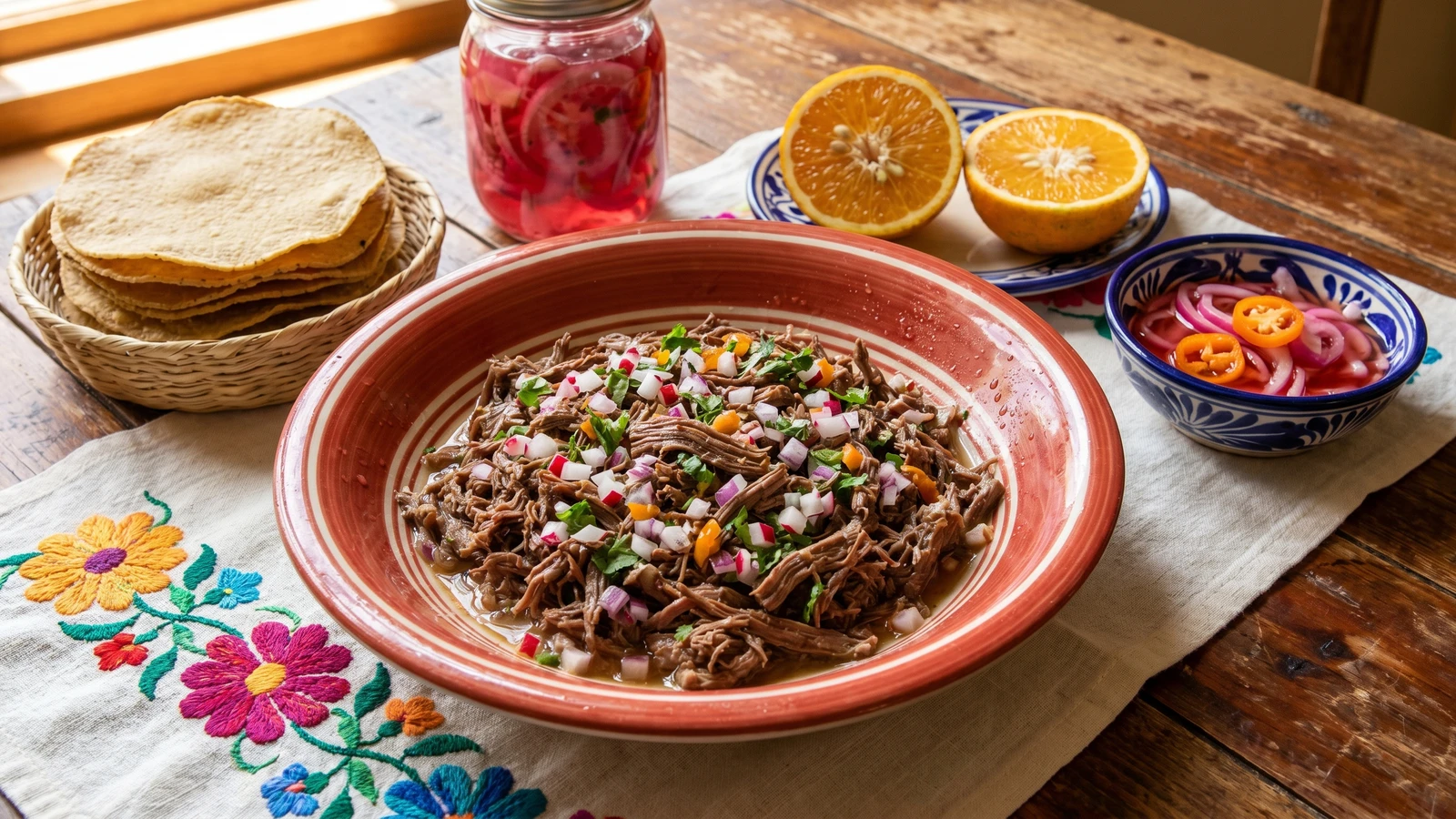
Yucatán's cold shredded beef salad, brisket simmered with epazote then pulled by hand and tossed with rabanito, cilantro, red onion, habanero, and naranja agria. Eaten over hand-pressed tostadas.
Salads
Mexican
Make Ahead
Picnic
Dinner Party
30 min
Active Time
2 hr 30 min cook•3 hr total
Yield6 to 8 servings
Dzik is from the Yucatán Peninsula. The word is Maya. It means shredded, and the dish is exactly that: meat pulled by hand into fine threads, then tossed cold with chopped vegetables and naranja agria. You see it on courtyard tables in Mérida, on cantina counters in Tizimín, on Hanal Pixán altars all across the peninsula at the end of October.
The Yucatán is its own country when it comes to cooking. The peninsula was separated from central Mexico for centuries by jungle and geography, and the Maya kitchen evolved on its own terms with its own ingredients: naranja agria instead of vinegar, chile habanero instead of jalapeño, achiote where central Mexico uses ancho, epazote and chaya as everyday herbs. Dzik carries all of that. It is not a beef salad in the way the rest of the country might understand the phrase. It is a Maya preparation that happens to be cold.
The meat must be shredded by hand. Not with a fork, not in a processor. The señoras in Tizimín pull it between their fingers until the threads are fine and even, and that texture is the dish. The naranja agria is the dressing. No oil. No vinegar. Just sour orange juice, salt, and the natural sharpness of radish and red onion. If you cannot find naranja agria, I will tell you what to use instead, but you should know what you are missing. Cada estado, su propia cocina, and the Yucatán cooks like nowhere else in Mexico.
My mother did not cook Yucatecan food. She was jalisciense and she stayed in her territory. The first time I ate proper dzik was in a small comedor off the main square in Valladolid in my second year of traveling the states. The señora who made it was named Doña Felipa and she shredded the brisket while she talked, never looking down at her hands. She told me the trick was patience: cook the meat slow, cool it before shredding, dress it cold, eat it the same day. I wrote it on the back page of my notebook and I have made it her way ever since.
Dzik takes its name from the Yucatec Maya verb meaning to shred or to tear into fibers, and the technique predates the Spanish conquest, when Maya cooks prepared shredded venison and wild game dressed with the juice of native bitter fruits. The substitution of beef came after the Spanish introduced cattle to the peninsula in the 16th century, and naranja agria, brought from Seville and naturalized in Yucatecan dooryard gardens, replaced the earlier indigenous citrus and bitter fruit juices that had performed the same acidic function. The dish remains a fixture of the Hanal Pixán observance, the Maya Day of the Dead celebrated each November across the peninsula, when families prepare cold shredded meat salads that can be eaten over many hours without reheating.
The technique, the tradition, and the story behind every dish.
Place the brisket in a heavy stockpot and cover with cold water by two inches. Add the halved white onion, garlic, epazote, bay leaves, salt, and peppercorns. Bring to a gentle simmer over medium heat. Skim the gray foam that rises in the first fifteen minutes. Cold water draws the flavor out cleanly. A hard boil clouds the broth and toughens the meat, and you want the meat tender enough to fall apart between your fingers.
The epazote is not optional. In Yucatecan kitchens it goes into the pot the way bay leaves go into a French stock. If you cannot find fresh, dried epazote works but use half as much. Skip it and the broth tastes generic.
2
Cook low and patient
Lower the heat until the pot shows lazy bubbles every few seconds. Cover partially and simmer for two to two and a half hours, until the brisket pulls apart with two forks and the connective tissue has surrendered. Do not rush this. Brisket cooked too fast turns stringy and dry. The broth you build here is the second half of the dish, save it for caldo de res or for moistening the meat at the table.
3
Cool the meat in its broth
Turn off the heat and let the brisket rest in the cooking liquid for at least thirty minutes. The meat finishes cooking gently and reabsorbs flavor as it cools. If you have time, refrigerate the whole pot for an hour. Cold meat shreds finer than hot meat, and dzik means shredded. The texture matters.
4
Shred the meat by hand
Lift the brisket out and place it on a cutting board. Using your fingers, pull the meat into very fine threads, finer than you think. No fork shredding, no food processor. Dzik is shredded by hand. The Yucatecan señoras in Tizimín pull it until it looks almost like coarse cotton. Discard any tough fat or sinew you find as you go, but keep the soft yellow fat that flavors the salad.
5
Build the salad cold
In a wide ceramic bowl, combine the shredded brisket with the diced rabanitos, red onion, cilantro, minced habanero, and tomato. Toss with clean hands so you can feel the texture. Pour the naranja agria juice over the top and toss again. Season with salt. The naranja agria is the dressing, no oil, no vinegar. Yucatán has used sour orange for centuries because it is what grows there. La naranja agria hace el trabajo.
If you cannot find naranja agria, mix two parts fresh lime juice with one part fresh orange juice and a small splash of grapefruit juice. It is a compromise, not an upgrade. The real fruit has a bitterness that lime alone cannot replicate.
6
Rest and taste
Let the dzik sit for fifteen minutes before serving. The naranja agria will pull the flavors together and the radish will soften slightly without losing its bite. Taste it. It should be bright, sharp, with the habanero coming in at the back of the throat and the cilantro fresh against the citrus. Adjust salt. Add more naranja agria if the salad tastes flat.
7
Serve at the table
Spoon the dzik onto crisp corn tostadas at the table. Top with sliced avocado and a spoonful of salsa xnipec for those who want more habanero. Lime wedges on the side. Eat with your hands. This is picnic food, courtyard food, the dish you bring to a Hanal Pixán table or a Mérida birthday lunch. Recetas probadas y garantizadas.
Chef Tips
•The brisket is the right cut because of the connective tissue. Skirt or flank will work but the result is leaner and less tender. Lean dzik is a contradiction the way lean carnitas is a contradiction.
•Chile habanero is the only chile that belongs in this dish. Not serrano, not jalapeño. The habanero has a fruity floral heat that complements the naranja agria, and the Yucatán grows the best ones in the country. Mince it very fine so the heat distributes evenly, and wear gloves if you are not used to it.
•If your radishes are mild, slice them an hour ahead and salt them lightly. They will firm up and sharpen. Dzik depends on the bite of raw rabanito against the soft meat. Without it the salad tastes flat.
•Naranja agria is the work. If you live near a Mexican or Cuban market, buy them whenever you see them and freeze the juice in small jars. They are seasonal and worth the effort to track down.
Advance Preparation
•The brisket can be simmered up to one day ahead and refrigerated whole in its broth. Shred and dress on the day you plan to serve.
•Once dressed, dzik holds in the refrigerator for up to six hours and is excellent for picnics and make-ahead lunches. Past that, the radish loses its crispness and the cilantro starts to darken.
•Do not freeze. The texture of the shredded meat suffers and the radish turns to mush.
Frequently Asked Questions
Nutrition Information
1 serving (about 165g)
Calories
230 calories
Total Fat
13 g
Saturated Fat
4 g
Trans Fat
0 g
Unsaturated Fat
8 g
Cholesterol
75 mg
Sodium
450 mg
Total Carbohydrates
5 g
Dietary Fiber
1 g
Sugars
2 g
Protein
22 g
Where cooking meets culture.
Culinary guides, cultural storytelling, and the editorial depth that makes cooking meaningful.