
Chef Lupita
Birria Tacos with Consome
Jalisco's goat birria, born around Cocula and carried into Guadalajara's markets, slow-braised in ancho, guajillo, cascabel, and chile de arbol, then tucked into corn tortillas crisped in its own red fat.
A cooking platform built around craft, culture, and the stories behind what we eat.
Created by
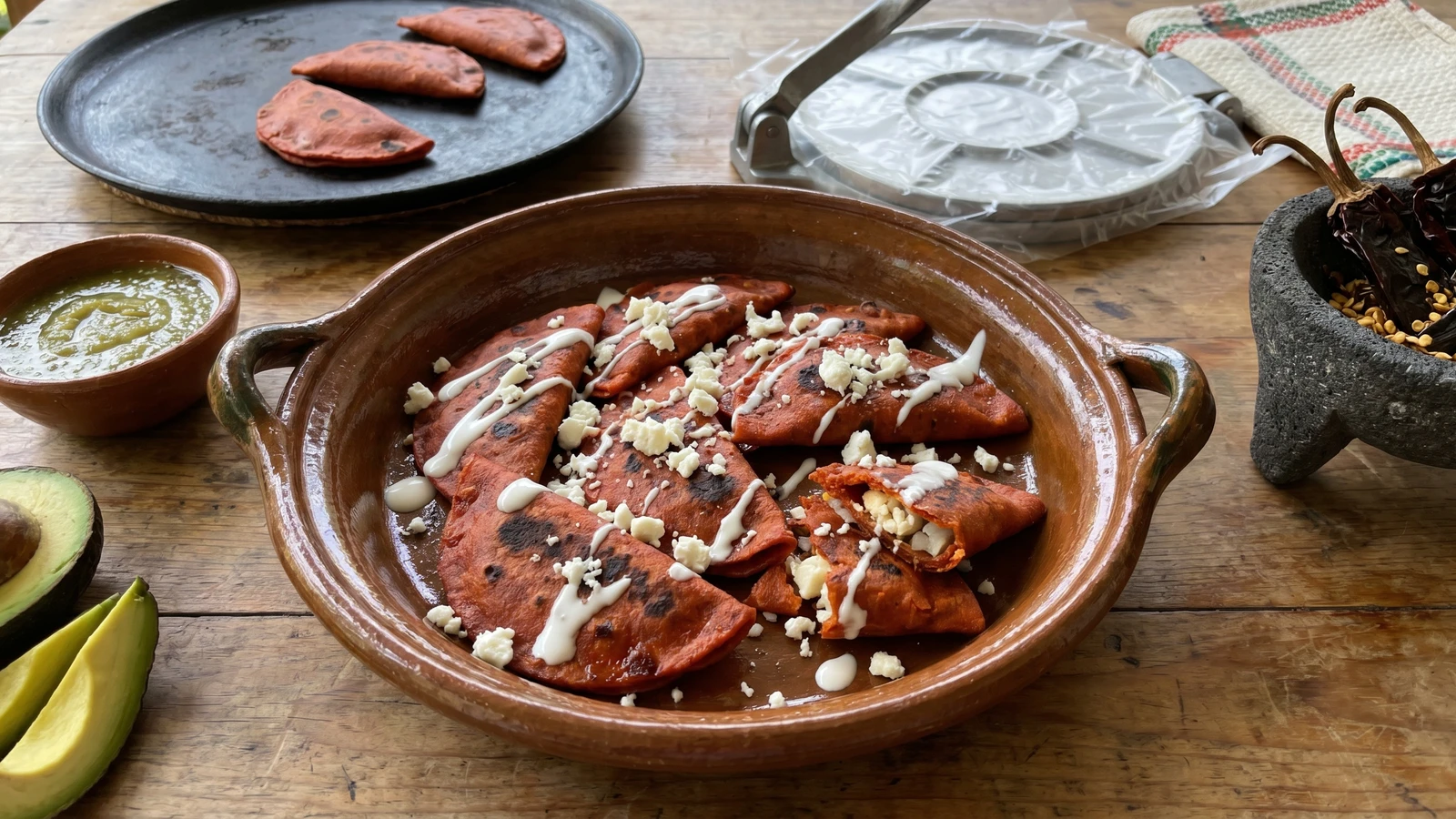
San Luis Potosí's red masa half-moons, born in Soledad de Graciano Sánchez, folded around queso fresco and onion, sealed on the comal, then crisped in manteca until the edges go firm.
San Luis Potosí sits between the Bajío and the altiplano, and these enchiladas live in Soledad de Graciano Sánchez, just outside the capital. Not in a casserole dish. Not under a blanket of sauce. They are small red masa half-moons, pressed by hand, filled with queso fresco and onion, sealed on the comal, then crisped in manteca.
The chile ancho goes into the masa. That is the point. It gives the dough a brick-red color and a sweet dried-fruit depth, not a wild heat. Not all Mexican food is a dare. The women of Soledad perfected the rhythm: press, fill, fold, seal, turn, fry. When you watch someone who has made them for forty years, the work looks fast. It is not fast. It is practiced.
I first ate them from a clay plate in the mercado, with salsa verde on the side and crema only where the cook wanted it, not drowned over everything. The masa had uneven edges because a hand made it. Good. La cocina no es decoración, es trabajo. Cada estado, su propia cocina, and San Luis Potosí marked this one red before it ever touched the comal.
Enchiladas potosinas are most closely tied to Soledad de Graciano Sánchez, San Luis Potosí, and are commonly credited to Doña Cristina Jalomo in the early 20th century. The best-known origin story says her masa became stained at a local mill after chiles had been ground there, leading her to fold the red dough around cheese and cook it on the comal. Unlike enchiladas mineras from Guanajuato or enchiladas queretanas, the defining technique is not a sauce poured over tortillas, but chile ancho kneaded directly into the masa before shaping.
Quantity
8
stemmed, seeded, and wiped clean
Quantity
2
peeled
Quantity
1 1/2 teaspoons, divided, plus more to taste
Quantity
3/4 cup, plus more as needed
Quantity
2 pounds
Quantity
1 tablespoon
softened, for the masa
Quantity
12 ounces
crumbled
Quantity
1/2 cup
finely chopped
Quantity
1/2 teaspoon
crushed between your fingers
Quantity
2 cups
for frying
Quantity
6
husked, rinsed, and quartered
Quantity
1
stemmed
Quantity
1/4 cup, packed
Quantity
2 tablespoons
chopped, for salsa
Quantity
1 tablespoon
Quantity
1/2 cup
for serving
Quantity
1/2 cup
for serving
Quantity
1
sliced or mashed with lime and salt, for serving
| Ingredient | Quantity |
|---|---|
| dried chile anchostemmed, seeded, and wiped clean | 8 |
| garlic clovespeeled | 2 |
| kosher salt | 1 1/2 teaspoons, divided, plus more to taste |
| warm water | 3/4 cup, plus more as needed |
| fresh nixtamalized corn masa for tortillas | 2 pounds |
| manteca de cerdosoftened, for the masa | 1 tablespoon |
| queso fresco or queso rancherocrumbled | 12 ounces |
| white onionfinely chopped | 1/2 cup |
| dried Mexican oreganocrushed between your fingers | 1/2 teaspoon |
| manteca de cerdofor frying | 2 cups |
| tomatilloshusked, rinsed, and quartered | 6 |
| fresh chile serranostemmed | 1 |
| fresh cilantro leaves and tender stems | 1/4 cup, packed |
| white onionchopped, for salsa | 2 tablespoons |
| fresh lime juice | 1 tablespoon |
| crema Mexicana (optional)for serving | 1/2 cup |
| crumbled queso fresco (optional)for serving | 1/2 cup |
| ripe avocado (optional)sliced or mashed with lime and salt, for serving | 1 |
Heat a dry comal over medium. Toast the chile ancho one or two at a time, about 15 to 20 seconds per side, pressing them flat with a spatula just until the skin softens, darkens slightly, and smells like raisins and warm tobacco. Do not blacken them. Burned chile makes bitter masa, and no amount of queso fresco will save it.
Put the toasted chiles in a bowl and cover with hot water, not boiling water. Let them soften for 20 minutes. Drain them, then blend with the garlic, 1 teaspoon salt, and 3/4 cup warm water until completely smooth. Strain through a fine-mesh sieve, pressing hard on the skins. You should have a thick, deep red paste. Reserve 2 tablespoons of this paste for the filling.
Place the fresh masa in a wide bowl. Add the remaining chile paste, the softened tablespoon of manteca de cerdo, and 1/2 teaspoon salt. Knead with your hands for 5 to 7 minutes until the color is even from edge to center. The masa should feel soft and pliable, like the lobe of your ear. If it cracks when pressed, sprinkle in warm water one tablespoon at a time. The red belongs inside the masa. That is what makes it potosina.
In a bowl, combine the crumbled queso fresco, finely chopped white onion, dried Mexican oregano, and the reserved 2 tablespoons of chile ancho paste. Mix with your fingers until the cheese is lightly stained and the onion is evenly distributed. Taste before adding salt. Queso fresco varies, and a careful cook does not salt blindly.
Line a tortilla press with two pieces of plastic cut from a clean produce bag. Divide the red masa into 24 balls, each about the size of a small golf ball. Press one ball into a tortilla about 4 inches wide. Keep the remaining masa covered with a damp towel so it does not dry while you work.
Place 1 tablespoon of the cheese filling slightly off center on the tortilla. Fold it into a half-moon and press the edges firmly to seal. Do not overfill. A fat enchilada tears, leaks cheese, and tells everyone you were impatient. Set the filled enchiladas under a damp towel while you shape the rest.
Heat the comal over medium. Cook the filled enchiladas in batches, about 45 to 60 seconds per side, until the masa loses its wet shine, the edges seal, and a few darker red spots appear. This is not the final frying. This step sets the shape so the filling stays inside when it meets the manteca. No me vengas con atajos.
While the sealed enchiladas rest, blend the tomatillos, chile serrano, cilantro, 2 tablespoons chopped white onion, lime juice, and a pinch of salt until coarse and bright green. Taste it. It should be sharp enough to cut the richness of the fried masa. Keep it on the side, not poured like a casserole sauce.
Melt the 2 cups manteca de cerdo in a wide skillet over medium-high heat. You want about 1/2 inch of hot fat. Fry the comal-sealed enchiladas in batches for 1 to 2 minutes per side, turning once, until the edges turn crisp and the red masa deepens in color. Drain on a rack or brown paper. La manteca es el sabor. Vegetable oil will fry them, yes, but it will not give you the same flavor.
Pile the enchiladas on a brown-glazed clay platter while the edges are still crisp. Spoon a little crema Mexicana over the top, scatter with crumbled queso fresco, and serve the salsa verde and avocado at the table. Three or four per person is normal. More if the table is honest. Recetas probadas y garantizadas.
1 serving (about 335g)
Culinary guides, cultural storytelling, and the editorial depth that makes cooking meaningful.
Discover Culinary ExplorerChef Lupita
Jalisco's goat birria, born around Cocula and carried into Guadalajara's markets, slow-braised in ancho, guajillo, cascabel, and chile de arbol, then tucked into corn tortillas crisped in its own red fat.

Chef Lupita
Sonora's working morning burrito: chicharrón de cáscara stewed in chile colorado with diced potato, rolled tight in a paper-thin tortilla sobaquera and eaten standing up at the carreta.

Chef Lupita
Mocorito's pork chilorio, shredded and confited in lard with chile ancho and pasilla, rolled into a thin handmade flour tortilla. The burrito Sinaloa sends out into the world.

Chef Lupita
Sonora's morning burrito of mashed pinto frijoles puercos and melted queso asadero, wrapped in a paper-thin sobaquera and seared on the comal until the cheese pulls in long strings.