Culinary Explorer

A cooking platform built around craft, culture, and the stories behind what we eat.
Discover Culinary Explorer
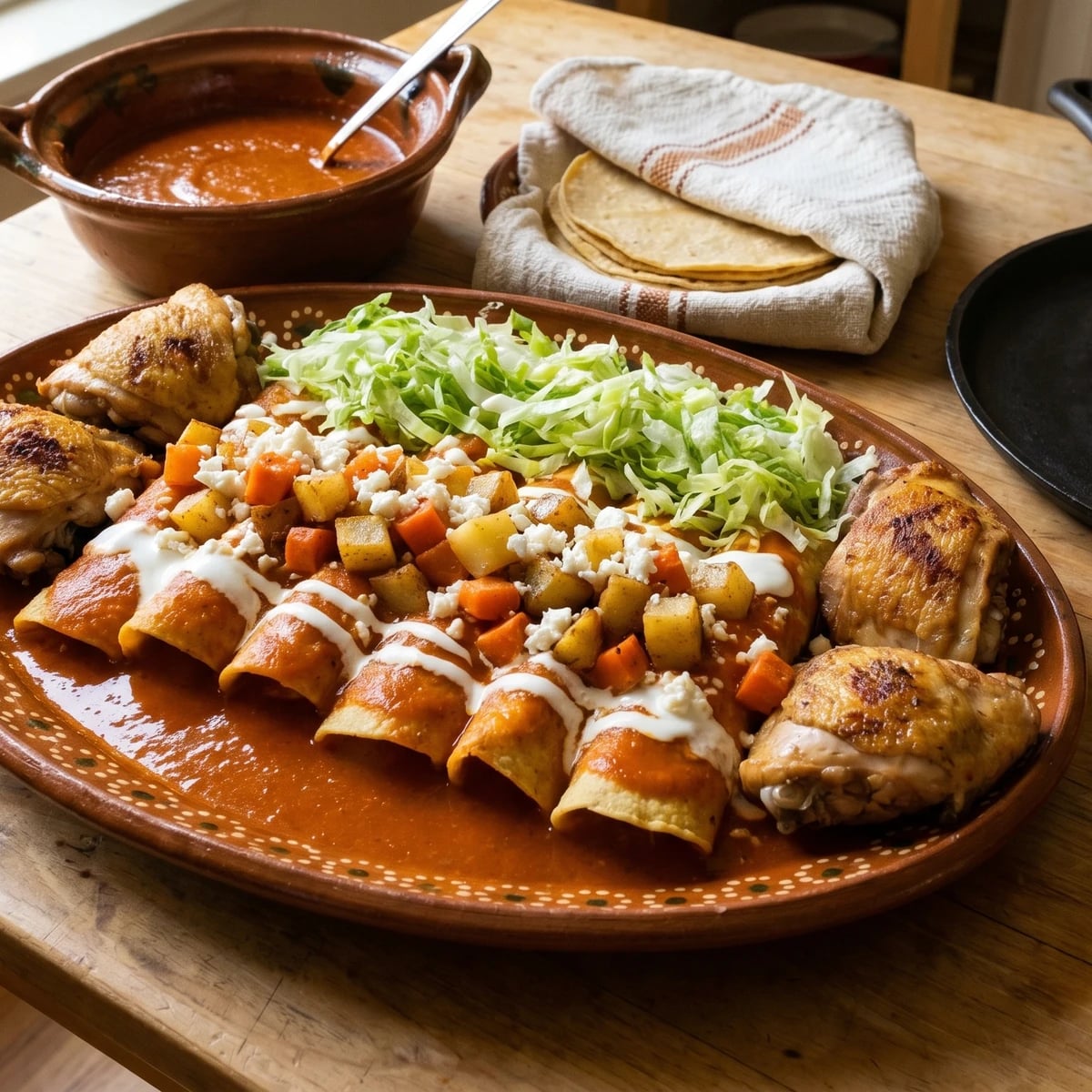
Enchiladas Queretanas con Pollo Entero

Enchiladas Queretanas con Pollo Entero

Created by

Queretaro's Bajio plate of corn tortillas bathed in jitomate and guajillo, served with a whole bone-in chicken pieza, fried potatoes and carrots, and chiles en escabeche on the side.

Sandwiches & Wraps
Mexican
Weeknight
Comfort Food
Dinner Party
45 min
Active Time
1 hr 30 min cook2 hr 15 min total
Yield6 servings

Queretaro, in the Bajio, owns these enchiladas. Not Guanajuato, not San Luis Potosi, and not some casserole covered in yellow cheese. This is the plate you see in the fondas around Santiago de Queretaro and Mercado de La Cruz: red tortillas, a smooth jitomate and chile guajillo salsa, fried papa y zanahoria, and one whole bone-in pieza de pollo sitting beside the enchiladas like it belongs there. Because it does.

The chicken is not shredded into the filling. Listen to that before you start. The tortillas may hold queso fresco and a little white onion, but the chicken stays whole, poached in its own broth and then browned in manteca de cerdo. The salsa is guajillo for color and clean chile flavor, jitomate for body, garlic, oregano, a whisper of cumin, and one clavo de olor if your hand is disciplined. Too much clove and the salsa tastes like a pharmacy. The senoras who taught this dish in Queretaro did not measure with fear, but they knew restraint.

The technique is Bajio cooking: comal, blender, cazuela, lard, patience. You toast the guajillos so their oils wake up. You fry the salsa so it stops tasting raw. You pass the tortillas through salsa and manteca so they bend without breaking and carry that red gloss to the plate. Flour tortillas do not enter this conversation. Cada estado, su propia cocina.

My mother wrote a Queretaro version in her notebook after visiting a friend near Amealco. In the margin she wrote, "el pollo va entero, no deshebrado." The chicken goes whole, not shredded. She was right. Saber cocinar es saber vivir.

Queretaro's enchiladas belong to the Bajio family of enchiladas de plaza, market plates that became common in central Mexico during the 19th century along mining, trade, and pilgrimage routes. Unlike Guanajuato's enchiladas mineras, where guajillo-dipped tortillas are fried and plated with vegetables, the queretana version is recognized by its smoother salsa of jitomate and chile guajillo and by the bone-in chicken piece served beside the tortillas. Chiles en escabeche entered the Mexican table through Spanish vinegar pickling, then settled into central-market cooking with jalapenos, carrots, onion, bay leaf, Mexican oregano, and thyme.

The technique, the tradition, and the story behind every dish.

Discover Culinary Explorer

Ingredients

whole chicken

Quantity

1 (3 1/2 to 4 pounds)

cut into 6 to 8 bone-in pieces

water

Quantity

10 cups

white onion

Quantity

1 medium

divided

garlic cloves

Quantity

8

divided

bay leaves

Quantity

4

divided

kosher salt

Quantity

2 teaspoons, plus more to taste

dried Mexican oregano

Quantity

1 1/2 teaspoons

divided

dried chile guajillo

Quantity

10

stemmed and seeded

Roma tomatoes (jitomates)

Quantity

4 ripe, about 1 pound

cumin seeds

Quantity

1/2 teaspoon

whole clove

Quantity

1

manteca de cerdo

Quantity

3/4 cup

divided

day-old corn tortillas

Quantity

18

white potatoes

Quantity

2 medium

peeled and cut into 1/2-inch dice

carrots

Quantity

2 medium

peeled and cut into 1/2-inch dice

queso fresco or queso ranchero

Quantity

1 1/2 cups

crumbled

white onion for filling

Quantity

1/3 cup

finely chopped

lechuga orejona or romaine lettuce

Quantity

2 cups

finely shredded

crema de rancho or crema mexicana

Quantity

1/2 cup

fresh jalapenos or chile cuaresmeno

Quantity

8

slit lengthwise

carrots for escabeche

Quantity

2

sliced on the bias

white onion for escabeche

Quantity

1/2 medium

thickly sliced

mild vegetable oil

Quantity

2 tablespoons

white vinegar

Quantity

1 cup

water for escabeche

Quantity

1 cup

fresh thyme

Quantity

2 sprigs

hand-pressed corn tortillas (optional)

Quantity

for serving

warmed

Equipment Needed

  • Large olla for poaching the chicken
  • Cast iron comal for toasting chiles and finishing tortillas
  • Wide clay cazuela for frying the salsa
  • High-powered blender
  • Fine-mesh strainer
  • Heavy skillet for browning chicken and frying potatoes

Instructions

  1. 1

    Poach the chicken

    Place the chicken pieces in a large olla with 10 cups water, half of the white onion, 4 garlic cloves, 2 bay leaves, 1 teaspoon salt, and 1/2 teaspoon dried Mexican oregano. Bring to a gentle simmer over medium heat and skim the foam during the first 10 minutes. Cook 30 to 35 minutes, until the chicken is just cooked through and the broth tastes like chicken, not water. Remove the pieces to a tray and strain the broth. Do not shred the chicken. The pieza stays whole.

  2. 2

    Make the escabeche

    While the chicken cooks, heat the vegetable oil in a small cazuela over medium. Add the jalapenos or chiles cuaresmenos, sliced carrots, thick onion slices, and 2 garlic cloves. Cook 5 to 6 minutes, turning the chiles until their skins blister in spots and the onion starts to soften. Add the vinegar, 1 cup water, 2 bay leaves, thyme, 1/2 teaspoon Mexican oregano, and 1 teaspoon salt. Simmer 8 minutes, then turn off the heat and let the chiles sit in their vinegar bath. Escabeche needs time to settle. Sharp at first, better after an hour.

  3. 3

    Toast the guajillos

    Heat a dry comal over medium. Toast the chile guajillo one or two at a time, about 15 to 20 seconds per side, pressing lightly with tongs until the skin darkens a shade and smells fruity. Do not let them blacken. Guajillo gives color and clean chile flavor, not punishment. Put the toasted chiles in a bowl and cover with hot water for 20 minutes.

    If a guajillo cracks like dry paper and smells dusty, it is old. Preguntale a las senoras del mercado. A good guajillo is flexible, deep red, and smells faintly of dried fruit.
  4. 4

    Char the vegetables

    On the same comal, roast the jitomates, the remaining quarter of white onion, and 2 garlic cloves until the tomato skins blister and the onion has browned edges. Toast the cumin seeds for 20 seconds in a dry corner of the comal, just until fragrant. This is not decoration. The comal gives the salsa the cooked edge that a raw blender salsa will never have.

  5. 5

    Blend the salsa

    Drain the softened guajillos and put them in a blender with the roasted jitomates, roasted onion, roasted garlic, toasted cumin, 1 whole clove, 1/2 teaspoon Mexican oregano, 1 teaspoon salt, and 1 1/2 cups reserved chicken broth. Blend until completely smooth, longer than you think. Strain through a fine-mesh sieve into a bowl, pressing with a spoon. The salsa should be red-orange, smooth, and thick enough to coat a tortilla.

  6. 6

    Fry the salsa

    Melt 2 tablespoons manteca de cerdo in a wide cazuela over medium heat. Pour in the strained salsa. It will sputter, so stir with discipline. Cook 8 to 10 minutes, until the color deepens and small red freckles of fat appear at the edges. Add another 1/2 cup chicken broth if it gets too thick. La manteca es el sabor. Frying the salsa is what turns chile and tomato into enchilada sauce for Queretaro, not a raw red puree.

  7. 7

    Cook the vegetables

    Put the diced potatoes and carrots in a small saucepan and cover with reserved chicken broth. Simmer 8 to 10 minutes, until barely tender, then drain well. Melt 3 tablespoons manteca in a skillet and fry the vegetables over medium-high heat until the edges turn golden. Salt them while they are hot. They should taste good before they ever touch the plate.

  8. 8

    Brown the chicken

    Pat the poached chicken pieces dry. Melt 2 tablespoons manteca in a heavy skillet over medium-high heat. Brown the chicken pieces skin side down first, then turn them until the outside is golden in spots. You are not cooking them again from raw. You are giving the pieza the browned face it needs on the plate. Keep warm.

  9. 9

    Prepare the filling

    Mix 1 cup crumbled queso fresco or queso ranchero with the finely chopped white onion. This is the filling for the tortillas. Notice what is not here: shredded chicken. The chicken is beside the enchiladas, bone-in, whole, and respected.

  10. 10

    Sauce the tortillas

    Keep the salsa warm in the cazuela. Melt the remaining manteca on a comal or wide skillet over medium heat. Dip one corn tortilla into the warm salsa, lay it on the manteca-slicked comal, and cook 10 to 15 seconds per side, just until flexible and glossy. Do not fry it crisp. Do not drown it until it tears. You want a tortilla that bends, holds sauce, and still remembers it is corn.

    Use day-old corn tortillas from a tortilleria if you can. Fresh tortillas are soft but fragile. Flour tortillas belong to northern traditions, not this Queretaro plate.
  11. 11

    Fill and fold

    Place a spoonful of the queso and onion mixture down the center of the tortilla. Fold it in half or roll it loosely, depending on how your tortillas behave. Repeat with the remaining tortillas, keeping them close together on a warm platter so they stay pliable. Recetas probadas y garantizadas, but tortillas have their own opinions. Work quickly.

  12. 12

    Plate Queretaro style

    Spoon a little extra jitomate-guajillo salsa over the enchiladas. Scatter the fried potatoes and carrots across the plate. Add one whole browned chicken pieza to each serving. Finish with the remaining queso fresco, a thin spoon of crema de rancho, and shredded lechuga orejona. Serve the chiles en escabeche in a small barro dish on the side. This is a Bajio plate, generous and practical. Asi se hace y punto.

Chef Tips

  • The salsa is guajillo and jitomate. Do not turn this into a chile ancho sauce and do not use canned enchilada sauce. A substitution is a compromise, not an upgrade.
  • Buy tortillas from a tortilleria the day before and keep them wrapped in a cloth. A slightly dry tortilla drinks the salsa and survives the comal. A supermarket tortilla with gums and preservatives fights you.
  • Use manteca de cerdo for the salsa, the vegetables, the chicken, and the tortillas. Vegetable oil will cook the food, yes. It will not give you the Bajio flavor. La manteca es el sabor.
  • Queretanas are not supposed to be painfully hot. Guajillo is mild, red, and fruity. The bite comes from the chiles en escabeche on the side, where each diner decides for herself.
  • If you serve shredded chicken inside these, you have made another dish. Maybe it is good. It is not this one.

Advance Preparation

  • The chiles en escabeche can be made up to 5 days ahead and kept refrigerated. They are better after one night.
  • The chicken can be poached one day ahead. Refrigerate the pieces in a little strained broth so they stay moist, then pat dry and brown before serving.
  • The jitomate-guajillo salsa can be made one day ahead. Reheat it in a cazuela with a spoonful of manteca and a splash of chicken broth before dipping tortillas.
  • Do not assemble the enchiladas ahead. Corn tortillas bathed in salsa should go from comal to plate while they are still flexible.

Frequently Asked Questions

Nutrition Information

1 serving (about 540g)

Calories
975 calories
Total Fat
54 g
Saturated Fat
19 g
Trans Fat
0 g
Unsaturated Fat
32 g
Cholesterol
170 mg
Sodium
1200 mg
Total Carbohydrates
68 g
Dietary Fiber
11 g
Sugars
12 g
Protein
54 g

Note: Chef personas and recipes are created with AI assistance. Cook with care: follow safe food-handling practices, check doneness with a thermometer when needed, and adapt for allergies and your kitchen.

Where cooking meets culture.

Culinary guides, cultural storytelling, and the editorial depth that makes cooking meaningful.

Discover Culinary Explorer

More from Bajío Enchiladas, Guacamayas & Antojitos Handhelds

Browse the full collection