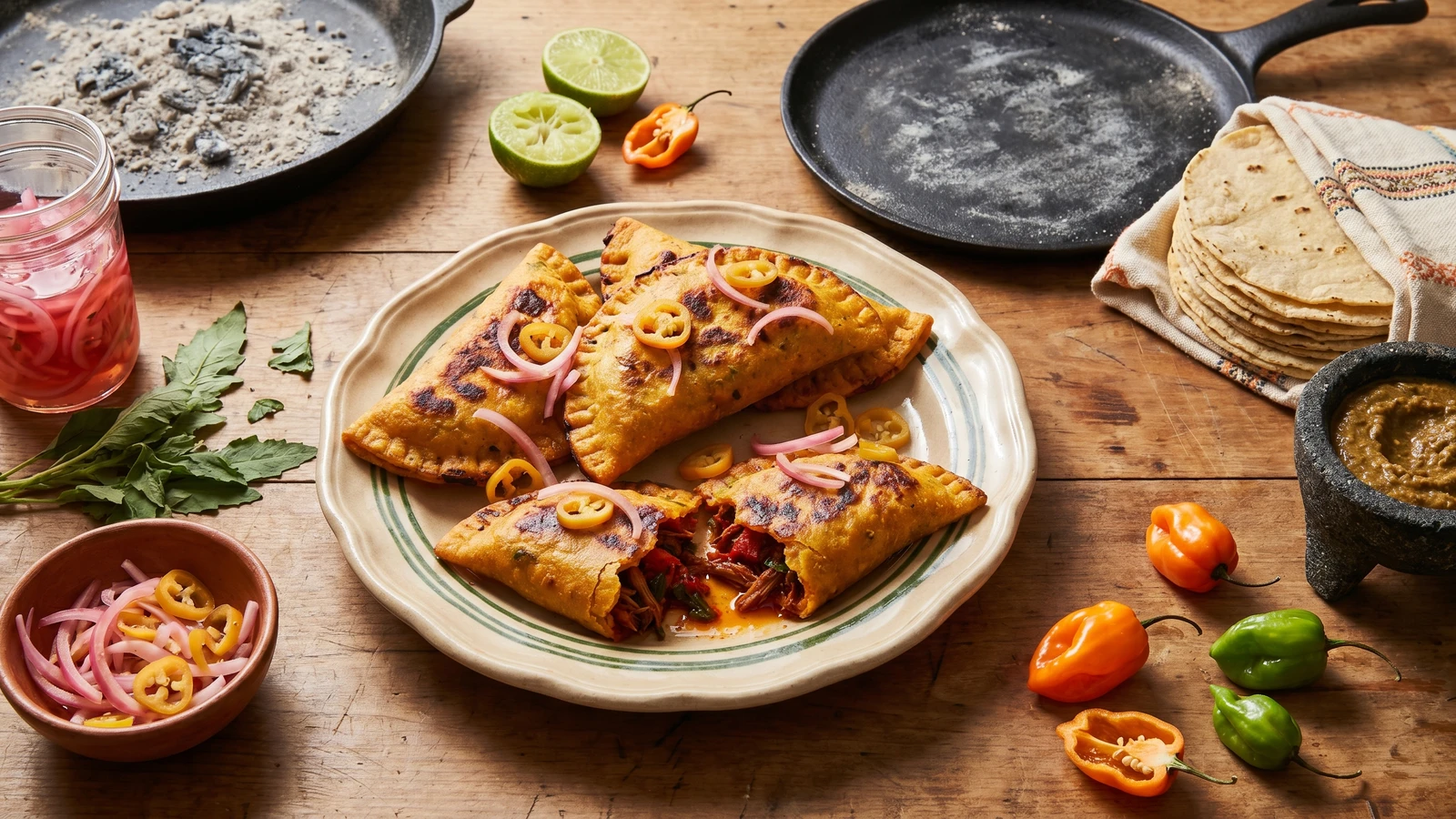
Campeche's dogfish empanadas, shredded cazón stewed with charred tomato and epazote, folded into hand-pressed corn masa and fried crisp, served with chile xcatic curtido and naranja agria.
Appetizers & Snacks
Mexican
Dinner Party
Potluck
Celebration
40 min
Active Time
45 min cook•1 hr 25 min total
Yield12 empanadas (4 to 6 servings)
This is Campeche's empanada. Not Argentina's, not Spain's, not the wheat-flour empanadas of northern Mexico. Campeche, the Gulf state on the western side of the Yucatan Peninsula, where the cazón comes off the boats in the morning and the women at the Mercado Pedro Sainz de Baranda have been frying these since before any of us were born.
Cazón is dogfish, a small coastal shark. The Peninsula eats it because the Peninsula has it, and the cooks of Campeche turned an unromantic fish into a regional signature by doing what good cooks always do: poaching it clean, shredding it fine, and building a guiso around it with charred tomato, sweet chile dulce, and enough epazote to push back against the richness of the shark. The epazote is the soul of this filling. Without it, you have a tomato fish empanada. With it, you have something that belongs only to the Gulf coast.
The masa is corn. Not flour. The Peninsula does not negotiate on this. The empanadas are pressed by hand, filled while the masa is still soft, and fried in lard or good clean oil until the outside crackles and the inside stays tender. At the table they get the Peninsula's grammar: chile xcatic charred and dressed in naranja agria, pickled red onions slicked through with habanero, a lime to squeeze. No cheddar. No sour cream. No flour tortillas pretending to be empanada wrappers.
My mother did not cook Yucatecan food. She was jalisciense. But there is a page in her notebook from a trip she took to Campeche in 1981, written in pencil, with the line at the top: "la senora del mercado dijo que el cazon huele fuerte y eso es bueno." The woman at the market said the cazón smells strong and that is good. She was right. If your fish smells like nothing, you have nothing. If it smells like the sea, you have empanadas de cazón. Saber cocinar es saber vivir.
Empanadas de cazón emerged as a Campeche specialty in the colonial era, when Spanish wheat-flour empanada traditions met Peninsular Maya corn masa and the abundant small sharks of the Gulf of Mexico, producing a turnover that is structurally Iberian but ingredient-wise entirely Mesoamerican. Cazón itself, in the Yucatec Maya kitchen, is one of the few proteins permitted in dishes that predate the conquest by name, often paired with epazote, a native herb the Maya called epazotl in its Nahuatl form, used both medicinally and to counteract the heaviness of fish and bean dishes. The state of Campeche codified the dish as part of its tourism gastronomy in the late 20th century, but the empanada itself has been sold from market stalls in San Francisco de Campeche since at least the 18th century, when the walled port city was one of the principal shipping points for Yucatecan goods to Veracruz and Havana.
The technique, the tradition, and the story behind every dish.
fresh sour orange juice (naranja agria)or 1/4 cup orange juice mixed with 1/4 cup lime juice
1/2 cup
lime halves (optional)
for serving
pickled red onions with habanero (optional)
for serving
Equipment Needed
•Cast iron comal or heavy skillet for charring tomatoes and chiles
•Tortilla press with plastic sheets cut from a freezer bag
•Wide, heavy cazuela or cast iron skillet for frying
•Slotted spoon or kitchen spider
•Wire rack set over paper for draining
Instructions
1
Poach the cazón
Place the cazón fillet in a wide pot with the whole half onion, the two whole garlic cloves, the bay leaves, the large sprig of epazote, and the teaspoon of salt. Cover with cold water by an inch. Bring to a gentle simmer, never a boil. Cook for 10 to 12 minutes, until the flesh turns opaque and flakes easily. Lift the fish out with a slotted spoon and let it cool on a plate. Discard the aromatics and the cooking water. The water is not stock. It is for drawing the ammonia out of the shark. Pour it away.
Cazón has a strong smell when raw. That is normal and it is why you poach with epazote and bay. If your fishmonger gives you cazón that smells of ammonia rather than the sea, send it back. Fresh cazón smells clean.
2
Char the tomatoes
Set a dry comal or heavy skillet over high heat. Place the tomatoes directly on the surface. Turn them every couple of minutes until the skins are blistered, blackened in patches, and the flesh has softened. This takes about 8 minutes. Let them cool enough to handle, then peel off the loose skins. Chop the flesh roughly and reserve the juices. The char is the foundation of the guiso. Do not skip it for a raw tomato shortcut. The salsa will taste flat.
3
Build the guiso de cazón
Flake the cooled cazón finely with your fingers, checking for any cartilage or skin. Discard anything that is not flesh. In a wide skillet, melt the 2 tablespoons of lard over medium heat. Add the chopped half onion, the chopped garlic, and the chile dulce. Cook for 5 minutes, until the onion is soft and translucent but not browned. La manteca es el sabor and this is where it carries the dish.
4
Stew the filling
Add the chopped roasted tomatoes with their juices to the skillet. If using recado rojo, dissolve the achiote in a tablespoon of water and stir it in now. Cook for 6 to 8 minutes, mashing the tomato with a wooden spoon, until the liquid reduces and the mixture turns into a thick, deep red sofrito. Add the flaked cazón and the four remaining epazote leaves, torn by hand. Stir gently to coat the fish without breaking it down to paste. Taste for salt. The filling should be assertive, slightly herbaceous from the epazote, and dry enough to hold its shape when you press it into the masa. Let it cool completely before filling. Hot filling tears the masa.
Epazote is non-negotiable for cazón. Cilantro is not a substitute. The epazote cuts the richness of the fish in a way that nothing else does. If your mercado does not carry it fresh, dried epazote will work in a pinch, but use only half as much.
5
Prepare the masa
If using fresh masa from a tortilleria, knead in the teaspoon of salt and the tablespoon of softened lard until the dough is smooth and pliable. If using masa harina, combine it with the warm water, salt, and lard, and knead for 3 minutes until the dough feels like soft modeling clay. Pinch off a small piece and press it between your palms. If the edges crack, work in a teaspoon of warm water at a time until they do not. Cover the dough with a damp cloth so it does not dry out while you work.
6
Press and fill
Divide the masa into 12 equal balls, about 2 1/2 ounces each. Line a tortilla press with two sheets of plastic cut from a freezer bag. Place a ball of masa in the center and press to a disc about 5 inches across and a little thicker than a tortilla. Peel off the top plastic. Spoon 2 generous tablespoons of cooled cazón filling onto one half of the disc, leaving a half-inch border. Lift the bottom plastic and fold the empty half over the filling, pressing the edges through the plastic to seal. Peel away the plastic carefully. Trim the curved edge with the rim of a small bowl or a tortilla cutter for a clean half-moon. Repeat with the rest of the masa and filling, keeping the finished empanadas covered with a damp cloth.
Do not overfill. Two tablespoons is the right amount. More and the empanada will split open in the oil and the filling will scatter. Asi se hace y punto.
7
Make the chile xcatic curtido
While the empanadas rest, char the chiles xcatic directly over a flame or on a hot comal until the skin blisters and blackens in patches, about 4 minutes total. Do not peel them. Slice them into thin rings, seeds and all, unless you want to lower the heat. Combine with the sliced red onion and the sour orange juice in a small bowl. Add a generous pinch of salt. Let it sit for at least 15 minutes. The onion will turn bright pink and the chile will soften into something you can spoon over each empanada at the table. This is the Peninsula's grammar. No vinegar, no sugar, just naranja agria and time.
8
Fry the empanadas
Pour about 1 inch of oil or melted lard into a wide, heavy skillet or cazuela. Heat over medium-high to 350°F. If you do not have a thermometer, drop in a small piece of masa. It should sizzle immediately and rise to the surface within a few seconds without browning instantly. Slide in 2 or 3 empanadas at a time, never crowding the pan. Fry for 2 to 3 minutes per side, turning once, until the masa is deep gold, blistered, and crisp. Lift onto a wire rack set over paper to drain. Salt them lightly the moment they come out of the oil. Eat them while the masa still crackles under your teeth.
If the oil is too cool, the masa will absorb it and turn greasy. If it is too hot, the outside will brown before the masa is cooked through. Watch the first one closely and adjust the heat. The second empanada is always better than the first.
9
Serve at the table
Arrange the hot empanadas on a platter with the chile xcatic curtido in a small clay bowl alongside, the pickled red onions with habanero in another, and lime halves scattered around. Each diner spoons curtido and onions over their own empanada. The masa should still crackle when you bite into it. The filling should be warm but not scalding, with the epazote pushing through the tomato and the chile xcatic cutting it all clean. Recetas probadas y garantizadas.
Chef Tips
•Cazón is hard to find outside the Gulf coast. In the United States, ask at a serious fish counter for smooth-hound shark, dogfish, or mako belly. If none of that is available, use a firm, mild white ocean fish like cobia, swordfish trim, or even mahi-mahi. It is a compromise, not an upgrade. The dish will be good but it will not be empanada de cazón.
•Make the filling a day ahead. The flavors deepen overnight and a cold filling holds its shape much better when you press the empanada closed. Hot filling tears the masa every time.
•Chile xcatic is the long pale-yellow chile of the Peninsula, with a clean, almost waxy heat. If you cannot find it, chile güero is the closest cousin. Do not substitute jalapeño. The flavor is wrong and the color is wrong.
•Naranja agria, the bitter Seville orange, is the Peninsula's acid. It is not lime. The flavor is more floral, more rounded, less sharp. If your mercado carries it, use it. If not, the orange-and-lime substitute gets you close, but tell your guests what they are eating so they know what to look for next time.
Advance Preparation
•The cazón filling can be made up to two days ahead and refrigerated, covered. The flavor improves overnight.
•The chile xcatic curtido can be made a few hours ahead and held at room temperature. Past four hours, refrigerate.
•Empanadas should be assembled and fried the same day. They do not hold well once filled, the masa absorbs moisture from the filling and the empanada becomes fragile.
Frequently Asked Questions
Nutrition Information
1 serving (about 280g)
Calories
740 calories
Total Fat
38 g
Saturated Fat
6 g
Trans Fat
0 g
Unsaturated Fat
30 g
Cholesterol
45 mg
Sodium
770 mg
Total Carbohydrates
74 g
Dietary Fiber
9 g
Sugars
4 g
Protein
24 g
Where cooking meets culture.
Culinary guides, cultural storytelling, and the editorial depth that makes cooking meaningful.