
Chef Takumi
Arare (あられ, small mochi rice crackers)
Arare begins as firm mochi, cut small and dried until patient enough to puff. Brush it with soy at the end, and the little hailstones turn crisp and savory.
A cooking platform built around craft, culture, and the stories behind what we eat.
Created by
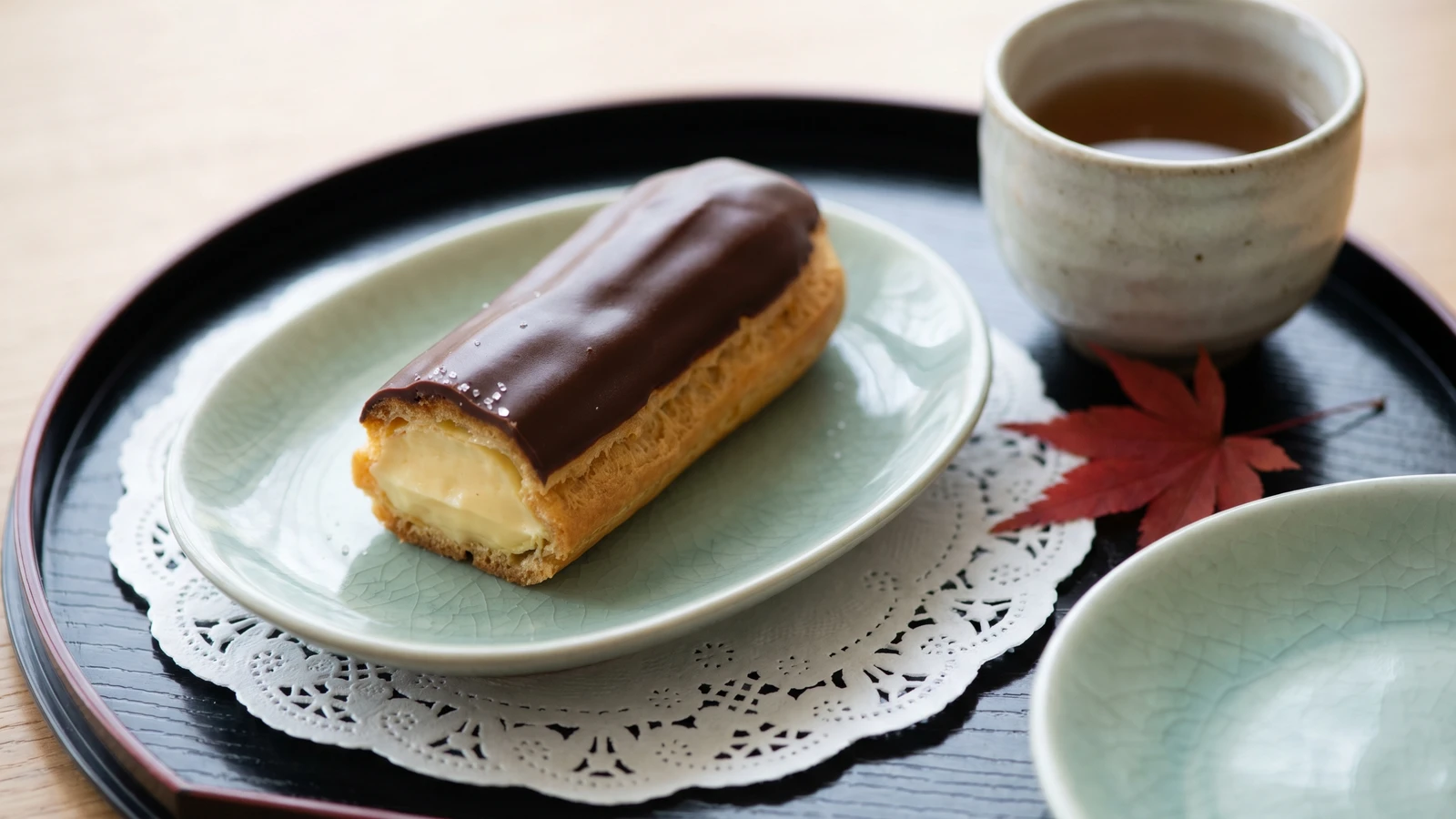
An eclair looks like bakery sleight of hand, but it is only hot dough, patient drying, and cream piped after the shell has cooled. Get the custard right and the rest behaves.
An eclair looks as if the baker slipped a secret tunnel into the pastry. That hollow center is not a trick. Pâte à choux is a cooked dough full of water, and when it meets a hot oven, that water expands and pushes the shell open from within. The oven sets the outside before the pressure escapes. Simple, but it does ask you to pay attention.
In the Japanese bakery, ekurea sits in the yōgashi case beside shū kurīmu, the cream puff: familiar, tidy, and rarely trying to impress anyone with size. The long shell is only a vessel. Cream is the decision. Use whole milk, fresh yolks, and chocolate you would eat by itself, because there is nothing here to hide a dull custard.
The one detail that decides the shell is drying the dough over the flame before the eggs go in. You're cooking off extra moisture and waking the starch so it can take the eggs without turning loose and soupy. Add the eggs slowly until the dough falls from the spoon in a thick ribbon, then pipe, bake, cool, and fill. Cool completely. Warm choux turns good custard into a sweet leak, and nobody needs that little lesson twice.
Served as a birthday sweet or with tea, one eclair is enough if it is made cleanly. Dip only the top in chocolate fondant, let the line stay neat, and leave the plate room. 本物 (honmono, the real thing) does not always arrive in a lacquer bowl. Sometimes it arrives on a paper-lace doily, quiet and exact.
The eclair appears in Parisian pastry in the nineteenth century, with the name in print by the 1860s, and it reached Japan through the Meiji-period appetite for yōgashi, Western-style sweets adapted for Japanese shop counters. Fujiya, founded in Yokohama in 1910, helped make cream-filled yōgashi ordinary in cities rather than rare hotel food. In Japan, ekurea settled beside shū kurīmu as the long chocolate-topped choux form, usually filled with kasutādo kurīmu, custard cream.
Quantity
500ml
for custard cream
Quantity
5 large
Quantity
90g
Quantity
25g
Quantity
15g
Quantity
1/4 teaspoon
divided
Quantity
30g
cut into small pieces, for custard cream
Quantity
1 teaspoon extract or seeds from 1/2 bean
Quantity
120ml
Quantity
120ml
for choux
Quantity
100g
cut into pieces, for choux
Quantity
1 teaspoon
for choux
Quantity
130g
sifted
Quantity
4
beaten, about 200g without shells
Quantity
1
Quantity
150g
Quantity
60g
chopped
Quantity
1 teaspoon
Quantity
1 to 2 teaspoons
as needed to thin the fondant
| Ingredient | Quantity |
|---|---|
| whole milkfor custard cream | 500ml |
| egg yolks | 5 large |
| granulated sugar | 90g |
| cornstarch | 25g |
| cake flour | 15g |
| fine saltdivided | 1/4 teaspoon |
| unsalted buttercut into small pieces, for custard cream | 30g |
| vanilla extract or vanilla bean seeds | 1 teaspoon extract or seeds from 1/2 bean |
| water | 120ml |
| whole milkfor choux | 120ml |
| unsalted buttercut into pieces, for choux | 100g |
| granulated sugarfor choux | 1 teaspoon |
| all-purpose flour or chūriki-ko (medium-strength flour)sifted | 130g |
| large eggsbeaten, about 200g without shells | 4 |
| extra beaten egg (optional) | 1 |
| prepared poured fondant or white confectioners' fondant | 150g |
| dark chocolate, 55 to 65 percentchopped | 60g |
| unsweetened cocoa powder (optional) | 1 teaspoon |
| hot wateras needed to thin the fondant | 1 to 2 teaspoons |
Warm the 500ml milk in a saucepan until the edge trembles and the surface looks glossy. In a bowl, whisk the yolks, 90g sugar, cornstarch, cake flour, and a pinch of salt until smooth and pale. Pour in a little hot milk while whisking, then add the rest. Return everything to the pan and cook over medium heat, whisking constantly, until it thickens, bubbles once or twice, and loses the raw starch smell. Keep cooking for one full minute after it thickens. That minute matters, because undercooked starch tastes chalky and thins as it cools.
Take the custard off the heat and whisk in the 30g butter and vanilla until the surface shines. Press it through a fine sieve if you see any lumps, then press plastic wrap directly onto the surface and chill until cold, at least 2 hours. The wrap keeps a skin from forming, and a cold cream pipes cleanly instead of sagging into the shell.
Heat the oven to 200C, or 400F. Line two baking sheets with parchment and draw eight 11cm guides on the underside, spacing them well apart. Choux swells from inside, so crowded piping gives you joined shells and uneven baking. Fit a pastry bag with a 12 to 15mm open-star tip if you have one, or a plain round tip if you don't.
In a heavy saucepan, combine the water, 120ml milk, 100g butter, 1 teaspoon sugar, and the remaining salt. Bring it to a full boil, not a shy simmer. The butter must be fully melted and the liquid must be hot enough to gelatinize the flour the moment it goes in.
Take the pan off the heat, add the sifted flour all at once, and stir hard until no dry flour remains. Return the pan to medium heat and cook, pressing and turning the dough with a wooden spoon or heatproof spatula, until it pulls cleanly from the sides and a thin film forms on the bottom, 90 seconds to 2 minutes. This is the step people rush. Dry it properly and the dough can take the eggs; leave it wet and the shells spread, then sulk flat on the tray.
Move the dough to a bowl and let it cool for 3 minutes, so the eggs don't scramble on contact. Beat in the eggs a little at a time, mixing fully after each addition. Stop when the dough is glossy and falls from the spoon in a thick V-shaped ribbon, leaving a track that slowly fills in. You may not need the extra egg. Choux is judged by texture, not by obedience to a number.
Pipe eight straight 11cm lengths, holding the bag low and steady so each shell is even from end to end. Smooth any pointed tails with a damp fingertip. If using an open-star tip, keep the ridges visible; they give the expanding dough little lines to open along, which helps the eclairs bake neatly instead of splitting wherever they please.
Bake at 200C, or 400F, for 20 minutes without opening the oven door. Reduce the heat to 170C, or 340F, and bake 15 to 18 minutes more, until the shells are deep golden, firm, and light for their size. The hot oven sets the outer shell while the water inside becomes steam and inflates the pastry. Open the door too early and the pressure escapes before the structure is ready, which is how a good-looking eclair becomes a tired slipper.
Transfer the shells to a wire rack and cool completely before filling. They should feel dry and sound faintly crisp when tapped. This is not fussiness. Warm choux melts the custard, and the trapped moisture softens the shell from the inside.
Warm the prepared fondant gently until fluid but not hot, about 35 to 38C if you use a thermometer. Stir in the melted dark chocolate and cocoa powder if using, then loosen with hot water a few drops at a time until it falls in a slow ribbon. Too thick and it tears the choux when dipped; too thin and it runs down the sides. A sensible stand-in is a powdered-sugar cocoa glaze, but fondant gives the clean bakery set.
Beat the chilled custard until smooth, then spoon it into a piping bag fitted with a small round tip. Make two or three small holes in the underside of each shell and pipe until the eclair feels gently heavy in your hand. Stop there. A split shell tells you only that you tried to make one pastry do the work of two.
Dip only the top of each filled eclair into the chocolate fondant, lift, and wipe the edge against the bowl so the line stays clean. Set the eclairs on a rack until the glaze loses its wet look and holds a soft satin finish. Serve the same day, slightly chilled or cool room temperature, with the cream fresh and the shell still distinct.
1 serving (about 165g)
Culinary guides, cultural storytelling, and the editorial depth that makes cooking meaningful.
Discover Culinary ExplorerChef Takumi
Arare begins as firm mochi, cut small and dried until patient enough to puff. Brush it with soy at the end, and the little hailstones turn crisp and savory.

Chef Takumi
Chocolate shu cream is judged twice: first by the hollow shell, then by the custard. Dry the dough properly, choose chocolate with backbone, and the little puff behaves.

Chef Takumi
Start with the lightest choux: tiny unfilled puffs, properly dried over heat, loosened with eggs, and baked until the shell lifts hollow under a coat of pearl sugar.

Chef Takumi
Zarame senbei is not a cookie wearing a Japanese coat. It is a rice cracker, dried well, baked crisp, brushed with soy, then caught while hot with coarse sugar.