
Chef Lupita
Besitos Yucatecos
Mérida's pale egg-yolk-and-vanilla kisses, tiny cookies built on eight yolks and a perfume of orange blossom, sandwiched with guava paste and dusted heavy with powdered sugar.
A cooking platform built around craft, culture, and the stories behind what we eat.
Created by
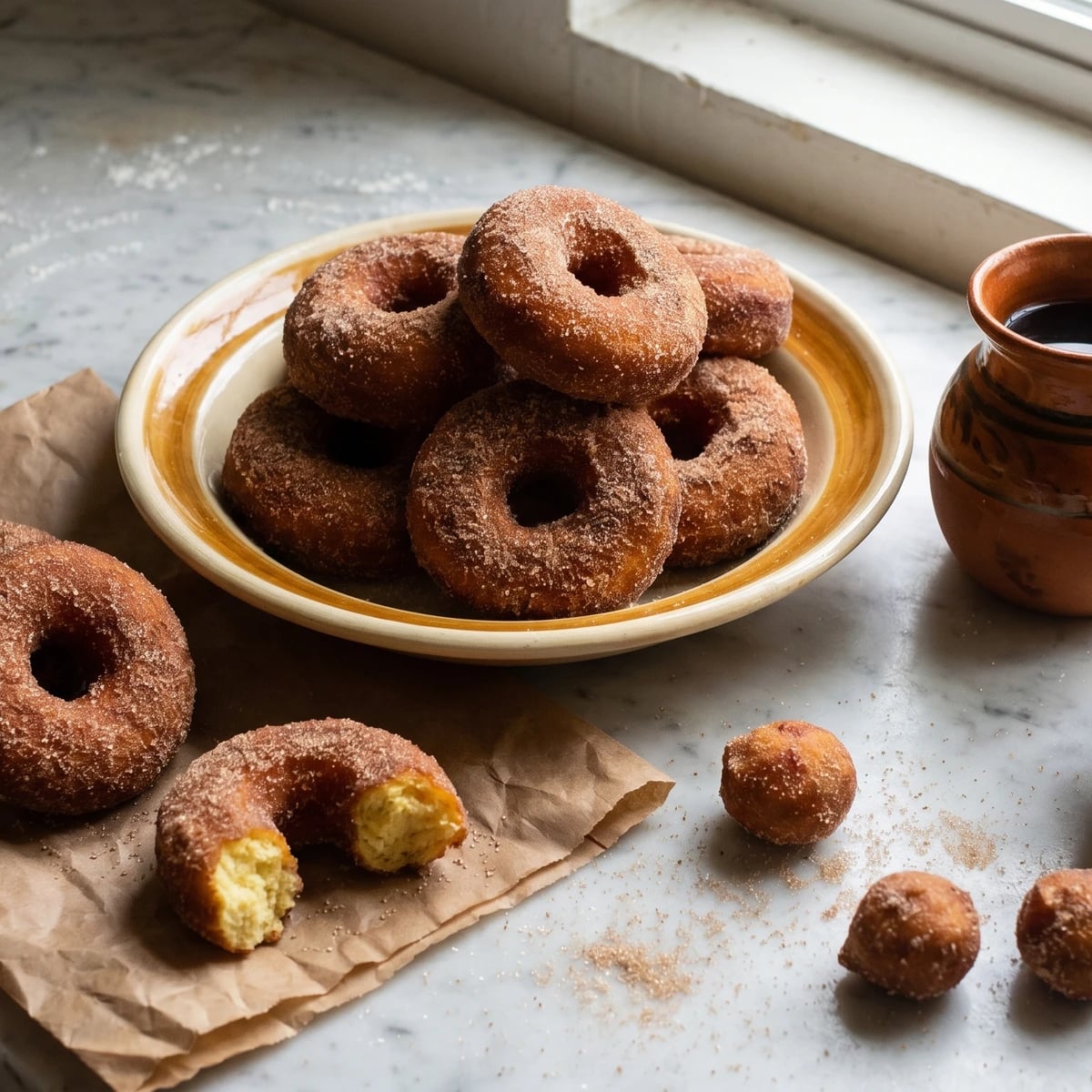
Yucatán's potato-enriched donuts from the panaderías of Mérida and Valladolid, denser and softer than yeast donuts, rolled hot in canela sugar and eaten with strong café yucateco.
These donas are from Yucatán. Specifically from the panaderías de barrio in Mérida and Valladolid, the ones that open at five in the morning and sell out by ten because the office workers and the taxi drivers and the abuelas walking home from the mercado all stop in for two donas and a café yucateco before the day really starts.
The potato is what makes them yucatecan, not just sweet. A pound of cooked, riced potato folded into an enriched yeast dough. It pulls the donut into a softer, denser, almost cake-like crumb that yeast alone cannot give you. Bite one and you understand. They tear apart in soft fibers instead of bread-like layers. They stay tender for two days, which is why the panaderías stack them in tall glass cases without worry. Yeast donuts go stale by afternoon. Donas de papa do not.
The naranja agria zest is the second thing that makes them yucatecan. Sour orange grows in every backyard from Campeche to Quintana Roo, the same fruit that perfumes cochinita pibil and pavo en relleno negro. Here it goes into the dough, just the zest, just enough to scent the kitchen while you fry. If you skip it, you have made a fine potato donut. You have not made a Yucatecan one.
My mother never made these. She was from Jalisco and her sweet tooth ran toward buñuelos and churros. The recipe in front of you came from a Sunday I spent in the panadería of Doña Mercedes Ek in a small town outside Valladolid, fifteen years ago now. She let me weigh the potato and watch her hands shape the dough on a marble counter older than both of us. She used pork lard for the frying and she would not hear of anything else. Saber cocinar es saber vivir.
Yucatán's tradition of potato-enriched yeast pastries traces to the late 19th century, when European bakers, particularly French and Lebanese immigrants who arrived in Mérida during the henequen boom, introduced enriched doughs that local bakers adapted using regional ingredients. The peninsula's relative isolation from central Mexico until the 20th century allowed Yucatecan panadería to develop its own canon, including donas de papa, marquesitas, and pan dulce yucateco, that differs significantly from the conchas and bisquets of central Mexican bakeries. The use of pork lard rather than vegetable shortening in traditional Yucatecan frying reflects the peninsula's deep porcine tradition, tied historically to the Mayan adoption of Spanish pigs and the central role of manteca in the regional kitchen.
Quantity
1 pound
peeled and cut into chunks
Quantity
3 1/2 cups
plus more for dusting
Quantity
2 1/4 teaspoons (one packet)
Quantity
1/2 cup
warmed to body temperature
Quantity
1/3 cup
Quantity
2
room temperature
Quantity
1
room temperature
Quantity
1/4 cup
softened
Quantity
1 teaspoon
Quantity
1 teaspoon
Quantity
from 1 fruit
Quantity
4 to 6 cups
Quantity
1 1/2 cups
Quantity
2 tablespoons
| Ingredient | Quantity |
|---|---|
| floury potatoes (papa blanca or russet)peeled and cut into chunks | 1 pound |
| all-purpose flourplus more for dusting | 3 1/2 cups |
| active dry yeast | 2 1/4 teaspoons (one packet) |
| whole milkwarmed to body temperature | 1/2 cup |
| granulated sugar | 1/3 cup |
| large eggsroom temperature | 2 |
| large egg yolkroom temperature | 1 |
| manteca de cerdo (pork lard)softened | 1/4 cup |
| fine sea salt | 1 teaspoon |
| vanilla extract | 1 teaspoon |
| naranja agria zest (or 1 orange plus 1 lime zest) | from 1 fruit |
| manteca de cerdo or neutral oil for frying | 4 to 6 cups |
| granulated sugar for coating | 1 1/2 cups |
| ground Mexican canela (Ceylon cinnamon) for coating | 2 tablespoons |
Place the peeled potato chunks in a pot of cold salted water. Bring to a boil and cook until a knife slides through with no resistance, about 18 minutes. Drain well and let the steam release for two full minutes before you do anything else. Wet potato makes wet dough, and wet dough makes heavy donuts. Pass the potato through a ricer or a fine mesh sieve. Do not use a food processor. The starch will turn gluey and the donut will be rubber. Measure out one cup, packed but not pressed, and let it cool to barely warm.
Warm the milk to body temperature. Test it on the inside of your wrist. If you cannot feel it, it is right. If it stings, it will kill the yeast. Stir in one tablespoon of the sugar and all of the yeast. Let it sit for ten minutes until it foams up like a thin cap of cream. If nothing happens, your yeast is dead. Start over with fresh yeast. No me vengas con atajos.
In the bowl of a stand mixer with the dough hook, combine the riced potato, the remaining sugar, eggs, egg yolk, softened lard, salt, vanilla, and the naranja agria zest. Mix on low until the lard breaks up and the mixture looks like a pale yellow paste. Pour in the foamy yeast mixture. Add the flour one cup at a time on low speed. The dough will look shaggy at first, then come together into a soft, slightly tacky mass. Knead on medium-low for eight minutes. It should pull cleanly from the sides of the bowl but still feel soft when you press it. Resist the urge to add more flour. A tight dough makes a tough donut.
Scrape the dough into a lightly greased bowl, cover with a clean kitchen towel, and let it rise in a warm spot until nearly doubled, about one hour. Yucatán is hot. The dough will rise fast in Mérida and slow in a cold kitchen. Watch the dough, not the clock. When you press a finger into it and the dent stays, it is ready.
Turn the dough out onto a lightly floured surface. Pat, do not roll, into a rectangle about one half inch thick. Cut with a three-inch round cutter, then punch a hole in the center with a small bottle cap or a one-inch cutter. Save the holes. They fry into the best bites in the basket. Place the shaped donas on parchment-lined sheet pans with at least two inches between them. Re-pat the scraps once and cut again. After the second pass, the dough toughens. Throw any further scraps away or fry them as ugly ones for the cook.
Cover the shaped donas loosely with a towel and let them rise for 30 to 45 minutes, until they look puffy and a finger pressed gently into the side leaves a slow-springing dent. Underproofed donas come out dense and tight. Overproofed donas collapse in the fryer. The middle is what you want.
Pour the lard or oil into a heavy, deep pot. You want at least three inches of fat. Heat it to 340F. Use a thermometer. Hot fat is the difference between a donut that absorbs grease and a donut that comes out light. Too cool and you fry a sponge. Too hot and the outside browns before the inside cooks. The classic Yucatecan panaderías fry in pork lard. La manteca es el sabor. If you fry in neutral oil, the donas are still good, but a true Yucatecan one carries the faint savor of manteca underneath the cinnamon sugar.
Whisk the coating sugar and ground canela together in a wide shallow bowl. Have it ready before you fry. Lift the donas with floured fingertips or a thin metal spatula and lower them gently into the fat, three or four at a time. Do not crowd the pot. Fry for 90 seconds, then flip with chopsticks or a slotted spoon. Fry another 90 seconds on the second side. They should be deep amber, the color of cajeta. Lift them out, let the fat drip back into the pot for a second, then move them straight onto a wire rack for 30 seconds.
While still hot, toss the donas one by one in the cinnamon sugar. Both sides. Press lightly so the sugar sticks. The heat melts a thin layer of sugar against the crust and that is what gives a Yucatecan dona its signature half-crystalline coating. Do this the moment they come out of the fat. A cooled dona will not hold the sugar. Eat the first one standing over the bowl. That one is for the cook. Así se hace y punto.
1 serving (about 78g)
Culinary guides, cultural storytelling, and the editorial depth that makes cooking meaningful.
Discover Culinary Explorer
Chef Lupita
Mérida's pale egg-yolk-and-vanilla kisses, tiny cookies built on eight yolks and a perfume of orange blossom, sandwiched with guava paste and dusted heavy with powdered sugar.

Chef Lupita
Yucatán's twice-baked rusks, half finished with sugar and half with flaky salt, built to drink coffee or hot chocolate with at any hour of the day.

Chef Lupita
Mérida's lard-enriched bizcochos, denser and crumblier than their agua cousins, the kind of pastry that appears at breakfast, at merienda, and on the table whenever family walks through the door.

Chef Lupita
Yucatán's flaky puff pastry balls, filled with sweetened cream cheese kissed with lima dulce, baked until the layers shatter under the sugar coat. The pan dulce of every Mérida baptism and birthday.