Culinary Explorer

A cooking platform built around craft, culture, and the stories behind what we eat.
Discover Culinary Explorer
Dom Rodrigos

Dom Rodrigos

Created by

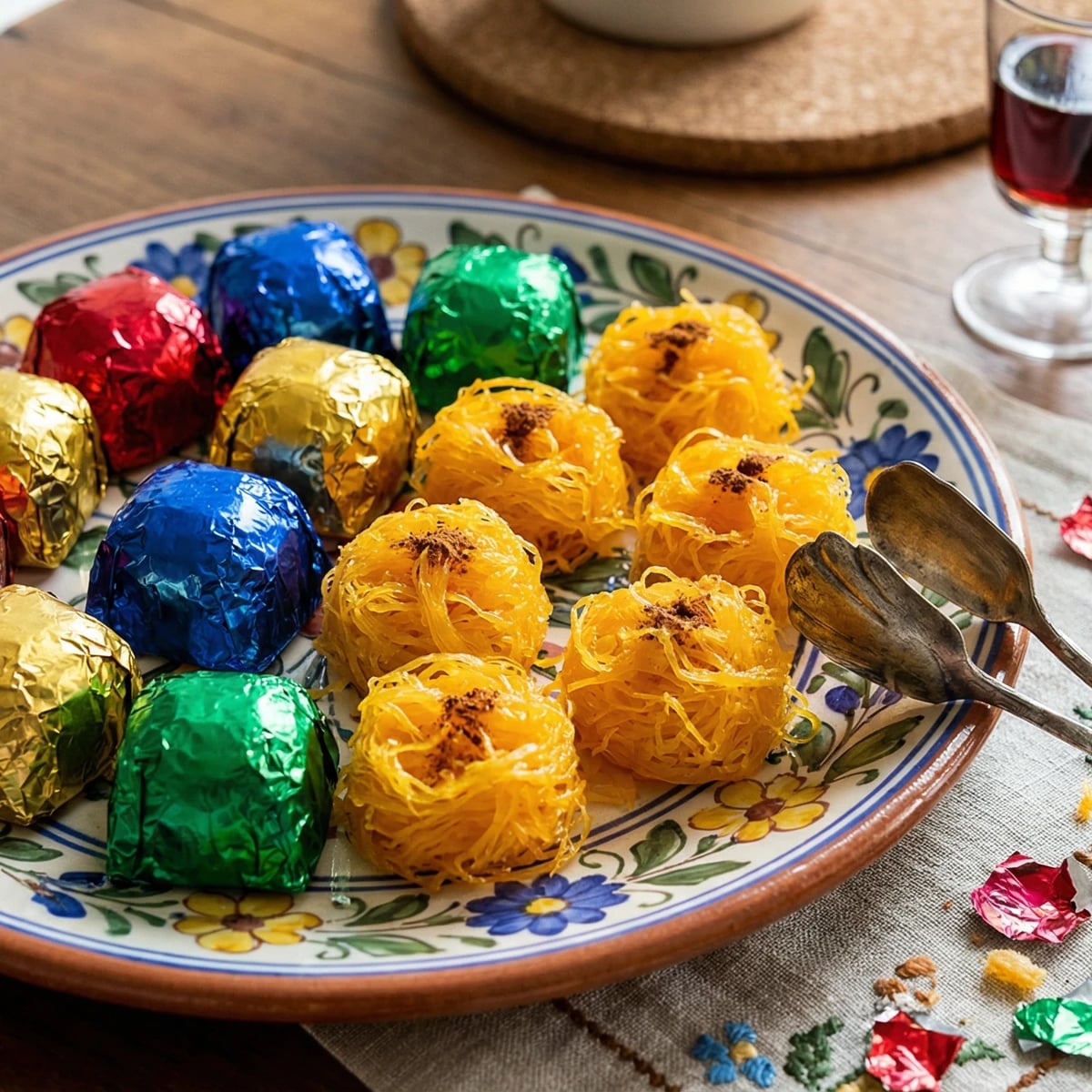
Golden nests of fios de ovos and almonds from Algarve's convents, wrapped in jewel-bright foil. The nuns made these to honor a governor, and we've been making them ever since.

Desserts
Portuguese
Holiday
Christmas
Special Occasion
45 min
Active Time
30 min cook1 hr 15 min total
Yield12 confections

There's a reason the Algarve guards these sweets so fiercely. Dom Rodrigos are not just confections. They're a lesson in what Portuguese hands can do with eggs, sugar, and time.

I first learned about fios de ovos in my grandmother's kitchen, but Avó Leonor was Alentejana, not Algarvia. For this recipe, I traveled to Lagos and sat with Dona Conceição, eighty-three years old, who learned from her own grandmother who learned from the nuns at a convent that no longer exists. She showed me how to read the syrup without a thermometer, how to drizzle the yolks so thin they become threads of gold, how to fold everything together so gently that the threads keep their air.

The egg-yolk tradition that defines Portuguese sweets was born in convents. The nuns used egg whites to starch their habits, leaving mountains of yolks with no purpose. Rather than waste them (that's not the Portuguese way), they invented an entire category of sweets: ovos moles, trouxas de ovos, barrigas de freira, and these beautiful Dom Rodrigos. Surplus became art.

This is not a simple recipe. The sugar must reach the right point. The threads must be thin. The shaping must be gentle. But when you unwrap that foil and taste the result, you'll understand why the nuns kept making them, why Governor Dom Rodrigo kept requesting them, why the Algarve has never stopped. A cozinha é memória, and these sweets carry five hundred years of it.

Dom Rodrigos were created by Algarve convent nuns, likely during the 16th or 17th century, to honor Dom Rodrigo de Menezes, a governor of the region known for his fondness for sweets. Like many doces conventuais, they emerged from the abundance of egg yolks left over from starching habits with egg whites. The town of Lagos claims them as a regional specialty, though Faro and other Algarve cities dispute this with typical Portuguese passion.

The technique, the tradition, and the story behind every dish.

Discover Culinary Explorer

Ingredients

egg yolks

Quantity

12 large

at room temperature

granulated sugar

Quantity

500g

water

Quantity

300ml

ground almonds (amêndoas)

Quantity

150g

ground cinnamon

Quantity

1/2 teaspoon

lemon zest

Quantity

from 1/2 lemon

finely grated

colorful foil candy wrappers

Quantity

12

Equipment Needed

  • Wide shallow pan for syrup
  • Fine-mesh sieve
  • Candy thermometer (helpful but not essential)
  • Funnel with small holes or squeeze bottle with fine tip
  • Slotted spoon
  • Cooling rack

Instructions

  1. 1

    Prepare the sugar syrup

    Combine the sugar and water in a wide, shallow pan. Stir over medium heat until the sugar dissolves completely. Stop stirring once it begins to boil. Let it cook until it reaches ponto de fio (thread stage), about 110°C (230°F). When you dip a spoon and lift it, the syrup should fall in a thin continuous thread. This is the moment. Not before, not after.

    The nuns who invented these sweets had no thermometers. They learned to read the syrup by touch and sight. You can too, but a thermometer helps while you're learning.
  2. 2

    Strain the egg yolks

    While the syrup heats, pass the egg yolks through a fine-mesh sieve into a bowl, pressing with a spoon. This removes the chalazae and any membrane, ensuring smooth, unbroken threads. The yolks should be silky and uniform. Room temperature is essential. Cold yolks will cook too fast when they hit the hot syrup.

  3. 3

    Create the fios de ovos

    Keep the syrup at a gentle simmer. Using a funnel with a very small opening (or a squeeze bottle with a thin tip, or the traditional funil de fios), drizzle the strained yolks into the syrup in thin, continuous streams, moving your hand in circles to create golden threads. Work in small batches. The threads will cook almost instantly, turning from liquid gold to delicate strands. After 30 seconds, use a slotted spoon or fork to lift the threads out and drain them on a cooling rack set over a tray. Continue until all yolks are used.

    The fios de ovos should be thin as hair, as the name suggests (fios means threads). Thick streams make clumsy, chewy results. Patience. Let the threads fall slowly.
  4. 4

    Prepare the binding syrup

    Bring the remaining syrup back to a boil and cook it to ponto de estrada (soft ball stage), about 116°C (240°F). At this point, a drop of syrup in cold water forms a soft, pliable ball. Remove from heat. Let it cool for 2 minutes until it thickens slightly but remains pourable.

  5. 5

    Mix the filling

    In a bowl, combine the ground almonds, cinnamon, and lemon zest. Gently fold in most of the fios de ovos, keeping them airy and intact. Drizzle in enough of the thickened syrup to bind the mixture, working carefully. You want the threads to hold together but not become a dense paste. Reserve some egg threads for topping.

  6. 6

    Shape the Dom Rodrigos

    With lightly oiled hands, take portions of the mixture and shape them into small cone or mound shapes, about the size of a large walnut. Work gently so you don't crush the delicate threads. Top each with a small nest of reserved fios de ovos. Place on a parchment-lined tray and let them set at room temperature for at least 2 hours.

    The traditional shape is a little pointed mound, like a small mountain. Some make them rounded, some peaked. The grandmothers in Lagos make them taller than those in Faro. Regional pride in miniature.
  7. 7

    Wrap in foil

    Once fully set, wrap each Dom Rodrigo in a square of colorful foil, twisting the top or folding the edges to enclose it. The foil is traditional, part of the joy of receiving these sweets. Gold, red, blue, green: a box of Dom Rodrigos looks like a treasure chest. That's the point.

Chef Tips

  • Your eggs must be at room temperature. Cold yolks seize when they hit the hot syrup and you'll have scrambled eggs instead of golden threads.
  • The funil de fios (thread funnel) is the traditional tool, a small cup with tiny holes in the bottom. A squeeze bottle with a very fine tip works if you can't find one. Some grandmothers just use their fingers, letting the yolk drip through the gaps. I'm not that skilled yet.
  • If your fios de ovos break into short pieces instead of long threads, your syrup is too hot or you're drizzling too slowly. Keep the syrup at a gentle simmer, not a rolling boil.
  • Dom Rodrigos keep for up to a week stored in an airtight container at room temperature. The foil wrapping isn't just decorative; it protects the delicate threads.

Advance Preparation

  • The fios de ovos can be made a day ahead and stored in an airtight container at room temperature. Handle gently when mixing.
  • Fully assembled Dom Rodrigos keep for up to a week wrapped in their foil. They actually improve slightly after a day, as the flavors meld.
  • Do not refrigerate. Cold dulls the texture of the egg threads.

Frequently Asked Questions

Nutrition Information

1 serving (about 65g)

Calories
290 calories
Total Fat
11 g
Saturated Fat
2 g
Trans Fat
0 g
Unsaturated Fat
8 g
Cholesterol
184 mg
Sodium
15 mg
Total Carbohydrates
45 g
Dietary Fiber
2 g
Sugars
42 g
Protein
5 g

Note: Chef personas and recipes are created with AI assistance. Cook with care: follow safe food-handling practices, check doneness with a thermometer when needed, and adapt for allergies and your kitchen.

Where cooking meets culture.

Culinary guides, cultural storytelling, and the editorial depth that makes cooking meaningful.

Discover Culinary Explorer

More from Chef Margarida's Desserts

Browse the full collection