
Chef Lupita
Aguascalientes Beef Tongue Pozole (Pozole de Lengua)
Aguascalientes' Bajio pozole de lengua, built with cacahuazintle hominy, tender beef tongue, chile ancho and guajillo, with xoconostle brightness and table garnishes.
A cooking platform built around craft, culture, and the stories behind what we eat.
Created by
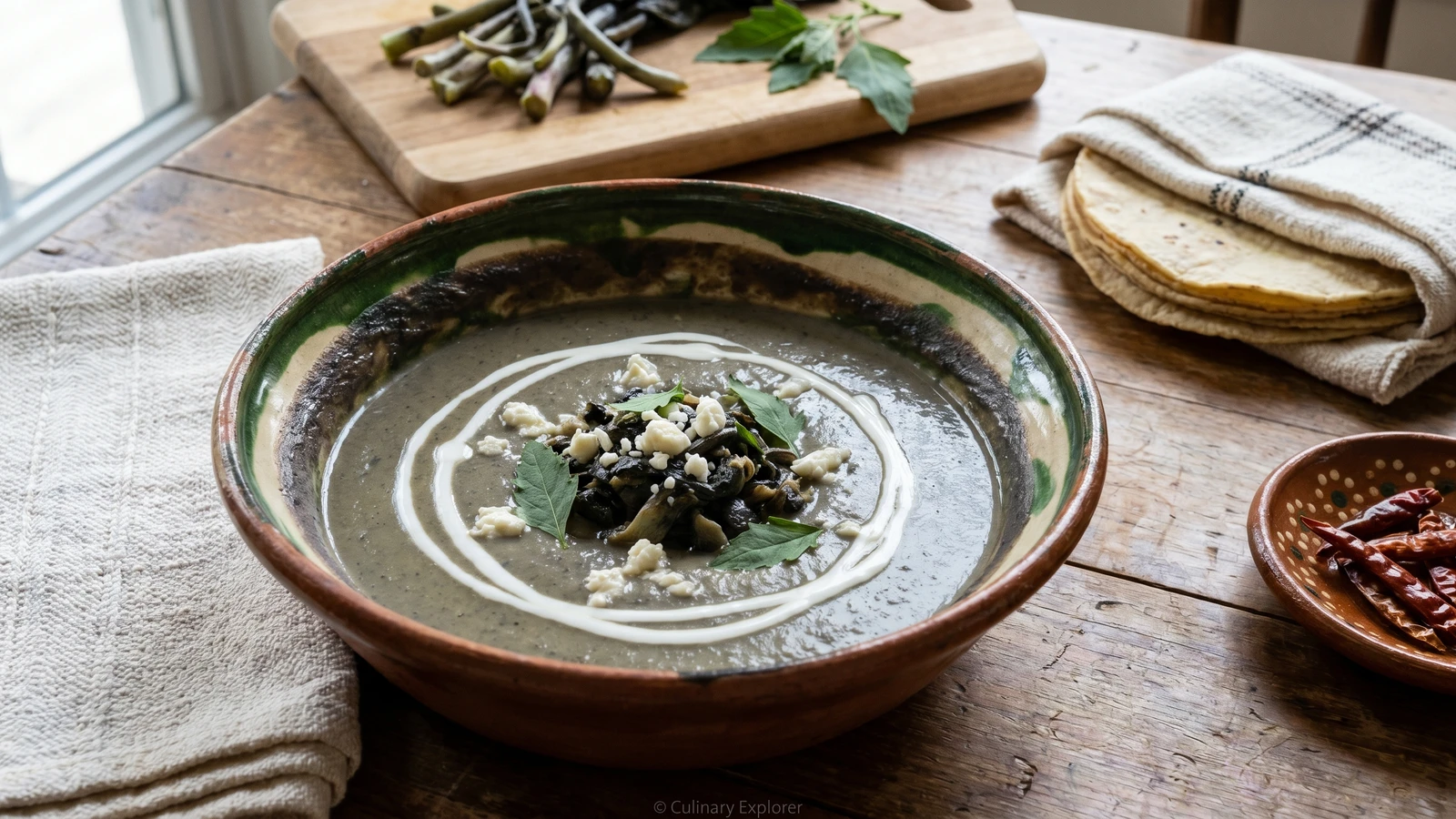
Ciudad de México's corn-truffle crema, huitlacoche sweated with cebolla, ajo, and epazote in lard, blended into a slate-grey soup, and finished with a swirl of cold crema mexicana.
This is a soup from the central highlands. Ciudad de México, Estado de México, Tlaxcala, Puebla. The valley where corn has been farmed for nine thousand years and where the rainy season swells the kernels with the black-grey fungus that Mexican cooks have prized since before Cortés set foot on the coast. Huitlacoche is not a defect. It is the harvest.
The Americans who buy our corn call it 'corn smut' and throw it away. The French call it 'the Mexican truffle' and pay restaurant prices for it. We just call it huitlacoche and we have been eating it since the Mexica brought it to the markets of Tenochtitlan. The word itself is Nahuatl. The dish is Nahuatl in its bones, corn, epazote, chile. The crema is the Spanish layer on top. That is Mexican food in one bowl: the indigenous foundation, the colonial finish, neither pretending the other does not exist.
My mother used to make this in late summer when the rains came and the huitlacoche showed up at the Mercado de Medellín for two or three weeks. She would buy a kilo, cook it the same day, and we would eat it for dinner that night with tortillas she had pressed by hand. She wrote in the margin of her notebook: 'no escatimes en el epazote' (do not skimp on the epazote). She was right. The epazote is what tells the diner this is a Mexican soup and not a French mushroom bisque trying to wear a costume. Saber cocinar es saber vivir.
Huitlacoche, whose name derives from the Nahuatl 'cuitlacochi' (the precise etymology is debated, with interpretations ranging from 'sleeping excrement' to 'aged corruption of corn'), has been cultivated and harvested intentionally in the central Mexican highlands for at least two thousand years, with archaeological evidence of consumption predating the Mexica empire. The Spanish chronicler Bernardino de Sahagún documented its sale in the markets of Tenochtitlan in the 16th century, and the dish's pairing with epazote, another pre-Columbian highland ingredient, reflects an ingredient combination that has remained essentially unchanged since the contact era. The crema-based preparation is a relatively modern adaptation, emerging in the late 19th and early 20th century as French culinary influence reshaped the formal dining rooms of Porfirian Mexico City, and was popularized as a representative dish of haute cocina mexicana through the 1960s and 1970s.
Quantity
1 pound fresh, or 2 cans (7 ounces each)
Quantity
3 tablespoons
Quantity
1 medium
finely diced
Quantity
4
finely minced
Quantity
1
stemmed and finely chopped (seeds in for heat)
Quantity
1 large sprig (about 2 tablespoons leaves)
leaves stripped and roughly chopped
Quantity
1 cup (1 ear)
cut off the cob
Quantity
5 cups
warm
Quantity
1 cup, plus extra for the swirl
Quantity
1 1/2 teaspoons, plus more to taste
Quantity
1/2 teaspoon
Quantity
for serving
Quantity
a few
Quantity
for serving
Quantity
for serving
warmed
| Ingredient | Quantity |
|---|---|
| fresh huitlacoche (or canned huitlacoche in brine, drained) | 1 pound fresh, or 2 cans (7 ounces each) |
| manteca de cerdo (pork lard) | 3 tablespoons |
| white onionfinely diced | 1 medium |
| garlic clovesfinely minced | 4 |
| fresh chile serranostemmed and finely chopped (seeds in for heat) | 1 |
| fresh epazoteleaves stripped and roughly chopped | 1 large sprig (about 2 tablespoons leaves) |
| fresh white corn kernelscut off the cob | 1 cup (1 ear) |
| homemade chicken brothwarm | 5 cups |
| crema mexicana | 1 cup, plus extra for the swirl |
| kosher salt | 1 1/2 teaspoons, plus more to taste |
| freshly ground black pepper | 1/2 teaspoon |
| crumbled queso fresco (optional) | for serving |
| extra epazote leaves (optional) | a few |
| reserved sautéed huitlacoche (optional) | for serving |
| hand-pressed corn tortillas (optional)warmed | for serving |
If you have fresh huitlacoche from a mercado, look it over carefully. Pull off any pieces of dried husk or silk. Cut the larger black-grey lobes off the cob with a sharp knife. Do not rinse it. Water washes away the flavor. If you are using canned huitlacoche, drain it well and give it a quick rinse to take the metallic edge off the brine. Then let it sit in a sieve while you work the aromatics. Fresh is the version. Canned is a compromise, not an upgrade.
Melt the manteca in a heavy 4-quart cazuela or pot over medium heat. When it shimmers, add the diced onion and a pinch of salt. Cook for about 6 minutes, stirring, until the onion turns translucent and the edges just start to gild. No browning. You want the sweetness, not the caramel. La manteca es el sabor, even in a soup that hides behind cream.
Add the garlic and the chile serrano. Cook for about 90 seconds, stirring constantly, until the garlic is fragrant but still pale. Burnt garlic turns bitter and there is no recovering from it in a cream soup. Add the fresh corn kernels and cook another two minutes. The corn deepens the body of the crema and reminds the diner that huitlacoche is, after all, a fruit of the corn.
Add the cleaned huitlacoche and the chopped epazote. Raise the heat to medium-high. Cook for 8 to 10 minutes, stirring often. The huitlacoche will release a black ink-like liquid that paints the pot. Let that liquid reduce until it coats the spoon. This is the moment the kitchen smells like nothing else, mushroom, sweet corn, the wet smell of a Mexican field after rain. That is the smell that tells you the dish is working. Pull out a generous half cup of the cooked huitlacoche and set it aside for the garnish.
Pour in the warm chicken broth. Add the salt and pepper. Bring to a low simmer and cook uncovered for 15 minutes. The flavors marry and the broth takes on the deep black-grey color of the huitlacoche. Taste it now, before the cream goes in. It should taste of earth and corn with a quiet heat at the back. Adjust salt as needed.
Working in batches, transfer the soup to a blender. Fill the blender no more than two-thirds full, hold the lid down with a folded kitchen towel, and start on low before going to high. Blend each batch for a full minute until completely smooth. Return the puree to the pot. The crema should be the color of wet slate, dark grey with a faint olive undertone. If it looks brown, your huitlacoche was old.
Set the pot over low heat. Stir in the cup of crema mexicana. Warm gently for two or three minutes, never boiling. Boiling crema breaks the soup and leaves you with grainy flecks of fat floating on the surface. Taste one more time for salt. The crema dulls the seasoning and the soup almost always needs another pinch at this point. Así se hace y punto.
Ladle into shallow clay cuencos or barro bowls. Spoon a small mound of the reserved sautéed huitlacoche in the center of each bowl. Drizzle a swirl of cold crema mexicana across the surface, the white against the slate-grey is the visual signature of this soup. Scatter a few crumbles of queso fresco and a few small epazote leaves. Serve with warm hand-pressed tortillas. La cocina no es decoración, es trabajo, but a swirl of crema on a black-grey soup is the one decoration this dish earns.
1 serving (about 390g)
Culinary guides, cultural storytelling, and the editorial depth that makes cooking meaningful.
Discover Culinary ExplorerChef Lupita
Aguascalientes' Bajio pozole de lengua, built with cacahuazintle hominy, tender beef tongue, chile ancho and guajillo, with xoconostle brightness and table garnishes.

Chef Lupita
Veracruz's Gulf coast rice from Alvarado, built with seafood stock, tomato, chile chipotle, epazote, shrimp, fish, jaiba, and pulpo, served loose and brothy in a clay cazuela.

Chef Lupita
Costa Chica's wet salt-beef stew, built from chile costeño, guajillo, tomato, manteca, yuca, plantain, and masa dumplings, the ranching pot of Cuajinicuilapa and Pinotepa.

Chef Lupita
Michoacán's P'urhépecha atápakua is a masa-thickened sauce and stew at once, built with pork, chile guajillo, and hierbabuena added only at the end.