
Chef Lupita
Aguascalientes Beef Tongue Pozole (Pozole de Lengua)
Aguascalientes' Bajio pozole de lengua, built with cacahuazintle hominy, tender beef tongue, chile ancho and guajillo, with xoconostle brightness and table garnishes.
A cooking platform built around craft, culture, and the stories behind what we eat.
Created by
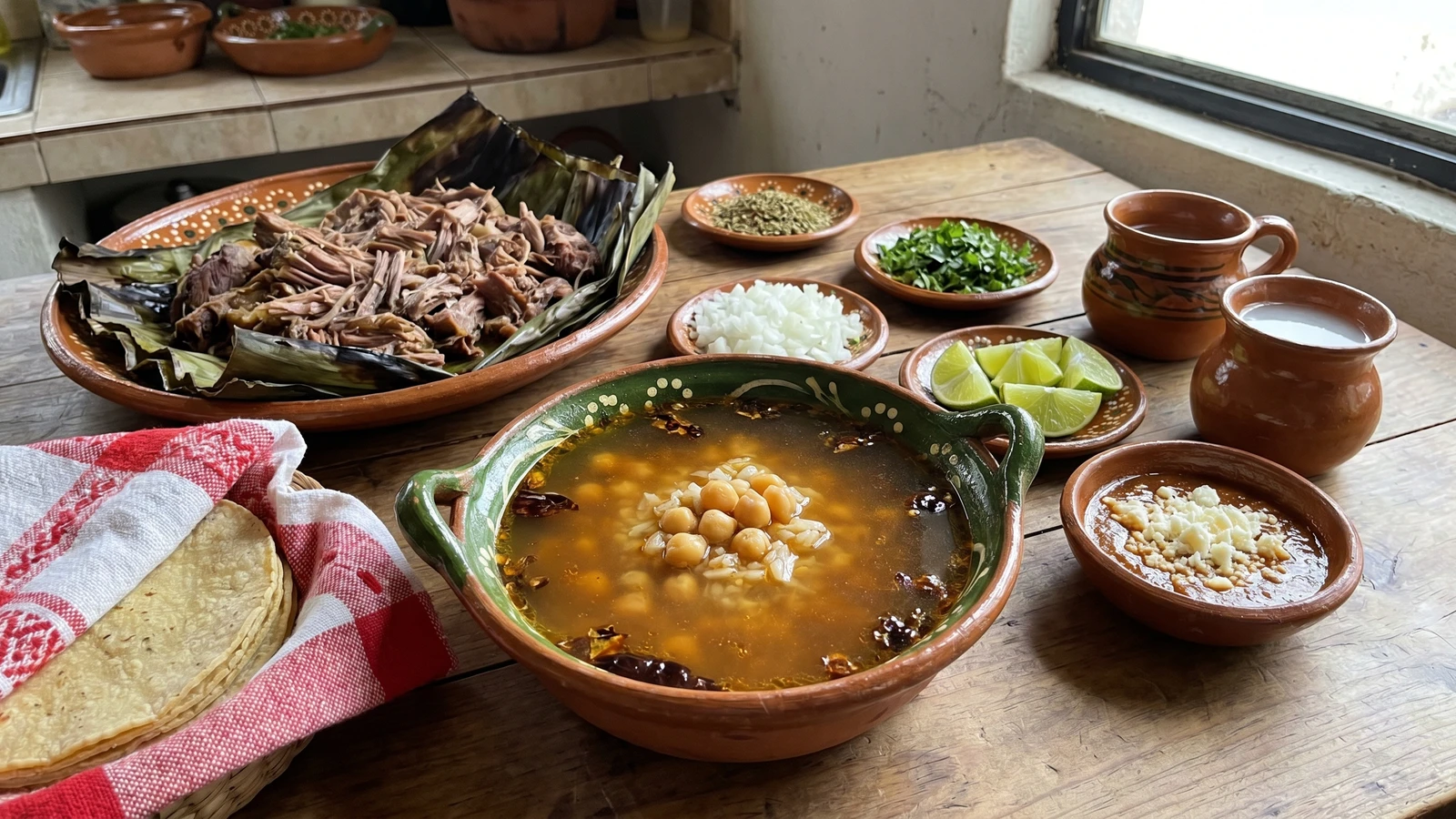
Hidalgo's Sunday morning consomé from the drippings of lamb steamed en penca de maguey, fortified with garbanzo and arroz, finished at the table with cebolla, cilantro, lime, and salsa borracha.
This is Hidalgo. Specifically the towns of the Valle del Mezquital and Actopan, where the barbacoyeros dig their pits before dawn on Saturday and serve before the church bells ring on Sunday. Barbacoa hidalguense is lamb steamed in pencas de maguey, the thick fleshy leaves of the agave that grows wild across the altiplano. The consomé is what catches the drippings.
The penca is not decoration. The penca is the dish. As the lamb steams, the sap and the chlorophyll of the maguey perfume the meat with something herbal, faintly sweet, almost mineral, that no other wrapper produces. Banana leaf is from Yucatán. Corn husk is from another dish entirely. If you cannot find pencas at a Mexican mercado or a serious specialty store, wait until you can. No me vengas con atajos.
The consomé below is fortified with garbanzo and arroz, the way my mother's friend from Pachuca taught me when I went up to Hidalgo for the first time to document the barbacoyeros. She told me the consomé is not a soup, it is the proof of the barbacoa. If the lamb was good and the penca was fresh and the heat was patient, the consomé will tell you. If anything went wrong, the consomé will also tell you. You cannot hide a mistake at the bottom of the pot.
Serve it at the table with diced raw onion, chopped cilantro, dried oregano crumbled between your fingers, lime, and salsa borracha, which is its own conversation: pasilla and pulque, that is what makes it borracha. Cada estado, su propia cocina, and this one belongs to Hidalgo from the first penca to the last spoonful.
Barbacoa derives from the Taino word 'barbacoa,' a wooden frame used for slow-cooking meat over coals, which the Spanish recorded in the Caribbean and carried inland; the technique then merged with the pre-Columbian Mesoamerican practice of pit cooking with hot stones and maguey leaves, a method documented among the Otomí and Nahua peoples of the central highlands long before contact. Hidalgo's identification with lamb barbacoa specifically dates to the post-conquest introduction of sheep, which thrived in the arid Mezquital Valley alongside the maguey already cultivated for pulque production, allowing a single landscape to provide both the meat and the wrapper. The accompanying salsa borracha, made with chile pasilla and pulque (the fermented sap of the same maguey), closes a self-contained culinary system rooted entirely in the Hidalgo altiplano.
Quantity
4 large
passed over an open flame until pliable
Quantity
5 pounds
cut into large pieces
Quantity
1 pound
for the drippings
Quantity
1 cup
soaked overnight and drained
Quantity
1/2 cup
rinsed
Quantity
1 medium
halved
Quantity
1 cup
finely diced
Quantity
1
halved crosswise
Quantity
4
stemmed and seeded
Quantity
2
stemmed and seeded
Quantity
2
lightly toasted
Quantity
1 tablespoon, plus more for serving
Quantity
2
Quantity
2 tablespoons, plus more to taste
Quantity
10 cups
Quantity
1 bunch
chopped
Quantity
4
cut into wedges
Quantity
for serving
Quantity
for serving
warmed
| Ingredient | Quantity |
|---|---|
| pencas de maguey (agave leaves)passed over an open flame until pliable | 4 large |
| bone-in lamb shoulder and shankcut into large pieces | 5 pounds |
| lamb bones (neck or rib)for the drippings | 1 pound |
| dried garbanzossoaked overnight and drained | 1 cup |
| long-grain white ricerinsed | 1/2 cup |
| white onionhalved | 1 medium |
| white onion for serving (optional)finely diced | 1 cup |
| head of garlichalved crosswise | 1 |
| dried chile guajillostemmed and seeded | 4 |
| dried chile anchostemmed and seeded | 2 |
| dried avocado leaves (hoja de aguacate)lightly toasted | 2 |
| dried Mexican oregano | 1 tablespoon, plus more for serving |
| bay leaves | 2 |
| kosher salt | 2 tablespoons, plus more to taste |
| water | 10 cups |
| fresh cilantro (optional)chopped | 1 bunch |
| limes (optional)cut into wedges | 4 |
| salsa borracha (optional) | for serving |
| hand-pressed corn tortillas (optional)warmed | for serving |
Pass each penca over an open flame, turning until the green skin chars in patches and the leaf turns pliable. This wakes up the agave sap that perfumes the meat. Scrape off the burned spines with the back of a knife. The penca is the soul of barbacoa hidalguense. Without it, you are making lamb stew. With it, you are making the dish that defines the state.
In the bottom of a heavy stockpot or vaporera, place the soaked garbanzos, the rinsed rice, halved onion, halved garlic head, bay leaves, dried oregano, toasted avocado leaves, and the salt. Pour in the ten cups of water. This is the catador, the catcher, that will receive every drop of fat and juice that falls from the lamb. The garbanzos and rice cook in the drippings while the lamb steams above. This is the architecture of consomé hidalguense.
Heat a dry comal over medium. Toast the guajillo and ancho chiles for about 20 seconds per side, until the skin puffs and the kitchen smells like a chile vendor's stall. Soak them in hot water, not boiling, for 15 minutes. Blend smooth with a half cup of the soaking water and a pinch of salt. Strain through a fine-mesh sieve and stir the puree into the water at the bottom of the pot. The chile is what stains the consomé that deep amber-red. Skip the toasting and you will taste the difference.
Fit a steamer rack or upturned cazuelita into the pot, just above the level of the liquid. The drippings need room to fall. Drape the prepared pencas across the rack, overlapping them so they form a green-charred basin that cradles the meat. Let the tips of the leaves hang over the edge of the pot. This is how the cooks in Actopan and Mixquiahuala have built barbacoa for generations.
Salt the lamb shoulder, shank, and bones generously on all sides. Pile them into the basin of pencas, bones tucked among the larger pieces. Fold the overhanging tips of the leaves back over the meat to seal it in a green package. The lamb should be wrapped, not exposed. The aroma of cooked maguey is half of what makes this dish.
Cover the pot with a tight lid. Seal the rim with a strip of wet masa or aluminum foil if your lid does not sit flush. No steam should escape. Set over low heat and cook for four to five hours. Do not lift the lid. Every time you peek, you lose the steam that is cooking the meat. The lamb is ready when it falls off the bone with no resistance and the kitchen smells of agave and cooked chile. Así se hace y punto.
Carefully unwrap the pencas. Lift the lamb out onto a deep platter and pull it apart with two forks, discarding any large pieces of fat or gristle. Skim the consomé in the bottom of the pot if there is a heavy layer of fat on top, but leave a shimmer. The shimmer is the flavor. Taste for salt. The garbanzos should be tender, the rice should be soft and almost dissolved into the broth, and the consomé should be amber, fragrant, and full-bodied.
Ladle the consomé into deep clay cazuelitas, dividing the garbanzos and rice among the bowls. Set the diced onion, cilantro, oregano, lime, salsa borracha, and warm tortillas on the table in small dishes. Each guest builds their bowl and makes their own tacos de barbacoa with the pulled meat alongside. This is Sunday morning in Hidalgo. The consomé is the welcome, the tacos are the meal, and the salsa borracha is the punctuation. Recetas probadas y garantizadas.
1 serving (about 420g)
Culinary guides, cultural storytelling, and the editorial depth that makes cooking meaningful.
Discover Culinary ExplorerChef Lupita
Aguascalientes' Bajio pozole de lengua, built with cacahuazintle hominy, tender beef tongue, chile ancho and guajillo, with xoconostle brightness and table garnishes.

Chef Lupita
Veracruz's Gulf coast rice from Alvarado, built with seafood stock, tomato, chile chipotle, epazote, shrimp, fish, jaiba, and pulpo, served loose and brothy in a clay cazuela.

Chef Lupita
Costa Chica's wet salt-beef stew, built from chile costeño, guajillo, tomato, manteca, yuca, plantain, and masa dumplings, the ranching pot of Cuajinicuilapa and Pinotepa.

Chef Lupita
Michoacán's P'urhépecha atápakua is a masa-thickened sauce and stew at once, built with pork, chile guajillo, and hierbabuena added only at the end.