
Chef Lupita
Aguascalientes Beef Tongue Pozole (Pozole de Lengua)
Aguascalientes' Bajio pozole de lengua, built with cacahuazintle hominy, tender beef tongue, chile ancho and guajillo, with xoconostle brightness and table garnishes.
A cooking platform built around craft, culture, and the stories behind what we eat.
Created by
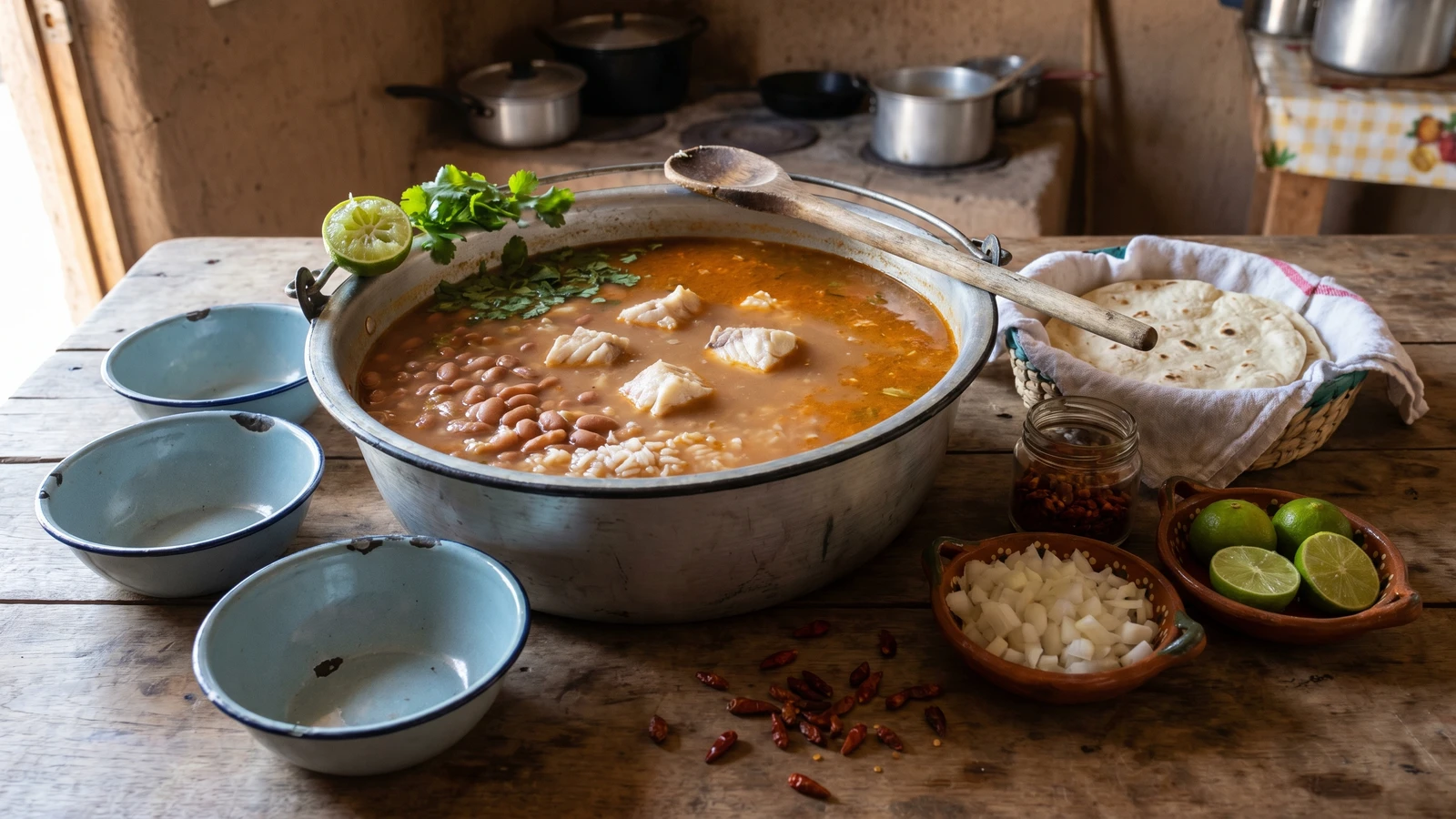
Loreto's fisherman's pot from Baja California Sur, where local cabrilla, pinto beans, and white rice cook down into a single rustic broth. Born of scarcity, kept by tradition, and still on the table every Friday in the old neighborhoods.
This is from Loreto, on the eastern coast of Baja California Sur, the oldest mission town in the Californias and one of the few places where the Sea of Cortez and the desert meet at the same dinner table. The dish has a name that tells you everything: comida de pobres. Poor people's food. The cooks of Loreto do not flinch when they say it. They are proud of it.
This is a one-pot meal built from what the boats brought in and what the despensa already had on the shelf. Pinto beans because pintos travel and store. White rice because it stretches the broth. A piece of cabrilla or pargo because the Sea of Cortez was generous that morning. A fresh Anaheim chile because the noroeste does not cook with the dried chiles of central Mexico, and a few crumbled chiltepines on the side for the cook who wants heat. Esto no es comida de un solo Mexico. The chiles, the rice, the flour tortillas at the table, all of it tells you you are nowhere near Oaxaca or Puebla. You are in the noroeste, where the cuisine answers to the desert and the sea.
I collected this recipe in 2019 from a senora named Dona Refugio in the Colonia Centro of Loreto, three blocks from the malecon. She made it for me on a Friday afternoon because Friday is the day this dish belongs to in the old neighborhoods, the day the fishermen come back with what did not sell at the morning market. She told me her mother made it through the lean years of the 1950s, when the pearl industry had collapsed and Loreto had not yet been discovered by tourists. The dish fed her family then. It feeds her grandchildren now. Saber cocinar es saber vivir.
Do not romanticize the name. This was hunger food. But hunger food made by cooks who knew what they were doing produces some of the most honest dishes in Mexican cuisine, and comida de pobres loretana belongs in that company. The fish has to be local and fresh. The lard is not optional. The lime at the end is what wakes everything up. Cada estado, su propia cocina, and this one is Sudcaliforniana.
Loreto was founded in 1697 as the first permanent Spanish mission in the Californias and served as the capital of Las Californias until 1777, predating the colonization of Alta California. The fishing-and-bean-pot tradition documented across the Sudcaliforniano coast emerged from the convergence of three food cultures: the indigenous Monqui and Cochimi peoples, who relied on shellfish, dried fish, and gathered desert foods; the Jesuit mission system, which introduced wheat, beans, and cattle to the peninsula; and the post-mission ranchero economy, which depended on the long shelf life of dried legumes. The dish's local name, comida de pobres, reflects the economic collapse of the 1828 mission secularization and the failure of the pearl industry in the early 20th century, periods when peninsular families combined whatever the boats brought in with whatever the despensa held.
Quantity
1 pound
soaked overnight and drained
Quantity
1 medium
halved (one half left whole, one half finely diced)
Quantity
6
3 left whole, 3 finely chopped
Quantity
2
Quantity
1 tablespoon, plus more to taste
Quantity
2 tablespoons
Quantity
1 cup
rinsed until the water runs clear
Quantity
3 medium
finely chopped
Quantity
1
stemmed, seeded, and finely chopped
Quantity
1/4 teaspoon
crumbled (for the table)
Quantity
1 teaspoon
Quantity
1 1/2 pounds
cut into 2-inch chunks
Quantity
4 cups, plus more as needed
Quantity
juice of 2, plus halves for serving
Quantity
for serving
warmed
Quantity
for serving
torn
Quantity
for serving
diced
| Ingredient | Quantity |
|---|---|
| dried pinto beanssoaked overnight and drained | 1 pound |
| white onionhalved (one half left whole, one half finely diced) | 1 medium |
| garlic cloves3 left whole, 3 finely chopped | 6 |
| bay leaves | 2 |
| kosher salt | 1 tablespoon, plus more to taste |
| manteca de cerdo (pork lard) | 2 tablespoons |
| long-grain white ricerinsed until the water runs clear | 1 cup |
| Roma tomatoesfinely chopped | 3 medium |
| fresh chile Anaheimstemmed, seeded, and finely chopped | 1 |
| dried chiltepin (optional)crumbled (for the table) | 1/4 teaspoon |
| dried Mexican oregano | 1 teaspoon |
| firm white-fleshed local fish (cabrilla, pargo, or corvina)cut into 2-inch chunks | 1 1/2 pounds |
| reserved bean cooking liquid | 4 cups, plus more as needed |
| limones | juice of 2, plus halves for serving |
| flour tortillas de harina (optional)warmed | for serving |
| fresh cilantro (optional)torn | for serving |
| raw white onion (optional)diced | for serving |
Drain the soaked beans and place them in a heavy 6-quart pot. Cover with cold water by three inches. Add the whole half onion, the three whole garlic cloves, and the bay leaves. Bring to a gentle simmer over medium heat. Skim the foam that rises in the first fifteen minutes. Cook uncovered at a lazy simmer for about an hour, until the beans are tender but still hold their shape. Add the salt only when the beans are already soft. Salt added too early toughens the skins. This is bean-cooking 101 and Loreto cooks know it.
In a wide cazuela or heavy skillet, melt the manteca over medium heat. Add the diced onion and cook until soft and translucent, about five minutes. Add the chopped garlic and the Anaheim chile. Cook for two more minutes, until the kitchen smells sweet and green. La manteca es el sabor. Use oil here and the dish loses its backbone.
Add the rinsed rice to the cazuela. Stir constantly for three minutes, until every grain is coated in fat and the rice turns slightly chalky-white. This step is what keeps the rice from collapsing into mush in the broth. A noroeste cook does not skip it.
Stir in the chopped tomatoes and the dried Mexican oregano. Crush the oregano between your palms before it goes in. Cook for four minutes, stirring, until the tomatoes break down and the mixture turns a rusty orange. The fat will start to separate at the edges. That is your signal to move on.
Pour in four cups of the reserved bean cooking liquid. Add the cooked beans with a slotted spoon, leaving the spent onion and garlic behind. Bring the pot to a gentle simmer. Taste for salt now. The broth should taste like a meal, not like water. Cook uncovered at a low simmer for twelve to fifteen minutes, until the rice is almost tender but still has a slight bite at the center.
Lower the chunks of fish into the pot, pushing them down so the broth covers them. Do not stir aggressively or the fish will break apart. Cover the pot, lower the heat, and cook for six to eight minutes. The fish is done when it turns opaque and flakes when nudged with a fork. Cabrilla and pargo are what they pull from the Sea of Cortez and what Loreto cooks have always used. If your market has fresh corvina or rockfish, those will work. Tilapia will not. No me vengas con atajos.
Squeeze the juice of two limones into the pot. Stir gently, just enough to distribute. Pull the pot off the heat and let it rest, covered, for five minutes. The rice finishes cooking in the residual heat and the flavors marry. Ladle into deep bowls. Serve with warm flour tortillas, torn cilantro, diced raw white onion, more lime, and the crumbled chiltepin on the side for those who want heat. Asi se hace y punto.
1 serving (about 580g)
Culinary guides, cultural storytelling, and the editorial depth that makes cooking meaningful.
Discover Culinary ExplorerChef Lupita
Aguascalientes' Bajio pozole de lengua, built with cacahuazintle hominy, tender beef tongue, chile ancho and guajillo, with xoconostle brightness and table garnishes.

Chef Lupita
Veracruz's Gulf coast rice from Alvarado, built with seafood stock, tomato, chile chipotle, epazote, shrimp, fish, jaiba, and pulpo, served loose and brothy in a clay cazuela.

Chef Lupita
Costa Chica's wet salt-beef stew, built from chile costeño, guajillo, tomato, manteca, yuca, plantain, and masa dumplings, the ranching pot of Cuajinicuilapa and Pinotepa.

Chef Lupita
Michoacán's P'urhépecha atápakua is a masa-thickened sauce and stew at once, built with pork, chile guajillo, and hierbabuena added only at the end.