
Chef Lupita
Brazo de Reina (Dzotobichay)
Yucatan's chaya tamal, masa kneaded green with the leaves of the Peninsula, stuffed with hard-boiled egg and ground pepita, wrapped in banana leaf and sliced into rounds for the Cuaresma table.
A cooking platform built around craft, culture, and the stories behind what we eat.
Created by
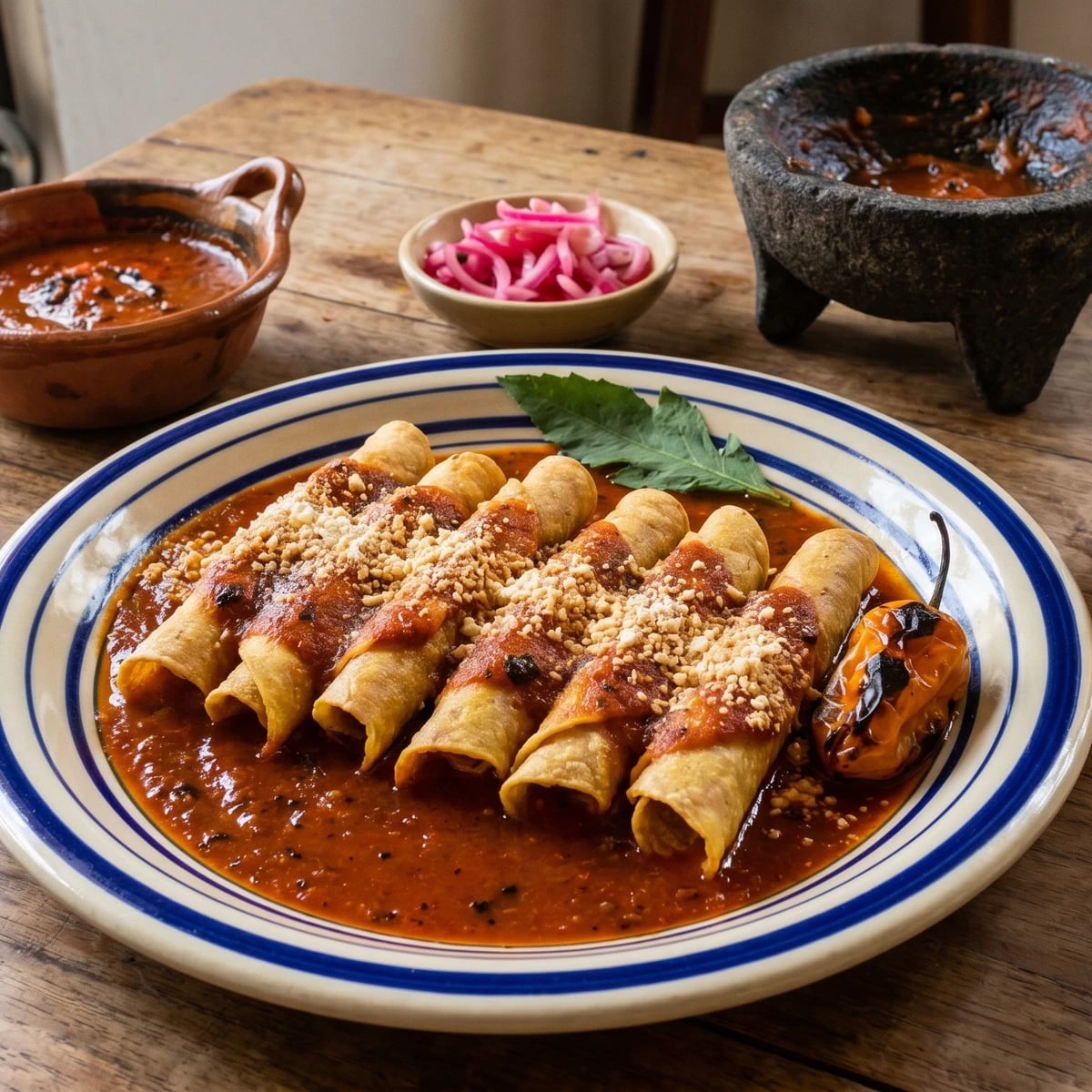
Yucatan's rolled and fried corn tortillas, empty inside, flooded with smoky chiltomate of charred tomato and habanero and dusted with queso sopero. The first botana that arrives with every cold beer in Merida.
Codzitos are from Yucatan. Not from a generic 'southern Mexico,' from Yucatan, and more specifically from Merida and the small towns around it where the word codzito comes straight from the Maya 'kots,' meaning roll. The Peninsula has its own grammar, sour orange, banana leaf, recado, pib, and codzitos belong inside that grammar. They are not taquitos. They are not flautas. Call them either of those at a cantina in Merida and watch the bartender's face.
What makes them codzitos is what is not inside them. Nothing. They are empty rolled tortillas, fried until rigid and hollow, made specifically to be a vehicle for chiltomate. This is the Yucatecan answer to the question of what to do with yesterday's tortillas, and it is a brilliant answer. The crispness of the tortilla, the smoky depth of the charred tomato salsa, the perfume of habanero, the salt of the queso seco de Bola, all of it works because nothing is fighting for attention. This is the first botana that arrives at your table when you order a beer at a Merida cantina, before you have even decided what else you want.
The chiltomate is the dish. Tomato charred on a comal until the skin blackens in patches, habanero blistered whole, garlic in its papery jacket, onion turned hard against the iron, all of it broken down with epazote and warmed in lard until the fat separates at the edge. The habanero stays whole. It perfumes, it does not burn. The cocineras at the Mercado Lucas de Galvez taught me that years ago, and I have not made it any other way since.
My mother did not cook Peninsula food. She was jalisciense. But there is a page in her notebook from a trip she took to Merida in 1982, the writing small and tight, with a note in the margin that says 'no se le pone nada adentro, va hueco' (nothing goes inside, it goes hollow). That margin note is the entire recipe. Cada estado, su propia cocina, and Yucatan keeps this one for itself.
The word 'codzito' descends from the Yucatec Maya verb 'kots,' meaning to roll or to coil, and the dish belongs to a family of Peninsula tortilla preparations, papadzules, salbutes, panuchos, codzitos, whose names and techniques predate the Spanish conquest and survived intact through colonization. Chiltomate, from the Maya 'chil' (chile) and the Nahuatl-derived 'tomate,' is one of the oldest documented salsa preparations in the Yucatan Peninsula, recorded by Franciscan friars in the 16th century as a daily condiment in Maya households. Yucatan's culinary isolation from central Mexico, maintained by geography and by the region's long-standing political identity as something culturally distinct from the rest of the country, allowed dishes like codzitos to remain anchored to their Maya roots while the rest of Mexican cuisine absorbed European, African, and Asian influences at a faster pace.
Quantity
24
slightly stale, left out for a few hours so they roll without cracking
Quantity
2 cups
for frying
Quantity
6 medium
Quantity
1/2 medium
peeled, kept whole for charring
Quantity
3
unpeeled
Quantity
1
whole, charred with the tomatoes
Quantity
1 sprig
Quantity
1 teaspoon, plus more to taste
Quantity
1 teaspoon
only if the tomatoes are tart
Quantity
1/4 cup
to loosen the salsa if needed
Quantity
1 cup
finely crumbled or grated
Quantity
for serving
Quantity
for serving, for the brave
| Ingredient | Quantity |
|---|---|
| thin hand-pressed corn tortillas, 4 to 5 inches acrossslightly stale, left out for a few hours so they roll without cracking | 24 |
| lard (manteca de cerdo)for frying | 2 cups |
| ripe Roma tomatoes | 6 medium |
| white onionpeeled, kept whole for charring | 1/2 medium |
| garlic clovesunpeeled | 3 |
| fresh chile habanerowhole, charred with the tomatoes | 1 |
| fresh epazote | 1 sprig |
| kosher salt | 1 teaspoon, plus more to taste |
| sugar (optional)only if the tomatoes are tart | 1 teaspoon |
| water (optional)to loosen the salsa if needed | 1/4 cup |
| queso sopero (queso seco de Bola or aged cotija)finely crumbled or grated | 1 cup |
| pickled red onion (cebolla morada en escabeche) (optional) | for serving |
| whole chile habanero (optional) | for serving, for the brave |
Heat a dry cast iron comal over medium-high. Lay the whole tomatoes, the onion half, the unpeeled garlic cloves, and the whole habanero on the comal. Do not crowd them. Turn each piece with tongs as the skins blister and blacken in patches. The tomatoes take about 8 to 10 minutes and should collapse softly when pressed. The garlic is ready in 4 minutes when the papery skin is brown and the clove inside is soft. The habanero blisters fast, watch it. This is the technique that defines chiltomate. Roasted, not boiled. The smoke is the flavor.
Peel the garlic. Tear the stem off the habanero. Place the charred tomatoes, onion, garlic, and habanero in a molcajete or blender with the epazote and salt. If you are using the molcajete, work the ingredients into a rough, textured salsa with visible flecks of skin and seed. If you are using a blender, pulse, do not puree. Chiltomate is a rustic salsa with body, not a smooth puree. Taste it. If the tomatoes are sharp, add the sugar. Yucatecan cooks balance, they do not mask.
In a small clay cazuela or skillet, melt one tablespoon of the lard over medium heat. Pour the chiltomate in. It will sputter. Cook for 8 to 10 minutes, stirring, until the salsa darkens slightly and the fat begins to separate at the edges. La manteca es el sabor. This step settles the rawness of the tomato and lets the habanero perfume the entire salsa without making it harsh. Loosen with the water only if it tightens too much. Keep warm.
Lay a tortilla flat on the counter. Roll it tightly into a thin cigar shape. Roll it like you mean it. A loose roll will unravel in the lard. Secure with a wooden toothpick through the center. Repeat with the remaining tortillas. The slightly stale tortillas are what make this work. A fresh tortilla cracks. A day-old tortilla bends. Pre-Columbian frugality at work, this is what you do with yesterday's tortillas in a Yucatecan kitchen.
In a heavy skillet or wide cazuela, heat the lard over medium-high until shimmering, about 350F. Test with the tip of a tortilla, it should sizzle on contact without browning instantly. Lower the rolled codzitos into the lard in batches of 6, never crowded. Fry for about 2 minutes, turning, until they are deep golden and rigid. They should sound hollow when you tap them with the tongs. Lift out and drain on a wire rack set over a sheet pan. Do not stack them on paper towels, they go soggy. Pull the toothpicks while they are still hot.
Arrange the codzitos on a Yucatecan slipware plate or a wide ceramic platter, lined up like firewood. Ladle the warm chiltomate generously over the top, flooding the plate so the bottoms of the codzitos sit in the salsa and start to soften while the tops stay crisp. That contrast is the dish. Shower with crumbled queso sopero. Serve immediately with pickled red onion and a whole habanero on the side for whoever can handle it. Eat with your fingers, with a cold beer, between conversations. Asi se hace y punto.
1 serving (about 195g)
Culinary guides, cultural storytelling, and the editorial depth that makes cooking meaningful.
Discover Culinary Explorer
Chef Lupita
Yucatan's chaya tamal, masa kneaded green with the leaves of the Peninsula, stuffed with hard-boiled egg and ground pepita, wrapped in banana leaf and sliced into rounds for the Cuaresma table.

Chef Lupita
Campeche's Gulf-port coconut shrimp, dipped in egg, rolled in grated dry coconut, fried to gold and served alongside a warm green-apple and naranja agria compote perfumed with habanero and canela.

Chef Lupita
Yucatan's pork belly chicharron, slow-rendered in lard until the meat surrenders and the skin cracks under the knife, folded into warm tortillas with xnipec and bright pink pickled onion.

Chef Lupita
Yucatan's small fried masa cakes shot through with chopped chaya leaf, pan-fried in lard until the edges crisp, eaten with charred chiltomate and a spoonful of habanero xnipec on top.