
Chef Lupita
Alegrías de Amaranto
Oaxaca's pre-Columbian amaranth bar, popped on a hot comal and bound with piloncillo, honey, and the sacred Zapotec grain that the Spanish tried, and failed, to outlaw.
A cooking platform built around craft, culture, and the stories behind what we eat.
Created by
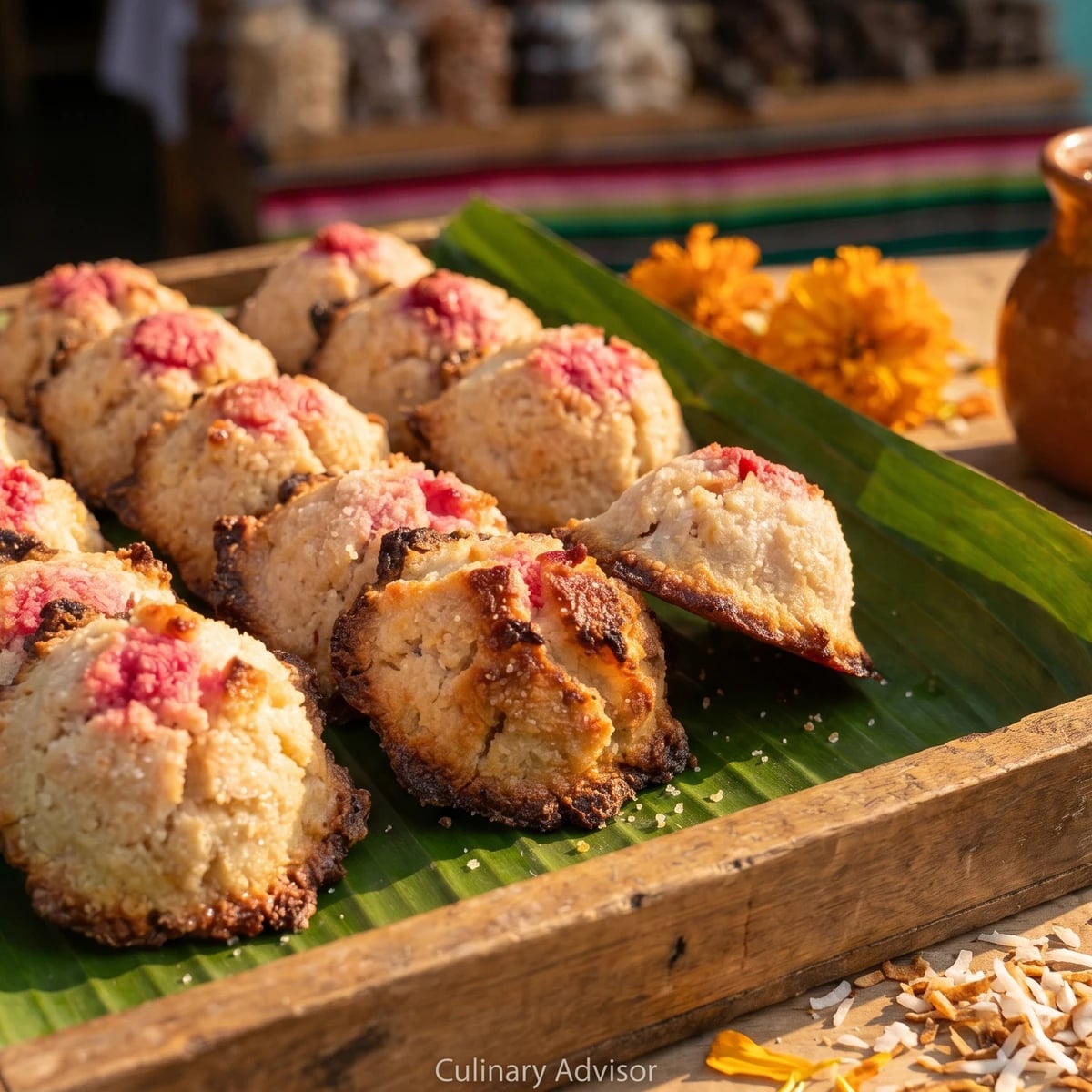
Oaxaca's coconut confection from the Pacific coast and the Centro Histórico dulcerías. Fresh shredded coconut cooked down with milk and sugar by the convent method, finished with a cochineal-pink crown and baked until the edges brown.
Cocadas are from Oaxaca, but more specifically they are from two places at once: the Pacific coast of the Costa Chica and Pinotepa Nacional, where the coconut palms grow heavy with fruit, and the dulcerías of the Centro Histórico in Oaxaca de Juárez, where the women who descend from the convent kitchens have been baking them onto banana leaves for generations.
This is a convent dessert as much as it is a coastal one. The slow reduction of milk and sugar, the tempering of egg yolks at the end, the shaping into uniform mounds, all of that comes from the Dominican and Carmelite nuns of colonial Oaxaca who turned the surplus sugar of the haciendas into dulces de leche, jamoncillo, dulce de yema, and cocadas. The coast brought the coconut. The convent brought the technique. Both belong to the cocada now, and you cannot make a real one without honoring both.
Do not use bagged shredded coconut. The senoras at the Mercado 20 de Noviembre will tell you the same thing. The dry, sweetened bagged stuff has lost its oil and its flavor, and it gives you a pale, sandy cocada that holds its shape but tastes like nothing. Crack a fresh mature coconut. It takes ten minutes. The cocadas it gives you are worth every one of them.
My mother did not make cocadas. She was from Jalisco and her dulces were jamoncillo and ate de membrillo. I learned cocadas from a Senora Constanza, an eighty-year-old vendor with a tray at Jardín Sócrates, who let me sit on a crate behind her stall for three afternoons in 1998 and watch her work. She tinted her tops with cochineal, not food coloring, and she baked them on banana leaves cut from her sister's tree in San Agustín Yatareni. Cada estado, su propia cocina, and this one belongs to Oaxaca.
Cocadas arrived in Mexico through two converging streams: the Manila Galleon trade, which brought coconut palms to the Pacific coast of Nueva España in the late 16th century, and the Spanish convent dulce tradition, which by the 17th century had taken root in Oaxaca's Dominican monasteries and the Convento de Santa Catalina. The slow reduction of milk and sugar with egg yolks, the technique that distinguishes a Mexican cocada from its Caribbean and Brazilian cousins, was a hallmark of the colonial convent kitchens that also produced jamoncillo, huevos reales, and yemitas. The cochineal-tinted pink top, common across Oaxacan dulcerías, references the state's pre-Columbian and colonial dominance of the cochineal dye trade, which was Nueva España's second most valuable export after silver until synthetic dyes displaced it in the late 19th century.
Quantity
1 large (about 4 cups freshly shredded)
husked, cracked, and finely shredded
Quantity
2 cups
Quantity
1 cup
Quantity
1 1/4 cups
Quantity
1
Quantity
1/4 teaspoon
Quantity
3 large
lightly beaten
Quantity
1 teaspoon
from Papantla if you can find it
Quantity
a few drops
Quantity
for lining the baking sheet
| Ingredient | Quantity |
|---|---|
| fresh mature coconuthusked, cracked, and finely shredded | 1 large (about 4 cups freshly shredded) |
| whole milk | 2 cups |
| sweetened condensed milk | 1 cup |
| granulated cane sugar | 1 1/4 cups |
| canela de Ceylon (true cinnamon stick) | 1 |
| fine sea salt | 1/4 teaspoon |
| egg yolkslightly beaten | 3 large |
| Mexican vanilla extractfrom Papantla if you can find it | 1 teaspoon |
| cochineal coloring or natural pink food coloring (optional) | a few drops |
| banana leaves or parchment paper | for lining the baking sheet |
Pierce the soft eye of the coconut with a screwdriver and drain the water into a bowl. Save it. You will use a few tablespoons later. Crack the shell with the back of a heavy knife or a hammer, working around the equator until it splits. Pry the white meat out in pieces with a paring knife. Peel off the brown skin if you want a paler cocada, leave it on if you want flecks of color and more flavor. Both are correct in Oaxaca.
Shred the coconut on the medium holes of a box grater, or pulse it in a food processor until it looks like coarse snow. You want texture, not paste. The cocada needs the strands to hold its shape on the tray. Measure four packed cups.
In a heavy 4-quart saucepan or a clay cazuela, combine the whole milk, condensed milk, sugar, cinnamon stick, salt, and three tablespoons of the reserved coconut water. Bring to a gentle simmer over medium heat, stirring with a wooden spoon. Once the sugar dissolves, lower the heat and let the mixture cook for about ten minutes, until it just begins to thicken and you can see the bottom of the pot for a moment when you drag the spoon through. La cocina no es decoracion, es trabajo. This is patience work.
Stir in the shredded coconut. Cook over low heat, stirring often with a wooden spoon, for 25 to 35 minutes. The mixture will go from soupy to glossy to thick. You are ready when you can drag the spoon across the bottom and see a clear path that holds for a few seconds before closing back. The mixture should mound on the spoon and not run. This slow reduction is the convent technique. The Dominican nuns of Oaxaca worked sugar like this for centuries before there were thermometers.
Pull the pot off the heat. Fish out the cinnamon stick. Whisk a ladle of the hot coconut mixture slowly into the beaten yolks to warm them, then pour the tempered yolks back into the pot, stirring constantly. Return the pot to low heat for two more minutes. The yolks tighten the mixture and give the cocada that pale gold center the senoras at the dulcerias around the Zocalo are known for. Stir in the vanilla.
If you want the classic two-tone cocada you see at Mercado 20 de Noviembre, scoop out about a third of the mixture into a separate bowl and tint it pale pink with cochineal or natural coloring. Cochineal is the historical Oaxacan dye, the same one that colored the wool of the Spanish empire. Use it if you can find it. The rest stays its natural pale gold.
Heat the oven to 325F. Line a heavy sheet pan with banana leaves wiped clean, or with parchment if banana is out of season. Using two soup spoons, drop generous mounds of the gold mixture onto the pan, about two inches across, leaving an inch between each. Press a small spoonful of the pink mixture onto the top of each mound. Do not flatten them. Cocadas should look like small domes.
Bake for 18 to 22 minutes, until the edges of the coconut strands turn deep gold and the pink tops set with just a touch of color at the peaks. The center should still feel slightly soft when you press it. The cocadas firm up as they cool. Pull them too early and they collapse. Leave them too long and they go dry and chewy. Watch them in the last five minutes. Asi se hace y punto.
Let the cocadas cool completely on the pan. They will lift cleanly off the banana leaf or parchment once they are room temperature. Store in a tin or a clay jar with a lid. They keep for a week and the texture only improves after the first day, when the sugar settles and the coconut tightens. Saber cocinar es saber vivir.
1 serving (about 40g)
Culinary guides, cultural storytelling, and the editorial depth that makes cooking meaningful.
Discover Culinary Explorer
Chef Lupita
Oaxaca's pre-Columbian amaranth bar, popped on a hot comal and bound with piloncillo, honey, and the sacred Zapotec grain that the Spanish tried, and failed, to outlaw.

Chef Lupita
Oaxaca's Day of the Dead sugar figures, Spanish-Moorish sugar paste molded into lambs, calaveras, and miniature fruits to dress the ofrenda. Edible ancestors, named in royal icing, set out for the souls who come home in November.

Chef Lupita
Oaxaca's hometown nieve, hand-churned in the wooden garrafa with pineapple, shredded carrot, toasted coconut, and chopped pecans. The proud invention of the dulceras under the laurel trees of the Zocalo.

Chef Lupita
Oaxaca's drunken jellied confections, small pastel cubes spiked with mezcal espadin and dusted in powdered sugar. The dulceria tradition of the Centro Histórico in one bite.